Half the evidence – full scaremongering

It’s been a few months. I’ve been very busy with this and that – and carrying out paid analysis of various subjects to do with the Ukraine war.

I’m not a lover of Russia, and detest their actions in Ukraine. Recently working on Russian war crimes has increased this hate towards the maniac in charge of the country, and those that feel it is a good thing.

I’ve also decided to avoid Twitter as much as possible. It’s a changed place. I hate bad, incomplete analysis and bad journalism. Twitter is full of it – far more than the good stuff.

Too many OSINT scammers, begging for Kofi donations, and people that give them it thinking they’re actually experts when they’re not.

However, I received an email about a Tweet regarding a recent documentary that was shown on the Swedish TV channel, SVT. I had to take a look.

This was about the apparent use of Russian navy Project 852 Akademik Krylov class AGORH Admiral Vladimirskiy to collect data on offshore wind farms near the UK and in the North Sea.

I’d already seen the numerous press reports in November, and had already laughed out loud at the dramatisation of it all. Headlines such as Fleet of Russian spy ships has been gathering intelligence in Nordic waters, investigation finds by CNN – I mean, no shit Sherlock, they’ve only been doing it for about 70 years!! Long before offshore wind farms were even dreamt about!

However, the documentary takes the biscuit.

Filmed in a clandestine – very Stieg Larsson Girl with the Dragon Tattoo way – it centres on the Admiral Vladimirskiy routing out to the north of the UK and transiting around various wind farms.

The conclusion – and only conclusion – was the ship was mapping cables for a potential attack on the UK and other European countries.

According to two British experts – one of which, a “pensioned Royal navy officer” who wanted to remain anonymous but was given the name “James” – stated this was “the first foray, by Russia, into understanding how to disrupt Western electricity generation….[to be] used as an economic weapon”.

The only evidence provided – Admiral Vladimirskiy had gone near offshore wind farms!

Now, even in the documentary they state the North Sea is littered with wind farms. It totally is. In fact, it’s pretty hard to get around the North Sea without going close to a wind farm.

As the image below taken from AIS provider FleetMon shows, it is near impossible to get from the English Channel to the NE without going past a wind farm. Many of the little black antenna markers represent a wind farm and their navigational warning.

A close up of the Moray Firth area shows this in more detail and the second image shows the number of wind farms near Denmark.

The documentary, and “James” in particular, could not see any reason for Admiral Vladimirskiy being on the east coast of the UK. – “The only reason I could see was the wind farm”.

According to numerous articles, independent marine analyst H.I. Sutton estimates that “in particular, it likely mapped the exact location of the seabed power cables going to offshore wind farms”.

But did he look at the full picture? Does he even have the knowledge and experience to really be a spokesperson on these matters?

So let’s look at this in detail – something they didn’t appear to do. Why? It doesn’t make a good story and it doesn’t scare the shit out of the unsuspecting public!

Before we look at Admiral Vladimirskiy‘s route a quick look at how the offshore wind farms work. By coincidence, I have invested in a fund that co-owns one of the sites the ship apparently visited. I have studied how wind farms such as these operate and know a bit about them. Why would you invest your money without first looking into how they operate, their safety measures and suchlike?

Everyone knows how they work really. Basically, offshore turbines spin in the wind, electricity is generated, this is sent to a transformer platform at the site, the electricity goes by buried cabling to a land site, which then sends it all to a larger substation.

The most important thing to take from the sentence above is buried cabling.

You see, the biggest danger to these sites isn’t the Russian navy – no, it’s an unsuspecting fisherman in his trawler going along and taking out half of Britain by accidentally cutting a cable.

To stop this from happening, the clever people at the wind farm developments bury the cables – up to 2 metres below the sea bed. If it isn’t possible to dig down into the sea bed, the cables are buried under rocks instead. Something the documentary failed to mention.

Moreover, it is far easier to take out the cables at source rather than try and locate them along a rough route, buried 2 metres under the seabed. Nope, just take out the transformer platform, or the cables as they leave it under the sea and save all the hassle of locating and digging up a cable, cutting it – blah blah blah.

And quite handily, these platforms can be located from space! No need to get up close to them for an inspection. Below is one of these platforms.

Regardless, it doesn’t take a genius or a “ex navy expert” to find the routes of all the cables are actually published online. It certainly doesn’t need a Russian navy “spy ship” to go and try to find them.

It took me around five minutes to locate all the information on three of the wind farms “visited and mapped” by Admiral Vladimirskiy.

To save you time, here’s a few screen shots:

Let’s move on to Admiral Vladimirskiy and its route as shown in the screenshot below from the documentary. The white areas are wind farms.

The main purpose of the Admiral Vladimirskiy is research. It is classed as a Ocean/Sea research vessel, although we know for sure this isn’t her only role – more on that later. Many maritime countries have some sort of Hydrographic fleet – or are in the process of creating one.

These ships travel around the world mapping the sea bed and taking BATHY surveys. I have personally heard Admiral Vladimirskiy send a weather and position report on HF radio when it was located in Antarctica. That is the extent of its travels. It goes everywhere.

There’s different equipment onboard these ships that carry out different tasks. Some of the equipment is designed to penetrate the sea bed (not physically) but this is to try and ascertain what the bed consists of – not what might be buried there. Other equipment take salinity readings and suchlike – important for military operations, in particular sub surface.

This equipment can include small submersible drones. Larger ships can carry manned submersibles. Admiral Vladimirskiy doesn’t.

One of the common parts of the survey is to measure the sea depth in a specific area for Russian maritime maps. This is useful for any future hostilities.

A good example of a survey report carried out for one of the Danish wind farms in the documentary can be found here.

As you’ll see – if you go through the whole report – it takes a considerable amount of time to map just a small area. The Admiral Vladimirskiy was apparently able to map all the cabling around the Moray Firth in a few passes, and in not much time. Er, no.

So what else could the Admiral Vladimirskiy be doing in the Moray Firth?

Taken from the documentary was a position report – apparently from AIS. As far as I’m aware, Admiral Vladimirskiy doesn’t utilise AIS. I may be wrong, but I’ve followed this ship for years and not known it to use AIS. I’ve not had much time lately to get into the radios so things may have changed, but I have access to a years worth of AIS data – including that covering this period – and can’t find any reference. Other Russian navy ships do use AIS occasionally so it isn’t impossible that Admiral Vladimirskiy does too now.

Maybe someone involved in the documentary can tell me otherwise?

However, as I mentioned earlier, there’s other ways of tracking her. And sure enough it was in the Moray Firth area for a few days.

The position plotted above in the image is roughly in line with where the wind farm cables run to the shore. What the documentary fails to mention is that it is also roughly 20 nautical miles out from the threshold to runway 23 at RAF Lossiemouth. In a near straight line down the runway. Aircraft, especially larger ones, quite often establish for an ILS approach at 15 to 20 miles from the threshold of the runway.

RAF Lossiemouth is home to the northern Quick Reaction Alert (QRA) Typhoon fighters which, as one of their roles, are used to intercept Russian aviation assets as they approach the UK. It is also home to the UK’s P-8 Poseidon Maritime Patrol Aircraft. Their primary role?? To locate and track enemy submarines. In particular – Russian submarines.

This airbase is of primary interest to Russia. And it isn’t the first time Russian ships have located themselves here.

In fact they have been doing it for decades.

Long before wind farms existed.

In November 2020 – in fact almost to the day Admiral Vladimirskiy was there – two Russian navy Project 864 Vishnya class AGI’s sat in approximately the same position. A week earlier Project 1155 Udaloy class DDGHM Severomorsk was there.

The area has even been graced with the Russian navy’s only aircraft carrier Admiral Kuznetsov on several occasions.

The Vishnya class are full blown Intelligence gathering ships. RAF Lossiemouth is a goodie bag of data for them.

The Moray Firth is a pretty sheltered area and it is a well known spot for Russian navy ships to avoid any bad weather in the North sea – and it used for refuelling and replenishing at sea too.

As well as being a Hydrographic vessel with all the equipment for under the sea analysis, Admiral Vladimirskiy has a plethora of equipment to deal with above the surface. It is littered with radio antenna for not only communicating with home, but to listen in and collect radio transmissions and data from other entities. COMINT/SIGINT and ELINT in other words.

Some of the equipment includes HF, VHF, UHF, Direction Finding and potentially SHF capabilities.

None of this is mentioned in the documentary.

So whilst Admiral Vladimirskiy could well have been mapping the sea bed for wind farm cables, it could equally have been collecting intelligence from RAF Lossiemouth. It certainly could have been doing both.

One cannot say either way – and therefore the conclusion from the documentary that “…the only reason I could see was the wind farm” is inaccurate.

Moreover, she could have just been loitering for a bigger task that was about to start.

But I’m jumping ahead a little because she moved off from the Moray Firth, around the corner and down to another position near the Seagreen Offshore Wind Farm that is located 27km off the coast of Angus in Scotland.

I provided the information on Seagreen earlier on. All the cables are buried here. And they come out of the western side of the field not the North East where Admiral Vladimirskiy loitered.

However, there’s something else of interest in that area.

Approximately 50 nautical miles away is RAF Leuchars. This used to be home to the RAF QRA before they relocated to Lossiemouth. Whilst closed, it is still a standby airfield and can be reactivated. It is still sometimes used.

And the position above is almost directly in line with the runways there. It was a regular position for Russian “fishing trawlers” to hang out. In fact they used to go a lot closer.

One other aspect of this position is that it is in a direct line with a UK air defence radar station and one of the worlds largest Air Combat Manoeuvring Instrumentation (ACMI) range – the D323’s. It is also nearly slap bang underneath a LOBE area – or an area where AWACS aircraft go when providing information to combat aircraft.

Most of the control for the 323’s come from the air defence site. Plonk an intelligence ship in between and you can get quite a lot of radio and data comms from anything taking place here.

During the Cold War, and the 323’s where just known as the ACMI range, there were normally a handful of Russian “fishing boats” in the area – day in, day out. The range was extremely busy – it still is sometimes, I’ve counted near 50 aircraft in there recently – and the data the “fishing boats” collected must have been priceless to the Soviet Union.

It still is a gold mine for the Russians.

From this location, the ship moved further south on the 15/11/22 arriving at the English Channel on the morning of 17/11/22, by passing a considerable number of wind farms along the way. Why miss these ones out if they were so important?

The ship then makes a transit up the North Sea to the midpoint, before heading NW towards the Newcastle area. The image below from the documentary shows the ships positions, and I have checked these as being correct.

The speed the ship was doing to move between all these locations in the time shown was too great to be mapping wind farm cables. It was doing something else in my opinion.

Let’s backpedal over a week to the 10th November 2022 and to the Royal Navy base at Portsmouth.

Royal Navy aircraft carrier and flagship HMS Queen Elizabeth (QNLZ) departs the naval base for a deployment to the North Sea for exercises as part of Operation Achillean. After this she would travel to Oslo arriving on the 22nd November. Other ships included HMS Kent, HMS Richmond, HMS Diamond and RFA Tidesurge.

According to the Royal Navy press release at the time:

The Carrier Strike Group will work closely with NATO and Joint Expeditionary Force allies as the UK underscores its commitment to safeguarding European security. 

The Joint Expeditionary Force (JEF) is a coalition of ten like-minded nations, which are dedicated to maintaining the security of northern Europe.

This latest deployment builds on a range of operations and exercises with JEF allies this year for the Royal Navy, including maritime patrols in the Baltic Sea.

HMS Queen Elizabeth will be at the centre of the Carrier Strike Group, with the Commander UK Carrier Strike Group, Commodore Angus Essenhigh, and his staff commanding from the aircraft carrier. 

F-35B Lightning jets from 617 Squadron will carry out flying operations, while helicopters from 820, 845, 815 and 825 Naval Air Squadrons will be undertaking sorties from a bustling flight deck.

During this exercise the aviation assets would utilise the D323’s as well as lower airspace around the fleet. Other non aviation tasks would also be carried out. Navy Lookout ran an article at the end of the exercise

The Russian navy would be extremely interested in this.

QNLZ and the fleet had arrived off the coast of Newcastle by 11/11/22 and commenced their exercising. AIS data for QNLZ dropped off at this time but I believe she stayed in this general area until the end of the exercise.

Admiral Vladimirskiy was still loitering at the Moray Firth on 11/11/22 but by 13/11/22 was just 65 nm from where the fleet were last seen on AIS and between the air defence radar site, QNLZ and the D323’s.

The question here is did Admiral Vladimirskiy tag along as the fleet moved?

We know that Admiral Vladimirskiy moved south to the English Channel and was there by 17/11/22. It then moved north again. We don’t know where QNLZ went at this time and going all the way back down there would be strange but maybe Admiral Vladimirskiy followed another asset? I’m not sure this is the case though as there’s more to be known about QNLZ ops than anything else.

However, Admiral Vladimirskiy was not in the area of the English Channel wind farms long enough to do any mapping and on the morning of 17/11/22 Russian Navy Project 304 Amur class repair ship PM-82 exited the eastern side of the English Channel. It had departed from its deployment to Tartus in Syria in early August.

Moreover, on 17/11/22 the two ships locations were near identical at the same time. It looks like they travelled Northeast together before splitting on 18/11/22. Admiral Vladimirskiy took the route back towards the Newcastle coast area whilst PM-82 headed for the Baltic Sea, passing under the Great Belt Bridge linking Danish islands Zealand and Funen on 20/11/22.

The QNLZ exercise ended sometime around the 19 or 20th of November and she headed for Oslo, arriving after lunch on 21/11/22

Admiral Vladimirskiy also departed the area though a bit behind. Only HMS Richmond escorted QNLZ to Oslo, with the rest remaining in the area for a few days carrying out other tasks.

Through the night of 21/11/22 and 22/11/22, Admiral Vladimirskiy entered the Skagerrak and sailed south.

So what is there to conclude about all this?

Personally, I don’t think Admiral Vladimirskiy was mapping wind farms. Not fully anyway. It had multiple tasks, the priority being to keep an eye on the QNLZ exercise from a distance.

It is too much of a coincidence that Admiral Vladimirskiy is in the same areas at the same time. The ship is more than capable of gathering data from the exercising ships and aircraft.

However, I can’t say it wasn’t mapping wind farms because I just don’t know.

It could have just been taking salinity and depth measurements. Quick and easy to do.

But, the creators of this documentary, with the experts they gathered in – cherry picked by the editors to give them the answers they wanted – can not say with 100% accuracy that mapping wind farms was the sole purpose of the voyage of Admiral Vladimirskiy.

But they have.

Whilst the documentary does include active members of the various navies and other experts, they are there more to explain the dangers should Russia (or any other country because we can all do it by the way) tamper with these networks.

By saying Admiral Vladimirskiy is definately mapping wind farms they have stirred up a lot of bad reporting. News outlets such as the BBC, Sky News, CNN etc. have all jumped on the bandwagon, spewing out crap mainly because they don’t have a clue about what they’re talking about or just copy and pasting someone else’s already inaccurate reporting.

Had SVT come to me I’d have given them a completely different outlook on what Admiral Vladimirskiy could be doing.

I’ve shown Admiral Vladimirskiy could have been doing any number of different tasks.

I doubt they’d have used my information though.

It wouldn’t have given them want they wanted.

Satellite imagery: Engels Airbase – 4 December 2022 1105 UTC


  • Unconfirmed reports of “drone attack” on Engels Airbase, Saratov on 5 December 2022
  • Satellite imagery not yet available for 5 December 2022
  • 4 December imagery available from Planet for potential comparison when 5 December becomes available

Various reports appeared on Social media regarding a potential Ukrainian forces strike on Engels Airbase, outside Saratov in Russia.

Engels is home to the 121st Guards Heavy Bomber Aviation Regiment flying Tu-95MS and Tu-160 strategic bombers. The base has been used extensively during the Ukrainian War campaign.

Whether this was an attack or not – the range to Engels from Ukraine is over 500km, probably closer to 600km for any of the Ukrainian positions – any damages to aircraft could be a hindrance to the Russian operations.

However, in 4 December 2022 imagery, there is a significant number of Tu-95s present – 18 in total. The reported damages (or loss?) to two Tu-95’s wouldn’t affect that much. With only 5 Tu-160’s present – out of a fleet of 17 – any loss to these airframes would be a little worse for Russia. But, there’s plenty of replacements available.

By comparing the image below, with that available on Jane’s from 17 October 2022, very little has changed. It is hard to assess Tu-95 and Tu-160 activity between the two dates. At least one Tu-160 (in the maintenance area) appears to have not moved.

Note: The imagery doesn’t take in the southern part of the taxiway system where aircraft have also been placed previously. I suspect there are some there but the numbers above do not take these into account as I won’t guess. The image is annotated with IL-76’s though these could also be IL-78’s.

I make no apologies for the watermarks after recent imagery theft.

Update – 5/12/22 1550 UTC

Looking at Sentinel imagery for 5 December, there does not appear to be any evidence of an explosion at the airfield. Certainly not of an aircraft. Sentinel is low resolution of course, so high resolution imagery is needed to confirm still.

The potential railhead source of the explosion still can’t be ruled out as there is a high glowing area there. This does appear to be here in earlier passes however, and could just be a consistent heat source or sun reflection.

The imagery also shows 5 aircraft parked on the southern taxiway/runway – possibly two IL-78’s and three Tu-95’s.

Kerch bridge attack – initial analysis


  • Kerch bridge attack severely damaged by bomb
  • Attack could be from boat or lorry bomb
  • Boat bomb looking more likely at this time

This is a very quick first analysis on the attack on the Kerch bridge on 8 October 2022.

Northbound carriageway of the bridge is destroyed, with southbound looking damaged but possibly not out of use.

Rail bridge is likely damaged due to fuel train caught at exactly the right moment. This burned for many hours.

Initial suspicions pointed towards a lorry bomb from CCTV footage but there are a few things to highlight.

1 – There is quite good security for vehicles to get through to pass across the bridge. The lorry in question doesn’t appear to have been that well searched but it was stopped.

2 – If it was the lorry, why didn’t it drive slower, or even stop?

3 – If it had stopped, there is no security in that area. The driver could have bailed out of the vehicle and set it off remotely, or by a short timer – therefore surviving the attack.

4 – Why was it in the “slow” lane? For best results it would have been on the outer lane, nearer the southbound side; and the rail bridge. Stopping would’ve been even more affective.

5 – The explosion appears to have come from under the bridge – and there was possibly a boat there at the time.

6- Other CCTV footage shows a possible wave from a boat under the bridge at the time of the explosion.

Still to be confirmed, but analysis of FleetMon AIS data shows a fishing boat – Delfin – drop its AIS at 1503 UTC whilst heading towards the bridge. It could then drift towards the bridge in darkness waiting for the right moment.

Delfin’s AIS is pretty good. It has been on at all times as shown below – this is the last 30 days activity. What a better disguise than to be a fishing boat operating in the area – fishing.

This is all hypothetical, but it could have been waiting for the train to pass and then been steered towards the bridge and detonated as it passes under. A means of escape could’ve been a dinghy. If it had a good GPS system then it could’ve been pretty accurately steered for a gap, but just as simple is jumping off near to the time.

As I say – hypothetical at the moment. But I feel the boat is the better method than the lorry.

The final potential possibility are charges set on the bridge. However, I’d have though that the rail bridge would also have been targeted with this method. Particularly if the train was the real target.

It will be interesting to see if Delfin appears on AIS again later.

UPDATE

Just to confirm that Delfin has reappeared on AIS off the Crimean coast and was in a T-AIS -receiver “black hole” – though it has been picked up on S-AIS before too.

As I said above, just an idea about how this could have played out. I’m still happy with the analysis that it wasn’t a lorry bomb that caused the damage and destruction at the Kerch bridge.

Plesetsk – Sarmat Yubileynaya test silo imagery update


  • Update to Janes articles from January and August 2021
  • Satellite imagery shows Plesetsk RS-28 Sarmat ICBM test silo compound upgrades

A year ago I published an article for Jane’s Intelligence Review magazine on upgrades to Russian Strategic Rocket Forces (Raketnye voyska strategicheskogo naznacheniya: RVSN) intercontinental ballistic missile (ICBM) complexes located southwest of Uzhur in the Krasnoyarsk Krai Oblast.

The silos near Uzhur are operated by the 62nd Missile Division (MD) of the 33rd Guards Missile Army/302nd Missile Regiment (MR) and are armed with RS-20V/R-36M2 (SS-18 ‘Satan’) ICBMs. They are scheduled to be upgraded to RS-28 Sarmat ICBMs with Russian President Vladimir Putin saying in April 2021 that “the first regiment armed with Sarmat super-heavy ICBMs is scheduled to go on combat duty in late 2022”.

Work at the silo and command centre sites is continuing and seems to be progressing well, though whether they will be activated by the end of 2022 is another matter.

Whilst GE has recent imagery for the Uzhur silo sites, they haven’t been so good at updating imagery of the Plesetsk Sarmat test silo – known as Yubileynaya.

Up until recently, the GE imagery of Yubileynaya dated back to 2014. However, they have just updated this to imagery from January 2021 – but still over a year and a half old. Moreover, as it is January the site is covered in snow, which makes it difficult to work out the upgrades that have taken place there.

The last test of Sarmat took place in April 2022, but new navigation warnings put out by Russia points to another test taking place this week.

I’ve been sitting on Planet imagery from Yubileynaya dated 10 May 2022 for just over two months now. This blog was supposed to have been written back then, but other developments took over and it has been delayed until now.

I have seen further imagery from 28 September 2022, but this can’t be shared here. This imagery does show activity around the silo that could be associated with an upcoming test. It must be noted that the silo was shut, and there is no missile present – neither is a silo loader.

Whilst later imagery is available for me to share, the imagery here shows the silo being worked on. The hatch is open, with the inner hatch visible. The recent imagery possibly won’t show much more than this as it is over a month old. I’m happy to go with it, but if further imagery of around now does become available, I’ll look into getting it.

So what has changed? Pretty much all of it.

The site has been cleared of the trees within the fence line – with a possible new fence-line put in place. The access gates are new, as is a defensive position/gate house.

New roads have been laid, new anti-static/lightning arrestor masts have been installed. And a new operations/control building is present. The test pad itself has been made larger, and a missile loading cage is alongside the hatch – used to hold a missile that is removed from the transporter vehicle, before being put onto the silo loader.

The GE image from below is dated 7 June 2014.

The 10 May 2022 imagery for comparison.

Image – ©Planet Labs PBC 2022/SkyWatch/Tony Roper. No reuse without permission

I am 100% not sorry for the watermarks after the thieving Sun newspaper stole other imagery without permission. I have also removed the capability to open the full image, meaning you can’t enjoy the imagery at its fullest quality. Again, you came blame the thieving scumbags at The Sun for this.

Screenshots taken from a Russian forces video of a previous Sarmat test allows you to see the various features of the test site.

Now we just wait and see it new imagery is made available prior to the test; and that a test actually takes place.

I always keep an eye on Plesetsk anyway; and expect some more imagery from other areas of the complex in future blogs.

Pankovo maritime support

To get the support infrastructure in place at Pankovo on Yuhzny Island has taken a lot of effort – and a lot of standard ISO ship containers.

These have been taken by several ships, mainly over the summer months, over two years. Due to weather and icing conditions during the winter period it is pretty impossible to do anything outside of the summer.

Recently the ships in use have been captured on satellite imagery – particularly on Sentinel. Over at Covert Shores, H I Sutton has just published a blog on the likely ships in use for this task. The activity around the islands has been tracked for quite some time however and this blog really just fully confirms the IDs of the ships Covert Shores had chosen as possibilities.

First of all, it can be confirmed it is Teriberka that is operating at the island harbour bay area – visible in a nice Sentinel graphic produced at Covert Shores. This ship has been to and from Arkhangelsk on at least three occasions since early August 2022.

Geolog Pechkurov can also be confirmed as the ship operating with Teriberka at the moment. She had been operating along with a research ship at the western end of the Matochkin Shar Strait between Severny and Yuzhny Islands early to mid-August, but returned with Teriberka mid September.

Both ships have their own cranes and lifting gear.

Probably the more unsual ship is Sevmorput – a nuclear powered container/cargo ship. It is large at 260 metres in length, with its own cranes and lifting gear. A considerable number of containers can be held on board.

Sevmorput has been in the area before and is likely to be the main carrier for most of the equipment and containers. Like the other two ships, operations here have been going on since at least mid-August with returns to Murmansk rather than Arkhangelsk.

Smaller barges are used to transport the containers from all the ships to the small jetty in the harbour bay area.

There’s not much more to say on this apart from that the amount of work that is needed to get operations running at Novaya Zemlya is considerable – and needs to be completed in a short time period due to weather conditions over the winter.

This means that time is running short for this period of activity – and also means should there be a test of Burevestnik, it can’t be too far away.

All S-AIS imagery taken from FleetMon

Burevestnik actually could be ready to test!


  • More imagery changes previous assessment
  • Pankovo test facility DOES have retractable shelter
  • Burevestnik missile canister captured in imagery on test ramp
  • Test could be imminent

Not too long after the update blog where I had presumed some sort of cover had been used at the test ramp as part of the construction process, I was sent imagery (that I can’t publish here) that showed that the ramp DID have a retractable shelter.

What I had thought was a small door in the shelter was in fact a difference in the concrete ramp tied together with shadows creating that effect. The shelter appears to be open at all times.

As well as Airbus, I decided to keep an eye out on Planet imagery for the same area. However, whenever Planet’s SkySat imagery was collected, it was always cloud covered at Pankovo.

I tried again with Airbus on 16 September 2022 having given up on Planet. The imagery was better – though nowhere near as good as that I’d been sent privately. This is despite the resolution being the same – 50 cm!

But it was good enough to prove that Burevestnik is present at Pankovo and appears to be close to being tested. The shelter was pushed back and a Burevestnik container was in position.

Image – ©CNES 2022, Distribution AIRBUSDS/SkyWatch/Tony Roper. No reuse without permission

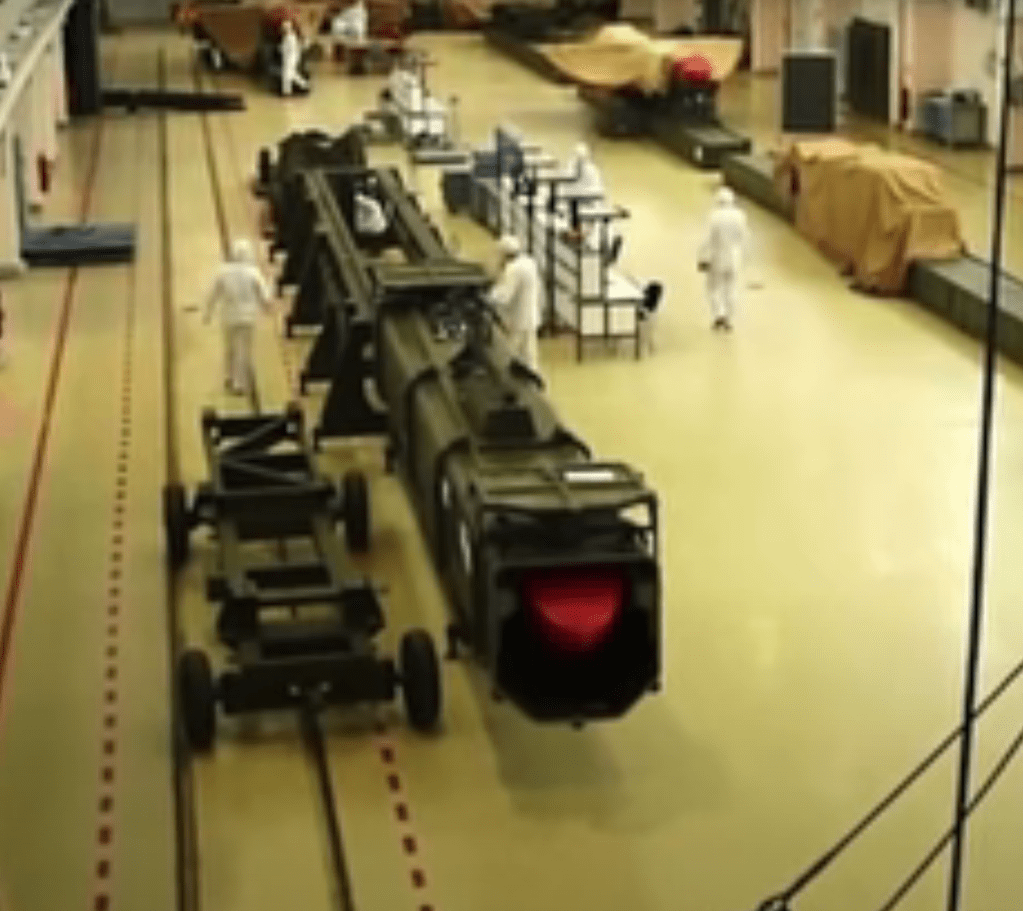
The canister is located between two raised walkways positioned either side. It appears to be on its trolley or loader system as shown below taken from Defense Updates YouTube video. The canister extends to just inside the entrance of the shelter.

Image – ©CNES 2022, Distribution AIRBUSDS/SkyWatch/Tony Roper. No reuse without permission

Pretty much everything else described in the previous blogs is as stated.

At the first set of buildings south of the test area – the “gate house” as I called it – nothing has changed. There is definitely a frame there which could be for another building or shelter. Or, another thought I’ve had is that it is an antenna tower laying on its side waiting to be raised. Time will tell on this.
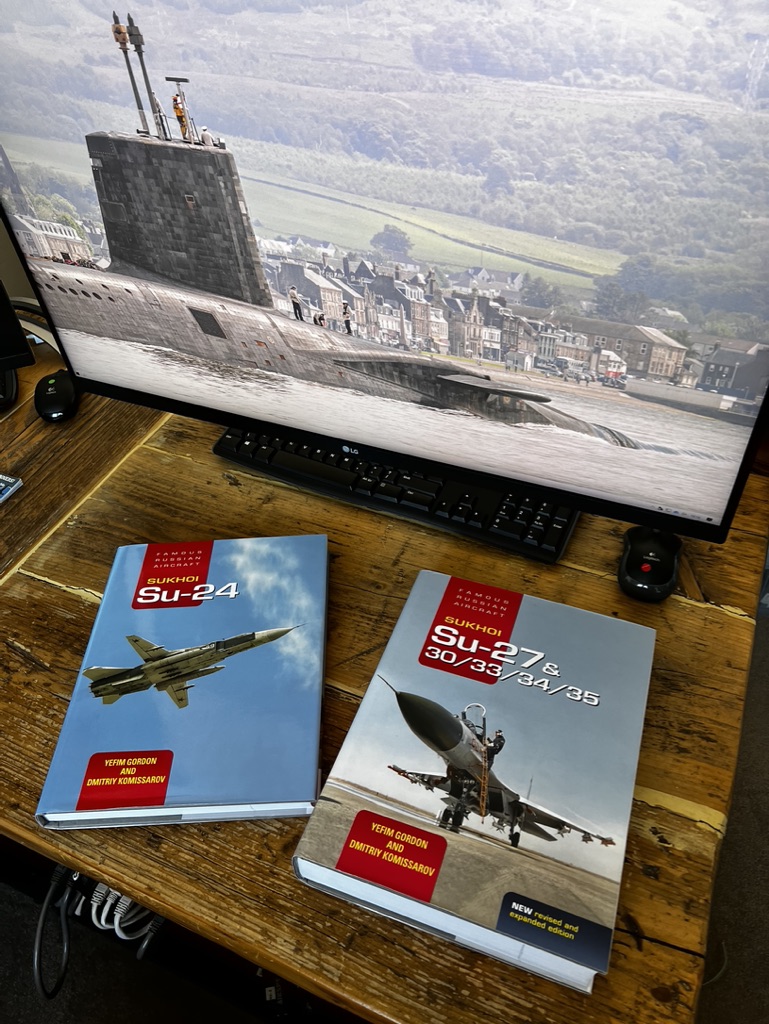
Image – ©CNES 2022, Distribution AIRBUSDS/SkyWatch/Tony Roper. No reuse without permission

Further south, along the gravel road, the area containing the two white shelters with access ramps showed little change. However, the better quality does now highlight a trailer parked at the northern shelter. This is 13 metres in length and could possibly be a transporter for the missiles or a fuel truck for the booster section of the missile

The theory is that the shelters are readiness shelters for preparing Burevestnik for testing before moving them up to the test area.

Image – ©CNES 2022, Distribution AIRBUSDS/SkyWatch/Tony Roper. No reuse without permission

Little has changed at the southernmost building, and is missed from this analysis. Looking at this area in closer detail, rather than being a power or generator building for the facilities, it could equally be a small area for holding the nuclear systems used in Burevestnik. Again, further assessment is required here.

With this new update it is worth keeping an eye out for navigational warnings for the Novaya Zemlya region. As it appears a missile is in the retractable shelter a test could be very imminent.

Pankovo Test Site – Novaya Zemlya update


  • Further imagery obtained
  • Old NOTAMs expired
  • New NOTAMs in place
  • Potential Burevestnik test unlikely
  • Extensive construction work taking place

In my last blog – Pankovo Test Site – Novaya Zemlya activity satellite imagery – I analysed imagery that showed potential preparations for an upcoming test of a 9M730 Burevestnik (SSC-X-9 “Skyfall”) nuclear-powered cruise missile.

Whilst the imagery showed some major changes to the Pankovo site, it didn’t provide any real evidence that a test was going to be carried out soon.

The reason for looking at Pankovo in the first place was down to Russian maritime warnings (PRIPs) and NOTAMs that covered the area on and surrounding Novaya Zemlya. Between them, the warnings covered dates up until 9 September 2022. One day does remain for some of the warnings – the NOTAMs having expired on 5 September. Up until that time there had been no news from Russian sources that claimed any testing from the islands had taken place. This I would have expected had they done so.

I obtained imagery of Pankovo for 6 September 2022, extending the search further south of the test site.

Between here and the beach/harbour area, several group of buildings have been in the construction process from early 2020 – certainly the first real signs of construction show on Sentinel from July 2020. Moreover, foundation work and ground clearing had started in 2019.

Image – ©CNES 2022, Distribution AIRBUSDS/SkyWatch/Tony Roper. No reuse without permission

At the test site there is one thing of note that changes the previous analysis in the last blog. What I thought was a raised platform or ramp in the 28 August imagery – and then an additional structure in the 2 September imagery – were in fact one and the same. The structure was always there, it is possibly under a white cover that stretched its entirety. In the latest imagery you can see that if it is a cover it has been partially pulled off the structure to reveal it underneath.

However, most of the new roads and test area are still raised. New equipment has arrived at the southern part of the test area since the last imagery.

The potential retractable shelter looks more permanent than first assessed and has a clear entranceway to the south. This structure could be an environmental entrance linking to the other blue areas. There does not appear to be any rails for retractable shelters, however these may be being placed under the blue north-eastern structure. Time will tell.

Image – ©CNES 2022, Distribution AIRBUSDS/SkyWatch/Tony Roper. No reuse without permission

At the building 1.5 km south of the test site there is little to show what it’s purpose is. For now I’m calling it the “guard house/access gate” but I highly suspect this isn’t correct. There is a communications mast with what looks like microwave antennas installed, pointing north/south going by the shadows. It is approximately 50 metres in length, a little less in width./

A significant number of tracks lead cross-country from this site out to the NE. When following these, they appear to lead to nowhere, splitting off further on the routes.

There is also what looks like a white framed structure here, possibly for a further building not yet completed.

Image – ©CNES 2022, Distribution AIRBUSDS/SkyWatch/Tony Roper. No reuse without permission

Where things get more interesting is further down the road, heading south to the old harbour bay and beach.

Another 1.8 km south from the “gate house” is a construction site with two white structures – each approximately 30 metres in length. These are placed to the west of the road with each having two vehicle access ramps – one at each end of the building. Whilst possibly drive through shelters, the ramps are offset from each other.

At least one helicopter pad is present with what looks like a MIL Mi-8 helicopter parked there at the time if the collection. There’s possibly another to the east of the road, but it could equally be the foundations of another building.

Image – ©CNES 2022, Distribution AIRBUSDS/SkyWatch/Tony Roper. No reuse without permission

Drive about another 1 km south and you get to another new group of buildings, joined together by a corridor. As a whole, the buildings measure approximately 130 x 40 metres. This complex has the feel of a generator building though it can’t be fully determined at this time. The southern side of it does appear to have five or six blue fuel tanks in place. It certainly looks like a utilities building of some kind.

Image – ©CNES 2022, Distribution AIRBUSDS/SkyWatch/Tony Roper. No reuse without permission

Proceed 1.5 km south and you arrive at the beach and “harbour” area. This has had long-abandoned buildings on the beach for some considerable time, though the area has been used in the summer months for gaining access to the test site and some of the better buildings used for short-term accommodation.

The imagery shows a considerable upgrade is taking place here. The old jetty, which was in ruins to be honest, has been replaced with a new one – be it with the same small footprint of the old one. The causeway to the jetty has been upgraded and potentially a new building footprint has been carved out at the old village. This could equally be a small quarry for sourcing hardcore for the tracks. Again, time will tell on this.

A large helicopter parking area has been established, with a MIL Mi-26 located here at the time of the collection. There’s a further helicopter pad at the northern group of buildings away from the beach. Communication masts are located at the village next to the helicopter parking area.

Image – ©CNES 2022, Distribution AIRBUSDS/SkyWatch/Tony Roper. No reuse without permission

Overall, a considerable amount of work is going on at Novaya Zemlya. However, at this time, I don’t think the area is ready for any missile tests – and it could well be another few years before it is ready.

The weather here gives them about 5 real months of construction time a year – and this could be pushing it. Once winter sets in, it will be impossible for any work to take place.

So, what of the navigational warnings if the islands aren’t being used for Burevestnik?

A little more investigation did find the likely reason for the first set of warnings.

Project 1144.2 Kirov class CGHMN Pyotr Velikiy carried out a test launch of a P‐700 3K-45/3M-45 Granit (SS‐N‐19 “Shipwreck”) SLCM at a target located off the coast of Novaya Zemlya on 24 August 2022 – the day the navigational warnings started. The ship also carried out general weapons handling in the area with anti-aircraft missiles and artillery firing at airborne targets. It is possible it also used its 2 AK-130 130 mm guns for targeting land targets. This would explain the warnings that covered the island.

It also worked with another ship in the area – likely to have been Project 956A Sovremenny class DDGHM Admiral Ushakov.

The Russian MoD stated that airspace around Novaya Zemlya was closed for this activity. They also stated the Granit test was a success, hitting the target located 200 km away.

Also operating in the area at the time were Project 1155 Udaloy class DDGHM Admiral Levchenko and Project 775 Ropucha class LSTM Alexander Otrakovskiy – along with support ships Project 1559V Boris Chilikin class replenishment ship Sergei Osipov and Project 1452 Ingul class salvage tug Pamir.

These were further north than Novaya Zemlya, operating off Franz Josef Land, for some of this time period. They then carried out a southbound transit west of Novaya Zemlya to the Gazpromneft’shel’f to carry out a security exercise at the Prirazlomnaya marine ice-resistant station located at 68.83523259654382, 58.14904110488897. The exercise simulated a terrorist attack at the station, with Levchenko sending a Ka-27 helicopter with special forces on board to resolve the situation.

The transit from Franz Josef took place exactly during the navigational warnings which means they too could have carried out weapons exercises during this period. They have now gone further east into the Kara Sea and and have carried out various combat exercises.

Two new NOTAMs that expire at 2100 UTC on 9 September 2022 now cover the area to the west of Novaya Zemlya.

The shape, length and altitudes of these two warnings point to a missile test, but sea- launched at a target over or on the sea surface – rather than on Novaya Zemlya.

According to the latest information, Pyotr Velikiy is still operating in the area.

This latest imagery, for me, concludes that Novaya Zemlya is not ready for testing Burevestnik – and won’t be for the foreseeable future – but the area continues to be one that is used for a multitude of different weapons tests as it has been for decades.

Pankovo Test Site – Novaya Zemlya activity satellite imagery


  • Russian PRIP warning
  • NOTAM activation
  • Further NOTAMs indicating delays
  • Satellite imagery shows changes at Pankovo test site
  • Possible Burevestnik test

On 20 August 2022, the Russian navy posted a PRIP/Navigation warning for the area surrounding Novaya Zemlya. These warnings are always of interest as they normally highlight some sort of weapons firing or testing from the island into the Barents Sea.

The warning extended from 24 August until 9 September.

@The_Lookout_N on Twitter kindly posted the PRIP and plotted the positions. This showed most of the islands covered by the warning.

Normally a NOTAM follows these warnings should there be any kind of weapons firing and sure enough, on 27 August, a NOTAM did appear. This only covered the period up to 30 August however.

The PRIP had already got me searching for imagery for the Pankovo test site – located at 73° 6’52.60″N 53°16’28.38″E – and one of the areas I check fairly regularly for new imagery on Google Earth (not much luck there to be honest!).

Novaya Zemlya has been used for several tests in the past. Most notably, during Soviet times, for nuclear weapons testing – including the RDS-202, the most powerful thermonuclear weapon ever tested.

Pankovo is associated with the 9M730 Burevestnik (SSC-X-9 “Skyfall”) nuclear-powered cruise missile. Tests began at Pankovo in 2017, with two reported. Both are thought to have failed, though a video does exist of the November 2017 test that depicts the missile being launched and flying along the Novaya Zemlya coastline.

In August 2019, a test at the Nenoksa test facility on the White Sea resulted in an explosion that killed five Rosatom technicians. A release of radiation from this hints at the test of Burevestnik. The facility at Nenoksa has similarities to those from the 2017 tests in Pankovo.

I covered the Nenoksa site in a Janes Intelligence Review (JIR) article in October 2020.

Probable Burevestnik test site, Nenoksa. Imagery is dated March 2020 according to Google Earth

Following the 2017 tests of Burevestnik at Pankovo, in July 2018, most of the site was dismantled, with just the old buildings used for accommodation remaining. The test area had consisted of several temporary support shelters and a retractable shelter to cover the missile. This shelter was placed on rails approximately 50 metres in length which were, themselves, placed on a concrete pad.

The dismantling of Pankovo, and the subsequent new site at Nenoksa, looked as if the tests were to continue at the White Sea site rather than at the remoter Novaya Zemlya location. The 2019 incident, however, may have made the Russians change their mind on this.

With the PRIP and NOTAM in place, I decided to download several images that covered the times in the warnings.

These currently cover 22 August 2022 to 2 September 2022.

The first NOTAM expired on 30 August, as previously stated, however new ones were published that covered 31 August to 5 September.

The imagery highlights several things.

Firstly, the test area has been changed. In 22 August imagery, the concrete launch area and rails have been removed and realigned – turning approximately 10 degrees to point further southwest. The pad also appears to have been raised. It cannot be determined whether any rails are in place.

The temporary support buildings/shelters are in place again – as is a possible retractable shelter for the missile itself. This is smaller than both the previous shelter here in 2017, and the one at Nenoksa.

Image – ©CNES 2022, Distribution AIRBUSDS/SkyWatch/Tony Roper. No reuse without permission

Very little had changed a week later, on 28 August.

Image – ©CNES 2022, Distribution AIRBUSDS/SkyWatch/Tony Roper. No reuse without permission

However, on 2 September 2022, a new support structure or container was located at the far end of the new concrete pad. Whether this contains a Burevestnik or other missile under test cannot be established.

Image – ©CNES 2022, Distribution AIRBUSDS/SkyWatch/Tony Roper. No reuse without permission

With a day to go until the PRIP and NOTAM expire, it is now a case of waiting to see what transpires.

Interestingly, NATO are also about to carry out an exercise themselves – off the coast of the UK. This “SINKEX” involves several ships, though it will be run by the US Navy as the main aim of the exercise will be to test a new US targeting satellite. It is reported that several Harpoon missiles will be fired at ex Oliver Hazard Perry-class FFG USS Boone. One ship slated to fire is Royal Navy Duke (Type 23) class FFGHM HMS Westminster.

US Navy Arleigh Burke class USS Arleigh Burke paid a quick one day visit to HMNB Clyde (Faslane) on the 2nd and 3rd of September 2022 – also associated with the SINKEX.

US Navy Arleigh Burke class DDGHM USS Arleigh Burke (DDG 51) departing a murky Faslane on 3/9/22 –
© Tony Roper Photography 2022
8 Boeing RGM-84L Harpoon Block II launchers on USS Arleigh Burke – © Tony Roper Photography 2022

Analysing the analysis – a closer look at the Saki air base attack satellite imagery


Yesterday – or rather, in the early hours of today – I posted my last blog, Novofedorivka – Saki Air base attack satellite imagery – The aftermath.

In that blog I made a typo. For every word where I meant to say Su-24, I said Su-23. This included in the satellite imagery labelling. So how could this possibly happen as I knew fully that they were Su-24s? I’d called them this correctly in the blog before that and regardless – I know what a Su-24 is.

To add salt to the wound of the error, on my desk next to me at the time of doing the analysis, I had the excellent books by Yefim Gordon & D Komissarov Sukhoi Su-24 and Sukhoi Su-27 & 30/33/34/35. They were still on my desk in the morning when I got up. I’d had the idea on going into a little detail about the aircraft themselves, but changed my mind.

The books still on my desk in the morning.

Looking back at the creation of the blog, I’m pretty sure I know what happened. When I started working on the imagery, when I typed in the first Su-24 label, I inadvertently typed Su-23. This could have been in error by hitting the 3 key instead of the 4, or by just stupidly typing it incorrectly.

From there, the rest is history. I copy/pasted the label for the others in the imagery, and this is where the brain takes over. I subconsciously took in Su-23 as being correct – regardless of knowing what they were, and having pointers near me to correct the mistake (including checking back on the other imagery and blog looking for changes).

Moreover, when it came to proof reading the whole thing, it still slipped through the net again. I even found other mistakes that I rectified.

In other words I totally believed what I was typing and had typed was correct, even though subconsciously I knew it was wrong. And I let it pass – I was seeing what I wanted to see

In my daytime Air Traffic Control world we use the well known term confirmation bias for this.

What is interesting about the whole thing is that just two hours before, in a busy radar session, I was calling a couple of aircraft by the wrong callsign. This is extremely common for us, and for pilots too.

To explain. We have radar screens with data-blocks that show the aircraft callsign, altitude/level, selected level in the flight management system on the aircraft (via ADS-B) and the exit code from UK airspace or last two letters of the destination airfield. We have plenty of other things available to us via Mode-S, but these are selectable.

We also have electronic flight progress strips (eFPS) which has plenty more info on, but the callsign is the obvious one and what I want to look at here.

I can’t remember the exact callsigns, but take an example of EZY12QC – “Easy one two quebec charlie“. I called this one “Easy one two quebec golf” on its first contact, and despite having a eFPS and radar that i was fully interacting with, I continued to do so. It didn’t matter what was in front of me, it was “quebec golf”, not “quebec charlie”. There was at least another flight like that. All was safe as it was checked by the aircrew that the instructions were for them, but it adds extra workload and time to radio transmissions and getting the traffic moving.

An example of aircrew error is taking the wrong calls for other flights with similar callsigns – normally with the same airline, though inter-airline errors do occur. On one occasion, a flight I was working kept taking the call of another that was with the same airline. Eventually, after the fourth or fifth time, he apologised and said he’d been doing that flight the day before and couldn’t get it out of his head – despite coming from Spain and using the correct callsign up until then.

In ATC we use a combination of long term memory, and short term memory. The long term stuff is for things like procedures, sector frequencies etc. Airline callsigns come into this too – their actual airline callsign such as “Easy” for EasyJet, “Speedbird” for British Airways.

The short term stuff is things like co-ordinated agreements with other sectors, the actual traffic picture, flights on frequency etc.

Short term stuff we remove from our brains, once we have no use for it, but we keep the other stuff forever. I still remember things from RAF Lyneham when I was there in 1989!

And, of course, this isn’t an aviation thing. It is present in everything humans do in their lives.

So, how does this affect analysing imagery etc.?

With the last blog, it was probably a combination of being up since 7am, doing an afternoon shift finishing at 2200 UK time that included confirmation bias in the last hour – and then an hours drive home. In other words, a long, tiring day with a fuddled up brain already in place.

Going back to saying that we see what we want to see – analysing imagery has plenty of this.

Not everything of course, but occasionally it creeps in. And it happens to everyone.

I’ll take the Saki attack “aftermath” as a prime example of this as I think there’s several places this has happened. And I’m just going to say this now – this is not a direct dig at anyone in particular.

In fact, I’ll start with one of mine – or a possible one. I’ve been watching Saki since 2014 so know it pretty well I think. I also have access to some fantastic data on the base.

The two buildings destroyed at the revetments are known “workshops” used by the Russians for quick repairs to aircraft. Often this has entailed taking parts from one aircraft to put onto another to keep the fleet “airworthy”. This is likely why there was a Su-24 at the eastern building. Parts are stored in one of the revetments west of the building.

The two concrete parking areas also targeted were for vehicles, equipment and spare parts – often kept in boxes or crates. One has been referenced as a building in some analysis and on social media. This is completely wrong. You only have to look back through Google Earth history to see that often there are Su-24s parked there. But people are seeing what they want to see – and to be honest, being a little lazy and not checking themselves. It doesn’t take much to go back through GE history.

I have all this information stored in my head as long term memory and that is what I believe these areas are used for. At some stage over the last few months, and in particular over the last few days, these buildings and parking areas have become weapons storage areas according to reports and social media. Where this came from I have no idea, but certainly, since the attack they have been known as “ammo storage buildings”.

Likely, the main reason for this is because the number of boxes and crates has increased since the beginning of the war – and they’re green. My confirmation bias says these are all sorts of equipment, whereas others say they are ammo boxes because this is what they’ve read/been told; and their confirmation bias won’t say otherwise. Ammo boxes are being seen because they are green – and well, so are ammo boxes.

One of the concrete areas has white torpedo like objects. These are Su-24 3,000 litre external fuel tanks that they carry on the inner pylons, under the wings. In the aftermath imagery you can see they have been shifted by the power of the nearby explosion. These have been referenced to missiles in storage. They’re not.

In reality, we don’t actually know what was in these green boxes and crates. Logic tells me it isn’t all munitions as they have hardened areas specifically for this. But, the Russian forces do have open munitions storage areas located at bases all over the country so who is to say? More than likely, it will be a mix of things.

The real confirmation bias from this incident comes it at the main apron. The Planet imagery I provided for the morning before the attack showed three Su-24’s and three Su-30’s parked on the main flight line.

There are a number of things to note – referencing the first image below. Firstly, the aircraft follow white taxiway lines to a white square to stop and shut down. These squares are clearly visible where aircraft aren’t parked.

Secondly, next to each parking spot there is equipment used with the aircraft. Starter generators, wheel chocks, ladders and other things needed for the aircraft. These can be seen in between the parked aircraft in the imagery.

The last thing to note is that there isn’t an aircraft parked on the far west spot – this is the spot that in the post attack imagery there is supposedly a destroyed Su-24. As there’s no wreckage present, this can’t be confirmed 100%, but photos and video have been produced that do show a destroyed Su-24. Actually, in the post attack imagery the burnt area centres on the equipment between the parking spots.

Looking at the second image below you can clearly see all the equipment still in place. But many saw these as destroyed aircraft – and Hey, Presto! six more aircraft that are actually over to the east of the base have been destroyed!

Total confirmation bias – you are seeing what you want to see. Because we all want to see Russia fail (well not everyone, obviously).

And yet all the clues are there. At the probable destroyed Su-24 area, there’s a completely burnt out patch covering the parking squares – yet for the “other six” there isn’t. The obvious equipment – seen in imagery just 24 hours before – is ignored and declared as wrecks.

Whilst the aircraft that were on the flightline probably didn’t escape some damage, from confirmation bias we have claims that the whole fleet of aircraft were totally destroyed – and whilst it was a very successful attack – it wasn’t as successful as is claimed.

This leads to misinformation – and what I call ” Bad OSINT”.

Novofedorivka – Saki Air base attack satellite imagery – The aftermath


It took a long time in coming, but imagery is available of the destruction caused at Saki (Saky) air base in Crimea.

Unfortunately, being at real work has delayed this analysis, but it’s worth putting out there anyway. Plus the imagery shows the majority of the airfield rather than just the main parking area. This alone provides some interesting information.

Primarily, the 43rd Independent Naval Attack Aviation Regiment of the Black Sea fleet has taken a bit of a hit. Definitely, three Su-30SM’s have been destroyed with one probably damaged. Moreover, four Su-24’s are destroyed in the revetment area – with the possibility of another on the main apron.

The Su-24 on the apron is inconclusive. There’s definitely an area that has been cleared – there’s vehicles around it etc. – but the imagery from earlier in the day doesn’t show an aircraft in that actual spot.

Most certainly, no other aircraft were destroyed where they parked on the main flightline. This is obvious from the ability to see all the “parking squares” and lack of burnt areas. If a Su-24 (or other aircraft) was destroyed at the scorched area then they have removed the wreckage pretty quickly – possibly to hide what happened, but the rest of the airfield gives it all away.

Most of the aircraft destruction is in the revetments – ironically used to protect aircraft from events like this. If only the Russian’s used HAS’s (Hardened Air Shelters) – they may not be feeling the pain. The good news is, they are.

The revetments have given up three Su-24’s and three Su-30’s. A further Su-24 is destroyed at the eastern maintenance minor workshop shed.

And this is where it all gets interesting.

The actual targets.

Two minor workshop sheds have been totally targeted and destroyed. Moreover, two other areas that were targeted – or appeared to have been – were general parking areas used for vehicles and equipment.

It is strange that the two large munitions areas and the fuel depots were also not targeted. And to be honest, if an aircraft has been destroyed on the main flightline, I suspect this is from secondary explosions and fire rather than a direct strike as there is no crater present. Why wasn’t this area targeted?

The area around the parking revetments is dotted with small craters, possibly from debris. But they do look more like explosive craters rather than that caused by falling debris.

A vast majority of the airfield grass areas has been burnt. This could have potentially spread to the burnt out cars that have been seen in videos – though one has certainly been destroyed by debris from explosions. @wammezz on Twitter produced a false-colour image of the whole base which clearly shows the extent of the burnt ground.

There’s been a number of aircraft movements since the event. A Su-30SM is now in the main maintenance area – possibly the one from the revetment nearby that is now missing. And whilst the number of Su-24’s in this area remain the same, either one has been removed/moved, or there’s been a change around.

Obviously, the main flightline has been emptied, as has the eastern secondary line, except for a single Su-30SM. A Su-23 has been relocated to just south of this area.

Three helicopters have departed, whilst the three remaining have been rotated to point east.

Due to costs I couldn’t get a full airfield view from Planet so it is possible some of the aircraft have been moved to the eastern airfield revetments.

There is still no conclusive evidence as to what was used in this attack.

I’ve always thought a Ukrainian SF mission – which I didn’t want to say in the other blog as it was still a recent event and there was a slight OPSEC concern with me to be honest. The Ukrainian armed forces have stated it was a SF mission also.

However, the craters visible do point to a missile strike, with a good friend betting a ATACMS strike.

I’m still torn.

Maybe the maintenance sheds held more than scrap parts of aircraft to keep the main line going from day to day. I’d like to say the Russians aren’t that stupid – but since March, they’ve clearly shown they are.

Whilst it is good to see the evidence of destruction in Crimea – finally – the event has almost created more questions than answers.