Buy New
-
To see product details, add this item to your cart.
Ships from: Amazon.com Sold by: Amazon.com
Used - Good
-
To see product details, add this item to your cart.
Ships from: Seattlegoodwill Sold by: Seattlegoodwill
Download the free Kindle app and start reading Kindle books instantly on your smartphone, tablet, or computer - no Kindle device required.
Read instantly on your browser with Kindle for Web.
Using your mobile phone camera - scan the code below and download the Kindle app.
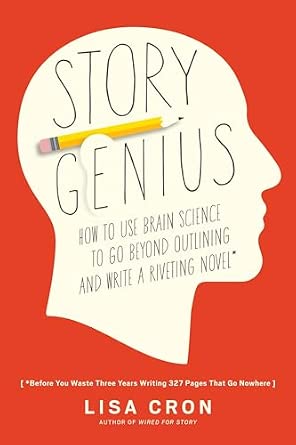
Story Genius: How to Use Brain Science to Go Beyond Outlining and Write a Riveting Novel (Before You Waste Three Years Writing 327 Pages That Go Nowhere)
Purchase options and add-ons
It’s every novelist’s greatest fear: pouring their blood, sweat, and tears into writing hundreds of pages only to realize that their story has no sense of urgency, no internal logic, and so is a page one rewrite.
The prevailing wisdom in the writing community is that there are just two ways around this problem: pantsing (winging it) and plotting (focusing on the external plot). Story coach Lisa Cron has spent her career discovering why these methods don’t work and coming up with a powerful alternative, based on the science behind what our brains are wired to crave in every story we read (and it’s not what you think).
In Story Genius Cron takes you, step-by-step, through the creation of a novel from the first glimmer of an idea, to a complete multilayered blueprint—including fully realized scenes—that evolves into a first draft with the authority, richness, and command of a riveting sixth or seventh draft.
- Print length288 pages
- LanguageEnglish
- PublisherTen Speed Press
- Publication dateAugust 9, 2016
- Dimensions5.47 x 0.83 x 8.23 inches
- ISBN-109781607748892
- ISBN-13978-1607748892
Book recommendations, author interviews, editors' picks, and more. Read it now.
Frequently bought together

Customers who viewed this item also viewed
- Save the Cat! Writes a Novel: The Last Book On Novel Writing You'll Ever NeedPaperbackFREE Shipping on orders over $35 shipped by AmazonGet it as soon as Saturday, Sep 19
- Wired for Story: The Writer's Guide to Using Brain Science to Hook Readers from the Very First SentencePaperbackFREE Shipping on orders over $35 shipped by AmazonGet it as soon as Saturday, Sep 19
- The Emotional Craft of Fiction: How to Write the Story Beneath the SurfacePaperbackFREE Shipping on orders over $35 shipped by AmazonGet it as soon as Saturday, Sep 19
- The Emotion Thesaurus: A Writer's Guide to Character Expression (Second Edition) (Writers Helping Writers Series)Becca PuglisiPaperbackFREE Shipping on orders over $35 shipped by AmazonGet it as soon as Saturday, Sep 19
- Bird by Bird: Some Instructions on Writing and LifePaperbackFREE Shipping on orders over $35 shipped by AmazonGet it as soon as Saturday, Sep 19
- The Anatomy of StoryPaperbackFREE Shipping on orders over $35 shipped by AmazonGet it as soon as Saturday, Sep 19
Customers also bought or read
- Save the Cat! Writes a Novel: The Last Book On Novel Writing You'll Ever Need#1 Best SellerBusiness Aspects of Writing
Paperback$10.81$10.81Delivery Sat, Sep 19 - Wired for Story: The Writer's Guide to Using Brain Science to Hook Readers from the Very First Sentence
Paperback$9.93$9.93Delivery Sat, Sep 19 - The Emotional Craft of Fiction: How to Write the Story Beneath the Surface
Paperback$12.29$12.29Delivery Sat, Sep 19 - The Emotion Thesaurus: A Writer's Guide to Character Expression (Second Edition) (Writers Helping Writers Series)
Paperback$19.95$19.95Delivery Sat, Sep 19 - Self-Editing for Fiction Writers, Second Edition: How to Edit Yourself Into Print ― A Professional Writing Guide on "Show, Don't Tell"
Paperback$11.22$11.22Delivery Sat, Sep 19 - Outlining Your Novel: Map Your Way to Success (Helping Writers Become Authors)
Paperback$11.83$11.83Delivery Mon, Sep 21 - Refuse to Be Done: How to Write and Rewrite a Novel in Three Drafts
Paperback$9.59$9.59Delivery Sat, Sep 19 - Bird by Bird: Some Instructions on Writing and Life#1 Best SellerSpeech
Paperback$9.99$9.99Delivery Sat, Sep 19 - Writing the Breakout Novel: Insider Advice for Taking Your Fiction to the Next Level
Paperback$13.86$13.86Delivery Sep 24 - 29 - Take Off Your Pants!: Outline Your Books for Faster, Better Writing
Paperback$8.99$8.99Delivery Mon, Sep 21 - A Writer's Guide to Active Setting: How to Enhance Your Fiction with More Descriptive, Dynamic Settings
Paperback$18.97$18.97Delivery Mon, Sep 21 - Fiction Writer's Guide to Dialogue: A Fresh Look at an Essential Ingredient of the Craft
Paperback$19.99$19.99Delivery Sat, Sep 19 - Save the Cat! Writes a Young Adult Novel: The Ultimate Guide to Writing a YA Bestseller
Paperback$10.31$10.31Delivery Sat, Sep 19 - Write Your Novel From The Middle: A New Approach for Plotters, Pantsers and Everyone in Between (Bell on Writing)
Paperback$13.95$13.95Delivery Mon, Sep 21 - The First 50 Pages: Engage Agents, Editors and Readers, and Set Your Novel Up For Success
Paperback$14.70$14.70Delivery Sep 29 - Oct 2 - Writing Irresistible Kidlit: The Ultimate Guide to Crafting Fiction for Young Adult and Middle Grade Readers
Paperback$19.99$19.99Delivery Sat, Sep 19 - The Secrets of Story: Innovative Tools for Perfecting Your Fiction and Captivating Readers
Paperback$11.35$11.35Delivery Sat, Sep 19
Editorial Reviews
Review
“In [Cron's] new book, Story Genius, she picks up the . . . theme . . . that a protagonist’s internal struggle makes the story work, and offers step-by-step advice on how to exploit this truth about neuroscience for richer, deeper, better first drafts. . . . Cron provides exercises and examples to keep writers on track, always highlighting the fact that emotions engage the brain faster than anything else. . . . The concepts are easy to understand and they are certainly important. Even if you can’t go on a retreat, you should try to find time to do the exercises for your own blueprint.”—Psychology Today
“It’s a simple question: 'How do you write an effective, engaging story?' Ask Lisa Cron. An accomplished author and story coach, she has just published her second book, Story Genius. A manual of sorts, it teaches cognitive storytelling strategies and uses actual brain science to help make its readers into better writers.”—Creative Screenwriting
“Cron, author of Wired for Story, proposes this new book as the answer to the question, What’s the biggest mistake writers make? She uses psychology and other sciences to explain what makes an utterly compelling story and how to write one. . . . Novice writers looking for a step-by-step guide to how to build—or fix—their novel might find a lot of useful information in here.”—Publishers Weekly
“Lost in the quagmire of trying to write a novel? Well, forget everything you've ever been told about story, because chances are, it's totally wrong. So where to turn? Story guru Cron not only gives you the skinny on why and how stories work (and why and how we respond to them), she also shows you how to craft a novel step by step, working with author Jenny Nash from the germ of an idea to a living, breathing story. I'd never consider writing a novel without Lisa's input, and neither should you.”—Caroline Leavitt, New York Times best-selling author of Is This Tomorrow and Pictures of You
About the Author
Excerpt. © Reprinted by permission. All rights reserved.
What’s the biggest mistake writers make? This is the question I’ve been asked most frequently over the years. The answer is easy: they don’t know what a story is. So even though they have a great idea, their prose is gorgeous, and there’s a lot of action, there’s no real story, and so no driving sense of urgency, which translates to: no readers.
The result? Countless writers end up heartbroken because no matter how hard they work, how many writing workshops they take, how many degrees they earn, they still can’t get an agent, can’t get a book deal, and if they decide to self-publish (in order to show those talent-blind publishing bigwigs a thing or two), they can’t get anyone other than their friends and family to buy their book. The statistics can be scary. In 2012, the New York Times reported that most self-published books sell fewer than 150 copies; surveys reveal that agents reject over 96 percent of the submissions they receive (personally, I’d put the number even higher). So it’s no surprise that writers end up disappointed, sad, and sometimes even a tad bitter. Worse, they’re convinced that their failure proves one thing only: they have no talent.
That’s when that internal voice we all have, the one that pretends to have our best interest at heart, moves in for the kill. Whatever made me think I could be a writer? I should give it up immediately and express my creativity some other way. Like—I don’t know—interpretive dance. Don’t! Not only because chances are you do have the talent, but seriously, the world has way too many interpretive dancers as it is.
Here’s the truth: not understanding how story really works is not your fault. It’s on a par with not knowing exactly how your body absorbs the nutrients in the food you eat. You know that it does, and if you took high school biology, you probably remember that it has something to do with cells and membranes and amino acids, but the how of it is invisible (thank heaven). The same is true of the effect that story—all stories—have on you, and even more surprising, why they have that effect.
This book is designed to help you crack the story code, and make what was invisible, visible—not to mention eminently doable. It will turn you into a Story Genius. It will show you, step by step, how to craft a blueprint for your story that will set you up for success from the get-go. It will also drastically cut down on rewriting time—and it’s the only thing that will. You’ll not only hook readers from the very first sentence, but your novel—or screenplay, play, or short story—will be deeper, richer, and more compelling than anything you’ve written before. How can I be sure? Because we’re not talking about some new flavor-of-the-month writing system conjured out of thin air. We’re talking brain science.
Humans are wired for story. We hunt for and respond to certain specific things in every story we hear, watch, or read—and they’re the exact same specific things, regardless of the genre. Why is this so? Because story is the language of the brain. We think in story. The brain evolved to use story as its go-to “decoder ring” for reality, and so we’re really expert at probing stories for specific meaning and specific info—and I mean all of us, beginning at birth. Even a kindergartner recognizes an effective story, because it’s built into the architecture of the brain. Story is how we make sense of the world around us; it’s a system that predates written language by eons. Heck, before spoken language, we grunted and signed in story. I’d wager that early in the morning, the cranky among us still do.
Because our response to story is hardwired, it’s not something we have to learn or even think about, which is why we are often unaware of the power story has over us. When a story grabs you, you’re in its sway, no questions asked. You may have heard the oft-expressed sentiment that getting lost in a good story demands a “willing suspension of disbelief.” In fact, this couldn’t be less true, because it implies we have a choice as to whether we fall under the spell of a captivating story. We don’t have a choice. The power story has over us is biological. But while responding to story is hardwired, creating a story is not. As the great Southern writer Flannery O’Connor once noted, “Most people know what a story is until they sit down to write one.”1 But here’s the part she missed: before we can learn to write a story, we have to know what a story actually is. That is, we have to know what’s really hooking and holding readers.
The problem is that most writers mistake story for the things we can see on the page: the stunning prose, the authoritative voice, the intense and exciting plot, the clever structure. It’s a very natural mistake, and a crippling one. Because while no one could deny that all those things are important, they lack the crucial element that gives a story meaning and brings it to life.
What drives a story forward is, at first blush, invisible. It’s not talent. It’s not voice. It’s not the plot. Think electricity. The same way even the most powerful lamp is useless unless it’s plugged in, a story can’t engage readers without the electricity that illuminates the plot, the voice, and the talent, bringing them to life.
The question is: what, specifically, generates that juice?
Product details
- ASIN : 1607748894
- Publisher : Ten Speed Press
- Publication date : August 9, 2016
- Edition : 1st
- Language : English
- Print length : 288 pages
- ISBN-10 : 9781607748892
- ISBN-13 : 978-1607748892
- Item Weight : 9.8 ounces
- Dimensions : 5.47 x 0.83 x 8.23 inches
- Best Sellers Rank: #11,345 in Books (See Top 100 in Books)
- #13 in Fiction Writing Reference (Books)
- #15 in Academic & Scholarly Writing
- #18 in Creative Writing Composition
- Customer Reviews:
About the author

Lisa Cron is the author of Wired for Story, Story Genius, and Story or Die. Her TEDx talk, Wired for Story, opened Furman University’s 2014 TEDx conference, Stories: The Common Thread of Our Humanity.
Lisa has worked in publishing at W.W. Norton and John Muir Publications, as an agent at the Angela Rinaldi Literary Agency, as a producer on shows for Showtime and Court TV, and as a story consultant for Warner Brothers and the William Morris Agency. Since 2006, she’s been an instructor in the UCLA Extension Writers’ Program, and she has been on the faculty of the School of Visual Arts MFA Program in Visual Narrative in New York City.
Lisa is frequent speaker at writing workshops, universities, and schools, and in her work as a story coach she helps writers, journalists, educators, business leaders, social justice advocates, and change makers master the unparalleled power of story. She can be reached at www.wiredforstory.com. Follow her on Twitter @lisacron