Refresh Your Home For Fall
Limited time deal NO_OF_HOURS hours NO_OF_MINUTES minutes Limited time deal NO_OF_MINUTES minutes Limited time deal NO_OF_MINUTES minutes NO_OF_SECONDS seconds Limited time deal NO_OF_SECONDS seconds Limited time deal
To see product details, add this item to your cart. You can always remove it later.
Shipper / Seller
Amazon.com
Amazon.com
Shipper / Seller
Amazon.com
Returns
30-day refund / replacement
This item can be returned in its original condition for a full refund or replacement within 30 days of receipt.
Read full return policy
Payment
Secure transaction
Your transaction is secure
We work hard to protect your security and privacy. Our payment security system encrypts your information during transmission. We don’t share your credit card details with third-party sellers, and we don’t sell your information to others. Learn more
Gift options
Available at checkout
Available at checkout This item is a gift. Change
At checkout, you can add a custom message, a gift receipt for easy returns and have the item gift-wrapped
Added to

Sorry, there was a problem.

There was an error retrieving your Wish Lists. Please try again.

Sorry, there was a problem.

List unavailable.
Kindle app logo image

Download the free Kindle app and start reading Kindle books instantly on your smartphone, tablet, or computer - no Kindle device required.

Read instantly on your browser with Kindle for Web.

Using your mobile phone camera - scan the code below and download the Kindle app.

QR code to download the Kindle App

  • Python for Algorithmic Trading Cookbook: Recipes for designing, building, and deploying algorithmic trading strategies with Python

Follow the author

Get new release updates & improved recommendations
Something went wrong. Please try your request again later.

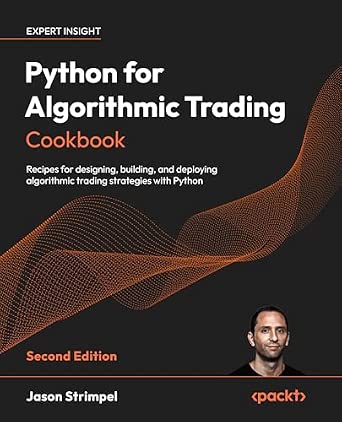
Python for Algorithmic Trading Cookbook: Recipes for designing, building, and deploying algorithmic trading strategies with Python

4.9 out of 5 stars (10)

Purchase options and add-ons

Transform financial market data into algorithmic trading strategies and deploy them into a live trading environment with recipes leveraging modern Python libraries like pandas, Polars, and DuckDB

Key Features

  • Backtest Python trading strategies with VectorBT and Zipline Reloaded using walk-forward analysis
  • Measure risk, performance, and alpha quality with Alphalens Reloaded and PyFolio
  • Automate strategy execution with the Interactive Brokers API for live trading

Book Description

Get practical Python code for algorithmic trading from Jason Strimpel, founder of PyQuant News and a veteran of global trading, risk management, and machine learning. This hands-on guide shows you how to turn market data into tested, automated trading strategies using modern Python tools.

You’ll source equities, options, and futures data with OpenBB and FMP, then accelerate Python for data analysis workflows with Pandas, Polars, Parquet, DuckDB, and ArcticDB. You’ll visualize market data with Matplotlib, Seaborn, and Plotly Dash before moving into alpha research and quantitative trading techniques.

Detailed recipes help you engineer alpha factors with PCA, regression, Fama-French models, SciPy, and statsmodels. You’ll design and evaluate quantitative trading strategies using VectorBT, Zipline Reloaded, Alphalens Reloaded, and PyFolio, including walk-forward analysis and risk-aware performance review.

For execution, you’ll connect to the Interactive Brokers API to stream ticks, manage orders, retrieve portfolio state, and monitor live trading workflows. By the end, you’ll have reusable Python templates for researching, backtesting, evaluating, and operating algorithmic trading strategies.

What you will learn

  • Acquire equities, futures, and options data using OpenBB and FMP
  • Process and analyze time series data efficiently with pandas and Polars
  • Store and query massive datasets with ArcticDB, DuckDB, and Parquet
  • Visualize trading data using Matplotlib, Seaborn, and Plotly Dash
  • Engineer alpha factors using PCA, regression, and Fama-French models
  • Backtest strategies with VectorBT and Zipline Reloaded frameworks
  • Evaluate performance and risk using Alphalens Reloaded and PyFolio
  • Deploy and automate live trades using the Interactive Brokers API

Who this book is for

This book is for traders, investors, and Python enthusiasts who need practical code to acquire, analyze, and automate algorithmic trading strategies using modern, high-performance Python tools. Readers should have some exposure to investing or trading, a basic familiarity with Python syntax, and a basic knowledge of libraries such as Pandas and NumPy. This book is ideal for discretionary traders who want to adopt a systematic approach and apply professional techniques, such as factor modeling, backtesting, and execution automation, to trading workflows using Python.

Table of Contents

  1. Acquire Free Financial Market Data with Cutting-Edge Python Libraries
  2. Analyze and Transform Financial Market Data with pandas
  3. Accelerate Financial Market Data Analysis with Polars and DuckDB
  4. Visualize Financial Market Data with Matplotlib, Seaborn, and Plotly Dash
  5. Build a Quantamental Research Database with Hedge Fund Tools
  6. Conduct Market Research with Advanced AI and Agentic Workflows
  7. Build Alpha Factors for Stock Portfolios
  8. Vector-Based Backtesting with VectorBT
  9. Event-Based Backtesting Factor Portfolios with Zipline Reloaded
  10. Evaluate Factor Risk and Performance with Alphalens Reloaded
  11. Assess Backtest Risk and Performance Metrics with Pyfolio

(N.B. Please use the Read Sample option to see further chapters)

Books with Buzz
Discover the latest buzz-worthy books, from mysteries and romance to humor and nonfiction. Explore more

Frequently bought together

This item: Python for Algorithmic Trading Cookbook: Recipes for designing, building, and deploying algorithmic trading strategies with Python
$44.99
Get it as soon as Monday, Sep 21
In Stock
Ships from and sold by Amazon.com.
+
$59.99
Get it as soon as Monday, Sep 21
In Stock
Ships from and sold by Amazon.com.
Total price: $00
To see our price, add these items to your cart.
Details
Added to Cart
Choose items to buy together.

Customers also bought or read

Loading...

From the Publisher

Jason_finance
Jason_1

What inspired you to write this new edition of Python Algorithmic Trading Cookbook?

The toolchain underneath quantitative research is moving at warp speed after the first edition shipped. Columnar engines like Polars and DuckDB went from interesting to essential, ArcticDB moved from internal Man Group infrastructure to the standard for petabyte-scale research, and AI agents stopped being a gimmick and started replacing hours of manual financial statement work.

I wanted to give readers a single book that reflects how professional quants actually work in 2026, not how they worked in 2022.

Jason_4

What's new in this edition compared to the previous version?

Three chapters are entirely new, and one has been rewritten end-to-end. Chapter 3 covers Parquet, Polars, DuckDB, and DuckLake for analytics that scale beyond what pandas can handle. Chapter 5 introduces ArcticDB for versioned, bias-free research datasets. Chapter 6 covers AI and agentic workflows with LangChain and LlamaIndex, including an AI equity research analyst and paper-to-code conversion.

Chapter 15 has been completely replaced with NVIDIA RAPIDS GPU acceleration, featuring recipes that wrangle 267 million rows, train factor models on 2 million observations, and solve Mean-CVaR portfolio optimization on the GPU.

Jason_3

What are the biggest lessons every new quantitative developer should learn, and what common mistakes does this book help them avoid?

The biggest mistakes traders make are introducing lookahead bias, overfitting to a single in-sample period, and moving directly from a notebook backtest to live trading without a proper execution layer. This book addresses these challenges directly. Chapter 5 uses ArcticDB's versioning to eliminate lookahead bias, Chapter 8 introduces walk-forward optimization with VectorBT to uncover overfitting, and Chapters 12-14 build a modular Interactive Brokers application. Chapters 10 and 11 introduce factor evaluation and Pyfolio Reloaded risk analytics so readers can validate strategies before allocating capital.

Beyond avoiding these pitfalls, I'd encourage new quantitative developers to master data infrastructure before writing a backtest, treat every result as guilty until proven innocent through robust testing, and write production code instead of monolithic notebooks. ArcticDB, Parquet, broker APIs, and GPU acceleration are now essential tools for serious quantitative research.

Python for Algorithmic Trading Cookbook
Customer Reviews
4.9 out of 5 stars 10
4.3 out of 5 stars 86
Topics covered Expanded coverage with Polars, DuckDB, Parquet, AI and agentic workflows, quantamental research, and advanced factor modeling Market data, visualization, storage, factor research, backtesting, risk analysis, and live trading
Example scenarios Research, backtest, evaluate, and automate live trading strategies using AI-assisted and high-performance workflows Build and backtest Python trading strategies
AI-powered quantitative research AI and agentic workflows for market research and strategy development Traditional quantitative research workflow
Modern technology stack pandas, Polars, DuckDB, Parquet, and ArcticDB pandas, SQLite, HDF5, ArcticDB
Production-ready trading End-to-end workflow with walk-forward analysis, performance evaluation, and Interactive Brokers automation Backtesting and Interactive Brokers connectivity
Edition scope Expanded edition with new chapters, updated tools, and modern end-to-end trading workflows Foundations of Python algorithmic trading

Editorial Reviews

Review

“This book supports both paper and live algo trading through genuinely comprehensive, hands-on content, allowing for considerable upskilling. It's well structured, with well-sized sections that never feel overloaded, and it reads well — not boring, not headache-inducing, but easy to soak up — with, I'd say, a high ROL (Return on Learning) ratio.”

Dr. Krzysztof Ozimek, PRM

Quantitative Finance Educator & Researcher


“Rather than focusing exclusively on pandas and technical indicators, it introduces readers to tools that are increasingly becoming part of professional quantitative workflows: OpenBB, Polars, DuckDB, ArcticDB, VectorBT, Interactive Brokers API, GPU acceleration with NVIDIA RAPIDS, and even AI-powered research workflows using LangChain and LlamaIndex. I also appreciated the breadth of the workflow it covers.

Whether you're an experienced quant looking to modernize your Python toolkit or a developer aiming to transition into systematic trading, I believe this is one of the strongest practical resources currently available.”

Andres Bagnasco

Sr. Solutions Architect at phData, Award-winning Professor, Top 10 LinkedIn Voice (Uruguay)

About the Author

Jason Strimpel is the founder of PyQuant News, co-founder of Quant Science, and Managing Director of Global AI and Advanced Analytics at a top-tier consulting firm. His 20+ year career spans trading, quant risk, ML, and enterprise data across Chicago, London, and Singapore. At BP, he managed $20B in counterparty credit exposure, then led quant engineering globally for BP's derivatives book. In Singapore, he led engineering, data science, and analytics at Rio Tinto Commercial, scaling the team behind its $60B commodities trading business. At AWS, he joined the firm's GenAI operations organization, building internally facing GenAI tools. He holds a Master's in Quantitative Finance from Illinois Institute of Technology.

Product details

  • Publisher ‏ : ‎ Packt Publishing
  • Publication date ‏ : ‎ July 10, 2026
  • Edition ‏ : ‎ 2nd ed.
  • Language ‏ : ‎ English
  • Print length ‏ : ‎ 536 pages
  • ISBN-10 ‏ : ‎ 1806662035
  • ISBN-13 ‏ : ‎ 978-1806662036
  • Item Weight ‏ : ‎ 2.01 pounds
  • Dimensions ‏ : ‎ 7.5 x 1.21 x 9.25 inches
  • Best Sellers Rank: #99,987 in Books (See Top 100 in Books)
  • Customer Reviews:
    4.9 out of 5 stars (10)

About the author

Follow authors to get new release updates, plus improved recommendations.
Jason Strimpel
Brief content visible, double tap to read full content.
Full content visible, double tap to read brief content.

Jason Strimpel is the founder of PyQuant News and co-founder of Trade Blotter, with a career spanning over 20 years in trading, risk management, and data science.

He previously traded for a Chicago-based hedge fund, served as a risk manager at JPMorgan, and managed production risk technology for an energy derivatives trading firm in London. In Singapore, Jason served as the APAC CIO for an agricultural trading firm and built the data science team for a global metals trading firm. He holds degrees in finance and economics and a Master’s in quantitative finance from the Illinois Institute of Technology.

His career has taken him across America, Europe, and Asia. Jason shares his expertise through the PyQuant Newsletter, social media, and teaches the course "Getting Started With Python for Quant Finance."