Buy New
-
To see product details, add this item to your cart.
Ships from: Amazon Sold by: Ibook USA
Used - Very Good
-
To see product details, add this item to your cart.
Ships from: BooksRun Sold by: BooksRun
Download the free Kindle app and start reading Kindle books instantly on your smartphone, tablet, or computer - no Kindle device required.
Read instantly on your browser with Kindle for Web.
Using your mobile phone camera - scan the code below and download the Kindle app.
Follow the authors
OK
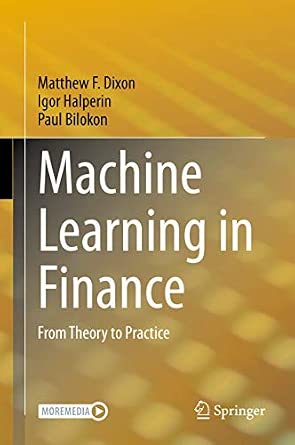
Machine Learning in Finance: From Theory to Practice
Purchase options and add-ons
This book introduces machine learning methods in finance. It presents a unified treatment of machine learning and various statistical and computational disciplines in quantitative finance, such as financial econometrics and discrete time stochastic control, with an emphasis on how theory and hypothesis tests inform the choice of algorithm for financial data modeling and decision making. With the trend towards increasing computational resources and larger datasets, machine learning has grown into an important skillset for the finance industry. This book is written for advanced graduate students and academics in financial econometrics, mathematical finance and applied statistics, in addition to quants and data scientists in the field of quantitative finance.
Machine Learning in Finance: From Theory to Practice is divided into three parts, each part covering theory and applications. The first presents supervised learning for cross-sectional data from both a Bayesian and frequentist perspective. The more advanced material places a firm emphasis on neural networks, including deep learning, as well as Gaussian processes, with examples in investment management and derivative modeling. The second part presents supervised learning for time series data, arguably the most common data type used in finance with examples in trading, stochastic volatility and fixed income modeling. Finally, the third part presents reinforcement learning and its applications in trading, investment and wealth management. Python code examples are provided to support the readers' understanding of the methodologies and applications. The book also includes more than 80 mathematical and programming exercises, with worked solutions available to instructors. As a bridge to research in this emergent field, the final chapter presents the frontiers of machine learning in finance from a researcher's perspective, highlighting how many well-known concepts in statistical physics are likely to emerge as important methodologies for machine learning in finance.
- ISBN-103030410676
- ISBN-13978-3030410674
- Edition2020th
- PublisherSpringer
- Publication dateJuly 2, 2020
- LanguageEnglish
- Dimensions6.14 x 1.25 x 9.21 inches
- Print length573 pages
Discover the latest buzz-worthy books, from mysteries and romance to humor and nonfiction. Explore more
Frequently bought together

Customers who viewed this item also viewed
- Advances in Financial Machine LearningHardcoverFREE Shipping on orders over $35 shipped by AmazonGet it as soon as Sunday, Sep 20
- Monte Carlo Methods in Financial Engineering (Stochastic Modelling and Applied Probability, 53)HardcoverFREE Shipping by AmazonGet it as soon as Tuesday, Sep 22Only 5 left in stock - order soon.
- Machine Learning for Algorithmic Trading: Predictive models to extract signals from market and alternative data for systematic trading strategies with PythonPaperbackFREE Shipping by AmazonGet it as soon as Monday, Sep 21
- Stochastic Calculus for Finance II: Continuous-Time Models (Springer Finance)HardcoverFREE Shipping by AmazonGet it as soon as Sunday, Sep 20Only 10 left in stock - order soon.
- Stochastic Calculus for Finance I: The Binomial Asset Pricing Model (Springer Finance)PaperbackFREE Shipping by AmazonGet it as soon as Monday, Sep 21Only 2 left in stock - order soon.
- Machine Learning for Trading: A disciplined workflow from research to live execution, with nine case studies and AI agentsPaperbackFREE Shipping by AmazonGet it as soon as Monday, Sep 21
Customers also bought or read
- Machine Learning for Algorithmic Trading: Predictive models to extract signals from market and alternative data for systematic trading strategies with Python
Paperback$47.60$47.60FREE delivery Mon, Sep 21 - Stochastic Calculus for Finance I: The Binomial Asset Pricing Model (Springer Finance)
Paperback$45.65$45.65FREE delivery Mon, Sep 21 - Monte Carlo Methods in Financial Engineering (Stochastic Modelling and Applied Probability, 53)
Hardcover$53.17$53.17FREE delivery Tue, Sep 22 - Analysis of Financial Time Series (Wiley Series in Probability and Statistics)
Hardcover$83.28$83.28FREE delivery Tue, Sep 22 - Quantitative Trading: How to Build Your Own Algorithmic Trading Business (Wiley Trading)
Hardcover$34.44$34.44Delivery Mon, Sep 21 - The Elements of Quantitative Investing (Wiley Finance)
Hardcover$46.20$46.20FREE delivery Sun, Sep 20 - Deep Learning (Adaptive Computation and Machine Learning series)
Hardcover$51.51$51.51FREE delivery Sun, Sep 20 - Algorithmic Trading: Winning Strategies and Their Rationale (Wiley Trading)
Hardcover$49.29$49.29FREE delivery Sep 22 - 25 - Machine Learning for Asset Managers (Elements in Quantitative Finance)
Paperback$23.00$23.00Delivery Mon, Sep 21 - Options, Futures, and Other Derivatives, Global Edition
Paperback$52.53$52.53FREE delivery Sun, Sep 20 - Option Volatility and Pricing: Advanced Trading Strategies and Techniques, 2nd Edition
Hardcover$91.83$91.83FREE delivery Sun, Sep 20 - Hands-On Machine Learning with Scikit-Learn, Keras, and TensorFlow: Concepts, Tools, and Techniques to Build Intelligent Systems
Paperback$49.50$49.50FREE delivery Mon, Sep 21 - Mathematics for Finance: An Introduction to Financial Engineering (Springer Undergraduate Mathematics Series)
Paperback$25.01$25.01Delivery Mon, Sep 21 - Hands-On Large Language Models: Language Understanding and Generation
Paperback$37.68$37.68FREE delivery Mon, Sep 21 - Advanced Portfolio Management: A Quant's Guide for Fundamental Investors
Hardcover$22.26$22.26Delivery Sun, Sep 20 - Expected Returns: An Investor's Guide to Harvesting Market Rewards (The Wiley Finance Series)
Hardcover$50.49$50.49FREE delivery Mon, Sep 21 - Mathematics of Machine Learning: Master linear algebra, calculus, and probability for machine learning
Paperback$44.30$44.30FREE delivery Mon, Sep 21 - Algorithmic and High-Frequency Trading (Mathematics, Finance and Risk)
Hardcover$82.37$82.37FREE delivery Sun, Sep 20 - Hands-On Machine Learning with Scikit-Learn and PyTorch: Concepts, Tools, and Techniques to Build Intelligent Systems
Paperback$77.72$77.72FREE delivery Mon, Sep 21 - Python for Data Analysis: Data Wrangling with pandas, NumPy, and Jupyter
Paperback$43.99$43.99FREE delivery Oct 1 - 16 - Probabilistic Machine Learning: Advanced Topics (Adaptive Computation and Machine Learning series)
Hardcover$145.42$145.42FREE delivery Tue, Sep 22 - The Man Who Solved the Market: How Jim Simons Launched the Quant Revolution
Hardcover$13.76$13.76Delivery Sep 28 - Oct 1 - Trades, Quotes and Prices: Financial Markets Under the Microscope
Hardcover$91.38$91.38FREE delivery Sun, Sep 20 - Deep Reinforcement Learning Hands-On: A practical and easy-to-follow guide to RL from Q-learning and DQNs to PPO and RLHF
Paperback$32.75$32.75Delivery Mon, Sep 21 - Python for Finance Cookbook: Over 80 powerful recipes for effective financial data analysis, 2nd Edition
Paperback$37.98$37.98FREE delivery Mon, Sep 21
Editorial Reviews
Review
“This book is, however, a well-structured and self-contained graduate textbook on ML applications in finance. Exercises and some applications are included at the end of each chapter and the Python code used in this book makes use of the Python Tensor Flow library. This book could also serve as a useful reference book for researchers and practitioners in quantitative finance.” (Gilles Teyssière, Mathematical Reviews, February, 2023)
“Each part is introduced with background information, examples of relevant practical applications, and references to the most recent scientific literature. … The book covers all essential areas of machine learning with relevance to quantitative finance. … An additional strong advantage of this book is the clear and consistent structure of its chapters. … Overall, the book covers multiple machine learning approaches with advanced technical exposition and is therefore especially suitable as an academic reference point, especially on Reinforcement Learning.” (Antoniya Shivarova, Financial Markets and Portfolio Management, Issue 35, 2021)
“This volume aims to present a broad yet technical treatment of (ML) algorithms used by financial practitioners and scholars alike. … the book fills a large void. … This encourages reproducibility as well as learning by doing, which is highly appreciated.” (Guillaume Coqueret, Quantitative Finance, October 15, 2020)
From the Back Cover
This book introduces machine learning methods in finance. It presents a unified treatment of machine learning and various statistical and computational disciplines in quantitative finance, such as financial econometrics and discrete time stochastic control, with an emphasis on how theory and hypothesis tests inform the choice of algorithm for financial data modeling and decision making. With the trend towards increasing computational resources and larger datasets, machine learning has grown into an important skillset for the finance industry. This book is written for advanced graduate students and academics in financial econometrics, mathematical finance and applied statistics, in addition to quants and data scientists in the field of quantitative finance.
Machine Learning in Finance: From Theory to Practice is divided into three parts, each part covering theory and applications. The first presents supervised learning for cross-sectional data from both a Bayesianand frequentist perspective. The more advanced material places a firm emphasis on neural networks, including deep learning, as well as Gaussian processes, with examples in investment management and derivative modeling. The second part presents supervised learning for time series data, arguably the most common data type used in finance with examples in trading, stochastic volatility and fixed income modeling. Finally, the third part presents reinforcement learning and its applications in trading, investment and wealth management. Python code examples are provided to support the readers' understanding of the methodologies and applications. The book also includes more than 80 mathematical and programming exercises, with worked solutions available to instructors. As a bridge to research in this emergent field, the final chapter presents the frontiers of machine learning in finance from a researcher's perspective, highlighting how many well-known concepts in statistical physics are likelyto emerge as important methodologies for machine learning in finance.
About the Author
Paul Bilokon, Ph.D., is CEO and Founder of Thalesians Ltd. Paul has made contributions to mathematical logic, domain theory, and stochastic filtering theory, and, with Abbas Edalat, has published a prestigious LICS paper. He is a member of the British Computer Society, the Institution of Engineering and the European Complex Systems Society.
Matthew Dixon, FRM, Ph.D., is an Assistant Professor of Applied Math at the Illinois Institute of Technology and an Affiliate of the Stuart School of Business. He has published over 20 peer reviewed publications on machine learning and quant finance and has been cited in Bloomberg Markets and the Financial Times as an AI in fintech expert. He is Deputy Editor of the Journal of Machine Learning in Finance, Associate Editor of the AIMS Journal on Dynamics and Games, and is a member of the Advisory Board of the CFA Quantitative Investing Group.
Igor Halperin, Ph.D., is a Research Professor in Financial Engineering at NYU,and an AI Research associate at Fidelity Investments. Igor has published more than 50 scientific articles in machine learning, quantitative finance and theoretic physics. Prior to joining the financial industry, he held postdoctoral positions in theoretical physics at the Technion and the University of British Columbia.
Product details
- Publisher : Springer
- Publication date : July 2, 2020
- Edition : 2020th
- Language : English
- Print length : 573 pages
- ISBN-10 : 3030410676
- ISBN-13 : 978-3030410674
- Item Weight : 2.05 pounds
- Dimensions : 6.14 x 1.25 x 9.21 inches
- Best Sellers Rank: #448,005 in Books (See Top 100 in Books)
- #156 in Business Statistics
- #315 in Statistics (Books)
- Customer Reviews:
About the authors

Dr Paul Alexander Bilokon is CEO and Founder of Thalesians Ltd and a member of the systematic trading team at EnBW, where he focuses on commodity (especially oil and gas) and power trading strategies. He previously served as Director and Head of global credit and core e-trading quants at Deutsche Bank, having also worked at Morgan Stanley, Lehman Brothers, Nomura, Citigroup (where he was one of the pioneers in electronic trading in fixed income), and BNP Paribas. Paul also has extensive high-frequency trading (HFT) experience.
Paul has graduated from Christ Church, University of Oxford, with a distinction and Best Overall Performance prize. At Oxford he wrote a distinguished project, Bayesian methods for solving estimation and forecasting problems in the high-frequency trading environment, supervised by Daniel Jones. He also graduated twice from Imperial College London. His MSci thesis Visualising the Invisible: Detecting Objects in Quantum Noise Limited Images, supervised by Duncan Fyfe Gillies and Marin van Heel, won him the university's Donald Davis Prize and the British Computing Society SET Award for Student Making Best Use of IT.
Paul has made contributions to quantitative and computational finance, mathematical logic, domain theory, stochastic filtering theory, machine learning, and artificial intelligence, with applications to finance, economics, engineering, medicine, and drug discovery. He lectures at Imperial College London on artificial intelligence, scientific computing, and quantitative finance. His lecture courses consistently achieve top rankings among the students. He has co-authored several books: Machine Learning and Big Data with kdb+/q (with Jan Novotny, Aris Galiotos, and Frédéric Délèze, published by Wiley), and Machine Learning in Finance: From Theory to Practice (with Matthew F. Dixon and Igor Halperin, published by Springer). The latter is now a standard textbook on machine learning and artificial intelligence at universities, banks, and hedge funds worldwide.
Dr Bilokon is a Member of British Computer Society and Institution of Engineering and Technology.
Paul is a frequent speaker at premier conferences such as Global Derivatives/QuantMinds, WBS QuanTech, AI, and Quantitative Finance conferences, alphascope, LICS, and Domains.

Discover more of the author’s books, see similar authors, read book recommendations and more.

Matthew Dixon, FRM, Ph.D., is an Associate Professor of Applied Math at the Illinois Institute of Technology and an Affiliate Associate Professor of the Stuart School of Business. He has published over 40 peer reviewed publications on machine learning and quant finance and has been cited in Bloomberg Markets and the Financial Times as an AI in fintech expert. He is Risk's 2022 Buy-side Quant of the Year (joint with Igor Halperin). He is also Associate Editor of the AIMS Journal on Dynamics and Games, and is a member of the Advisory Board of the CFA Quantitative Investing Group.