
Return on Investment (ROI) is a financial metric used to assess the profitability and efficiency of an investment by measuring the amount of profit or loss generated in relation to its cost. It indicates how effectively invested funds are being utilized to produce returns and is commonly expressed as a percentage. A higher ROI signifies a more profitable investment, while a lower or negative ROI indicates lower profitability or a loss. This measure helps investors and businesses compare different investment opportunities and make informed financial decisions.
ROI is expressed as a percentage, making it easy to compare different investment opportunities. However, it does not consider the time period of the investment.
Importance of ROI
- Investment Comparison: Helps compare returns from different investment options
- Better Decision-Making: Assists in selecting the most profitable opportunities
- Efficient Resource Allocation: Ensures optimal use of funds
- Pricing Strategy: Supports setting product prices for maximum profitability
- Investor Confidence: Builds trust among investors and stakeholders
- Risk Analysis: Helps identify potential risks and returns
- Strategic Planning: Guides long-term financial planning and growth
ROI in Financial Analysis
- ROI is part of profitability ratios, which help assess how efficiently a business uses its resources to generate profit.
- The Statement of Profit and Loss plays a key role in calculating ROI, as it provides the necessary data on earnings and expenses.
Note: ROI is often confused with Return on Capital Employed (ROCE), but they are not exactly the same. ROCE is a more specific profitability ratio focusing on capital efficiency.
Illustration 1:
Calculate Return on Investment from the following information:
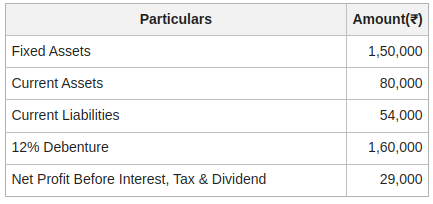
Solution:
Step 1: Calculate Capital Employed
Capital Employed = Non-current Assets + Current Assets − Current Liabilities
= 1,50,000 + 80,000 − 54,000
= ₹1,76,000
Step 2: Apply ROI Formula
Return on Investment = 16.47%
Illustration 2:
Calculate Return on Investment from the following information:

The net profit after tax is ₹1,00,000, and the amount of Tax is ₹20,000.
Solution:
Profit before interest and tax = 1,00,000 + Debenture Interest + Tax
= 1,00,000 + 60,000 + 20,000
= ₹1,80,000
Capital Employed = Equity Share Capital + Preference Share Capital + Reserves + Debentures
= 5,00,000 + 1,50,000 + 2,00,000 + 3,00,000
= ₹11,50,000
Return on Investment = 15.65%