
Spring Cloud provides built-in support for implementing load balancing in microservices architectures, helping distribute requests efficiently across multiple service instances. It supports both client-side and server-side load balancing approaches, each offering different ways to manage traffic and improve system scalability.
- Client-side load balancing distributes requests using logic within the client (e.g., Spring Cloud LoadBalancer).
- Server-side load balancing uses a centralized server or proxy (e.g., NGINX, AWS Elastic Load Balancer) to route requests.
- Helps improve performance, fault tolerance, and efficient resource utilization in microservices systems.
Load Balancer in Spring Cloud
A load balancer in Spring Cloud distributes incoming requests across multiple service instances to ensure better performance, reliability, and availability. It helps prevent server overload and ensures smooth handling of traffic in microservices architectures.
- Distributes requests using algorithms like round-robin and least connections.
- Improves scalability by allowing horizontal scaling (adding more instances).
- Enhances fault tolerance by routing traffic away from failed instances.
- Supports health checks to send traffic only to healthy services.
- Works with tools like Spring Cloud LoadBalancer for client-side load balancing.

Type of Load Balancer
There are two ways to load balance the request
1. Client-Side Load Balancer
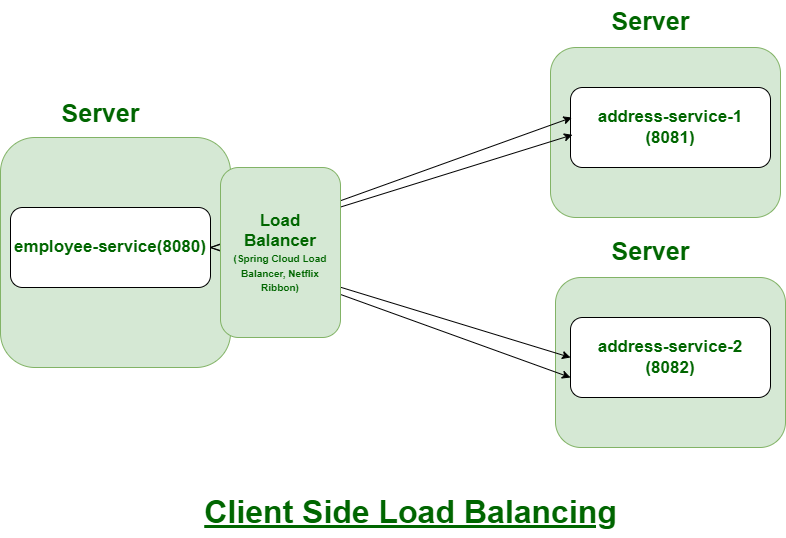
Client-side load balancing is a mechanism where the responsibility of distributing requests lies with the client itself. The client maintains a list of available service instances and decides which instance to call using a load balancing algorithm.
- The load balancing logic resides within the client application.
- Maintains a list of service instances (often via service discovery).
- Uses algorithms like round-robin to select the target instance.
- Reduces dependency on external load balancers, improving flexibility.
2. Server-Side Load Balancer
Server-side load balancing is a mechanism where a centralized load balancer handles the distribution of incoming requests across multiple service instances. The client sends requests to the load balancer, which then forwards them to the appropriate backend server based on a routing algorithm.
- A dedicated load balancer sits between clients and backend services.
- All requests first reach the load balancer, which then routes them to available servers.
- Uses algorithms like round-robin, least connections, etc., for traffic distribution.
- Simplifies client logic since the client does not manage service instances.

Client Side Load Balancer vs Server Side Load Balancer
| Feature | Client-Side Load Balancer | Server-Side Load Balancer |
|---|---|---|
| Definition | Load balancing logic is handled by the client itself | Load balancing is handled by a centralized server/proxy |
| Request Flow | Client directly selects and calls a service instance | Client sends request to load balancer, which forwards it to a server |
| Location of Logic | Inside the client application | Dedicated external component between client and services |
| Service Discovery | Client fetches and maintains list of service instances | Load balancer manages service instance list |
| Dependency | No dependency on external load balancer | Requires a separate load balancer component |
| Scalability | Scales well with microservices but increases client complexity | Highly scalable and easier to manage centrally |
| Fault Tolerance | Client handles retry and failover logic | Load balancer handles failover and routing |
| Latency | Lower latency (direct communication) | Slightly higher due to extra network hop |
| Complexity | More complex client-side logic | Simpler client, complexity handled by server |
| Flexibility | More flexible (custom logic per client) | Less flexible, centralized configuration |
| Maintenance | Harder to maintain across multiple clients | Easier centralized management |
| Examples | Spring Cloud LoadBalancer, Netflix Ribbon | NGINX, HAProxy, AWS Elastic Load Balancer |