

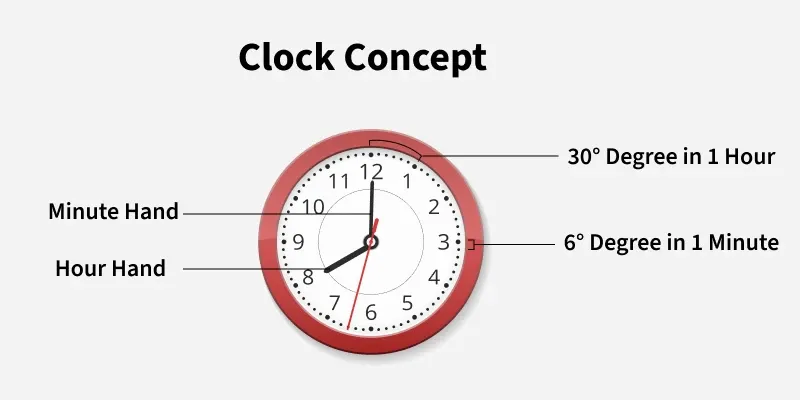
A typical analog clock has a circular face with twelve-hour markings and 60-minute markings placed around the circumference of the circle, called minute spaces.
- When it comes to telling time, clocks use two primary hands: the hour hand and the minute hand.
- The hour hand, also known as the short hand, is typically smaller and moves more slowly than the minute hand.
- Meanwhile, the larger, faster-moving hand is called the minute hand or long hand.
- The markings on the face of a clock are 60 spaces, one each for a minute. Every hour, the minute hand completes one round of 60 spaces, and the hour hand completes one full round every 12 hours.
Angle between hour and minute hands:
\theta = \left| 30H - \frac{11}{2}M \right|
Important Points and Shortcuts for Clock
- In 60 minutes, the minute hand gains 55 spaces (also known as minute spaces) over the hour hand.
For example, if the initial time is 12:00, then after 1 hour, the minute hand would cover 60 spaces whereas the hour hand would cover only 5 spaces. Thus, the minute hand covers 55 spaces extra than the hour hand.
- The minute hand covers 360 degrees in 60 minutes. =>
In 1 minute, the minute hand covers 360 / 60 = 6 degrees
- The hour hand covers 360 degrees in 12 hours.
In 1 hour, the hour hand covers 360 / 12 = 30 degrees
In 1 minute, the hour hand covers 30 / 60 = 0.50 degrees
- The angle between the minute hand and the hour hand increases by 5.50 degrees every minute.
For example, after 2 minutes, angle made by the minute hand = 2 x 6 = 12 degrees and angle made by the hour hand = 2 x 0.50 = 1 degree
Angle between the hour hand and the minute hand after 2 minutes = 12 – 1 = 11 degrees = 2 x 5.50 degrees
- In every hour, the minute hand and the hour hand coincide once.
- If the minute hand and the hour hand are in the same line, then the angle between them is either 0 degree or 180 degrees.
- The angle between the minute hand and the hour hand is 180 degrees if they are 30 spaces apart, 90 degrees if they are 15 spaces apart, and 0 degrees if they are 0 spaces apart.
- If the clock shows time ahead of the actual time, it is said to be running fast.
For example, if the clock is showing 12:15 PM but it is actually 12:00 PM, then the clock is said to be running 15 minutes fast.
- If the clock shows time behind the actual time, it is said to be running slow.
For example, if the clock is showing 2:15 PM but it is actually 2:30 PM, then the clock is said to be running 15 minutes slow.
Clocks - Questions and Answers
Question 1: At what time between 5 PM and 6 PM would the two hands of the clock be together?
Solution:
At 5 PM, the hour hand would be at 25 spaces and the minute hand would be at 0 spaces. The minute hand would need to cover these 25 spaces to meet the hour hand. Since the minute hand gains 55 minutes over the hour hand in 60 minutes, we get:
25 minutes would be gained in (60/55) × 25 = 1500/55 = 300/11 minutes
Thus, the two hands of the clock meet at 300/11 minutes past 5 PM, i.e., around 5:27 PM.
Question 2: In a clock, the time is 6.55. What is the angle between the hour hand and the minute hand of the clock?
Solution:
At 6:55, the angle between the hour hand and the minute hand of the clock is 122.5 degrees.
Here's how it's calculated:
The hour hand angle from 12 o'clock is \30 \times 6 + 0.5 \times 55 = 180 + 27.5 = 207.5 degrees.
The minute hand angle from 12 o'clock is6 \times 55 = 330 degrees.
The difference between the two angles is|207.5 - 330| = 122.5 degrees.The angle between the hour and minute hands at 6:55 is 122.5°.
Question 3 : At what time between 3 PM and 4 PM would the two hands of the clock be together?
Solution:
At 3 PM, the hour hand would be at 15 spaces and the minute hand would be at 0 spaces. The minute hand would have to cover these extra 15 spaces in order to meet the hour hand. Now, 55 minutes are gained by the minute hand in 60 minutes. => 15 minutes would be gained in (60 / 55) x 15 = 180 / 11 minutes Thus, the two hands of the clock meet at 180 / 11 minutes past 3 PM, i.e., around 3:16:22 PM.
Question 4 : How many times in a day the two hands of a clock coincide?
Solution:
Between 11 to 1, the hands of the clock coincide only once, i.e., at 12. At 12:00 AM and 12:00 PM, the hour hand and the minute hand do not coincide with each other So, every 12 hours, they coincide 11 times. Therefore, the two hands of the clock coincide 22 times in a day.
Question 5 : At what time between 5 and 6 o’clock, do the minute and hour hands make an angle of 34 degree with each other
Solution:
The angle between the minute hand and the hour hand at 5 o’clock is 150 degrees.
The angle between the hands becomes 34 degrees when the angle changes by 116 degrees and 184 degrees, i.e. (150-34) and (150+34).
The angle changes by 5.5 degrees in 1 min.
The angle changes by 116 degrees in 1/5.5 x 116=21 1/11 min.
The angle changes by 184 degrees in 1/5.5 x 184=33 5/11 min.
Therefore the angle between the two hands is 34 degrees when the time is 5 hr 21 1/11 min, and again at 5 hr 33 5/11 min.