Cellulose In Digestion - Herbivores, Termites, & Ruminants
Last Updated :
23 Jul, 2025
Cellulose is a type of fiber that cannot be digested by the human digestive system. The presence of beta-acetal linkages in cellulose distinguishes it from starch and determines its digestion. The organisms that are capable of digesting the cellulose with their cellulase enzyme are microorganisms such as bacteria, fungi, and protozoa.
Except for a few multicellular organisms, such as termites, most higher organisms cannot digest cellulose without the help of microorganisms. In this article, we will discuss cellulose in digestion and why humans can digest starch but not cellulose.
What is Cellulose?
Cellulose is a natural, linear polymer made of glucose units. It is a major component of the cell walls of most plants and is also found in some algae and bacteria. Cellulose comprises around 33% of all vegetable matter and is the most abundant of all naturally occurring organic polymer on Earth. The glucose units in cellulose are connected in a unique way (beta‐linkages) to make cellulose very resistant to breakdown. Mammals lack the enzymes required to break these beta‐linkages, required to release the glucose. But, bacteria, fungi, and protozoa that reside in the rumen of ruminant animals do possess the enzymes necessary to break those glycosidic bonds. Herbivores also possess the same microbes that can break down cellulose, but they are located in a different part of the gut known as the cecum. The relationship between microbes and herbivores is called a symbiotic relationship.
Also Read: Carbohydrates
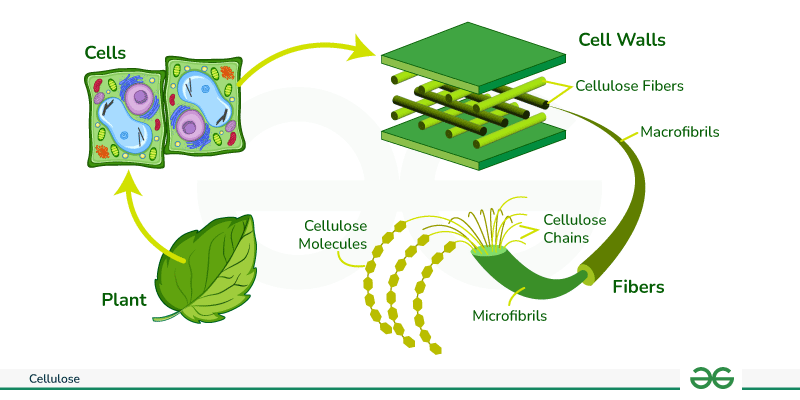
Structure of Cellulose
Cellulose is an organic compound derived from D-glucose units and having the formula (C6H10O5)n. It is a polysaccharide comprising of a linear chain of several hundred to many thousands of β(1→4) linked glycosidic bonds. This linkage motif differs from that of α(1→4)-glycosidic bonds present in starch and glycogen. Glucan chains of cellulose aggregate via hydrogen bonds and van der Waals forces to form a long thread-like crystalline structure called a cellulose microfibril.

Cellulose Digestion in Ruminants
The digestive system of ruminant animals such as cow, goat, buffaloes or sheep exhibits pre‐gastric fermentation. This means the site of microbial digestion and anaerobic fermentation of cellulose occurs before digesta reaches the small intestine, the place in the digestive tract where nutrients are absorbed by the body for productive function.
Ruminants are a group of mammals, including cows, sheep, and deer, that have a unique digestive system with four compartments: the rumen, reticulum, omasum, and abomasum. They are animals which chew the cud, which is unchewed grass taken into the rumen which is returned to the mouth for chewing (regurgitation). Reticulum is responsible for regurgitation, forcing the cud back into the cow’s mouth as part of rumination.
The rumen is the largest compartment of the ruminant digestive system. It serves to store partially digested food, provides physical mixing of digesta with ruminal fluid, and is an anaerobic fermentation chamber. The ruminant and ruminal microbes possess a symbiotic relationship. First, the ruminant provides the perfect home for those microbes i.e., an anaerobic environment, perfect temperature and abundance of food. The microbes break that food down, including cellulose, which would be otherwise useless to the animal, and then use nutrients for their own growth. Eg. Fibrobacter succinogenes, Ruminococci .
Also Read: Human Digestive System
Cellulose Digestion in Termites
Animals such as termites consume wood and dry leaves which also contain cellulose. The digestion of cellulose in termites is also done by the enzyme cellulase produced by protozoans which live symbiotically with the termites. The byproducts of the breakdown of cellulose could be acetic acid or glucose.
Few termite species, however, lack the ability to manufacture enough cellulase independently and are dependent on microbes from the domains of Archaea, Eubacteria and Eucarya to digest cellulose. Irrespective of the various levels of termite independence, there exists a symbiotic relationship between termites and over 400 species of microorganisms. These microorganisms are named mastigophorans.
Cellulose Digestion in Herbivores
Plants have cellulose in their cell walls, which is consumed by herbivores. Numerous herbivores use the ability of some bacterial groups to ferment plant cell walls in order to extract energy from them. After that, the body absorbs it and uses it as nourishment. Herbivores can digest cellulose by monogastric digestion by using the symbiotic gut bacteria. The efficiency of herbivores in obtaining energy from the digestion of cellulose is lower than that of ruminants. Here, microbial fermentation is used to break down cellulose.
Animal evolution has given rise to different ways for plants to be digested. While the digestive tracts of many herbivores include a large fermenting organ, certain herbivores—like giant pandas, which consume bamboo as their primary food—have digestive tracts that resemble those of carnivorous animals. Thus, fermenting organs are not strictly necessary for herbivores.
Reasons Why Humans Cannot Digest Cellulose
Humans lack the ability to digest cellulose for several reasons:
- Lack of Cellulase Enzyme: Cellulose is a complex carbohydrate composed of glucose units linked together by beta-1,4-glycosidic bonds. Humans do not produce the enzyme cellulase that is needed to break down these linkages and hydrolyze cellulose into individual glucose molecules.
- Lack of Specialized Digestive Structures: Humans have a monogastric digestive system (single-chambered stomach) whereas ruminant animals have multi-chambered stomachs. Humans lack the specialized chambers and microbial populations important for efficient digestion of cellulose.
- Complex Structure of Cellulose: The beta-1,4-glycosidic linkages in cellulose are resistant to hydrolysis by human digestive enzymes, making cellulose indigestible in the human stomach and small intestine.
- Limited Fermentation in the Colon: Certain gut bacteria break down cellulose to some extent in the human colon. But the fermentation in the colon is limited, and the byproducts, such as short-chain fatty acids, are not as efficiently absorbed and utilized for energy as the breakdown of other carbohydrates.
Also Read: Disorders Of Digestive System
Importance of Cellulose in Digestion
Although cellulose itself is not directly digestible by humans, its presence in the diet has important roles for digestive health:
- Cellulose is a dietary fiber, which is an important component of a healthy diet. It adds bulk to the diet, promoting a feeling of fullness and hence avoids overeating.
- The presence of cellulose helps stimulate peristalsis i.e., the contractions of the muscles of digestive tract that move food along the digestive system.
- It facilitates the movement of stool through the intestines, helping to alleviate constipation.
- The fermentation of cellulose by gut bacteria produces short-chain fatty acids, which can be absorbed and utilized by the body for energy.
Also Read:
Explore
Biology
7 min read
Cell
Human Physiology
Plant Physiology
Genetics and Evolution
Health and Diseases