C++ Program To Find All Factors of A Natural Number
Last Updated :
23 Jul, 2025
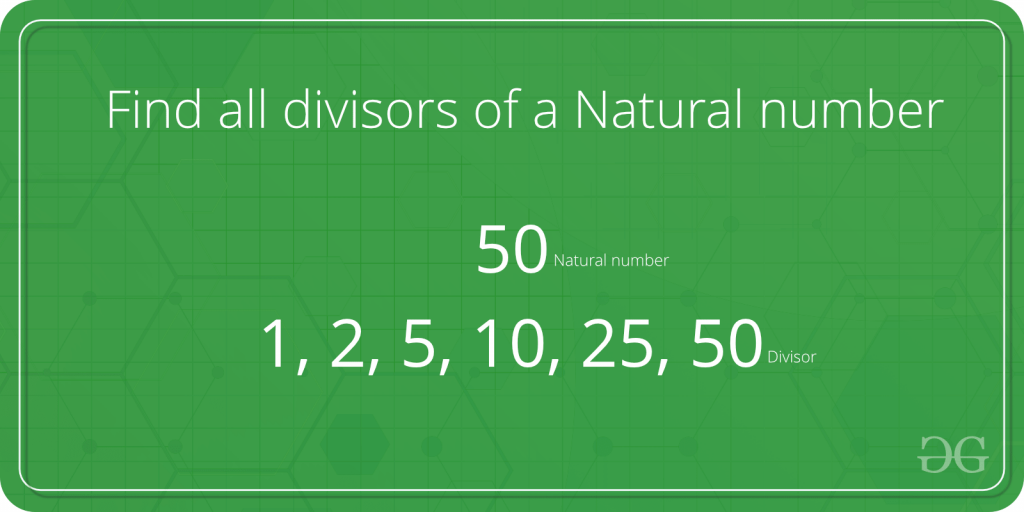
Given a natural number n, print all distinct divisors of it.
Examples:
 Input : n = 10
 Output: 1 2 5 10

 Input:  n = 100
 Output: 1 2 4 5 10 20 25 50 100

 Input:  n = 125
 Output: 1 5 25 125
Note that this problem is different from finding all prime factors.
A Naive Solution would be to iterate all the numbers from 1 to n, checking if that number divides n and printing it. Below is a program for the same:
C++
// C++ implementation of Naive
// method to print all divisors
#include <iostream>
using namespace std;

// Function to print the divisors
void printDivisors(int n)
{
    for (int i = 1; i <= n; i++)
        if (n % i == 0)
            cout <<" " << i;
}

// Driver code
int main()
{
    cout <<"The divisors of 100 are: ";
    printDivisors(100);
    return 0;
}

// This code is contributed by shivanisinghss2110
Output:
The divisors of 100 are:
1 2 4 5 10 20 25 50 100
Time Complexity : O(n)
Auxiliary Space : O(1)
Can we improve the above solution?
If we look carefully, all the divisors are present in pairs. For example if n = 100, then the various pairs of divisors are: (1,100), (2,50), (4,25), (5,20), (10,10)
Using this fact we could speed up our program significantly.
We, however, have to be careful if there are two equal divisors as in the case of (10, 10). In such case, we'd print only one of them.
Below is an implementation for the same:
C++
// A Better (than Naive) Solution
// to find all divisors
#include <iostream>
#include <math.h>
using namespace std;

// Function to print the divisors
void printDivisors(int n)
{
    // Note that this loop runs
    // till square root
    for (int i = 1; i <= sqrt(n); i++)
    {
        if (n % i == 0)
        {
            // If divisors are equal,
            // print only one
            if (n / i == i)
                cout <<" "<< i;

            // Otherwise print both
            else
                cout << " "<< i << " " << n / i;
        }
    }
}

// Driver code
int main()
{
    cout <<"The divisors of 100 are: ";
    printDivisors(100);
    return 0;
}

// This code is contributed by shivanisinghss2110
Output:
The divisors of 100 are:
1 100 2 50 4 25 5 20 10
Time Complexity: O(sqrt(n))
Auxiliary Space : O(1)
However there is still a minor problem in the solution, can you guess?
Yes! the output is not in a sorted fashion which we had got using the brute-force technique. Please refer below for an O(sqrt(n)) time solution that prints divisors in sorted order.
Find all divisors of a natural number | Set 2
Explore
C++ Basics
Core Concepts
OOP in C++
Standard Template Library(STL)
Practice & Problems