

Deep learning has transformed AI by enabling machines to learn from large amounts of data and perform complex tasks. This progress is supported by frameworks that provide the tools to build and train modern models.
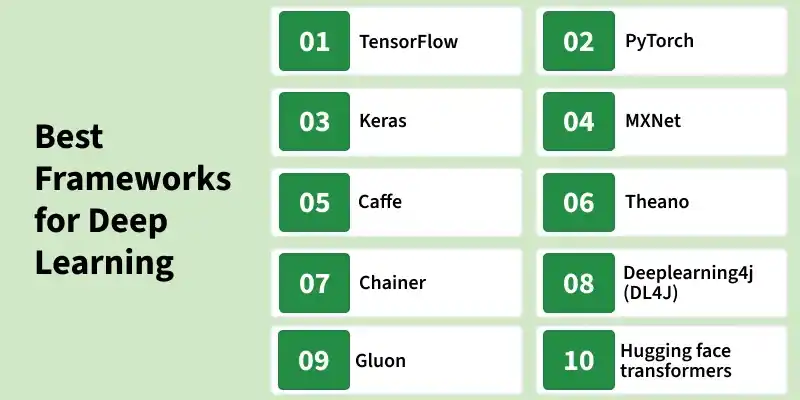
Popular Deep Learning Frameworks
1. TensorFlow
TensorFlow is a leading deep learning framework developed by Google. It offers flexibility, scalability and strong community support, making it suitable for both research and production applications.
- Capabilities: A Toolkit set for numerical computation, machine learning and deep learning which is diverse. Static graph computations and the possibility to deploy models on mobile devices is provided (The object is TensorFlow Lite).
- TensorBoard: Integrated visualization tool for model graphs, training curves and histograms of various metrics.
- Benefits: Communities having vast areas and well developed infrastructure, capable of being scaled up and remodel whenever it is required.
- Limitations: It is fair to say such complexity may not be suitable for the beginners often since it requires one to understand the low-level picture. The process of debugging a computation graph can be complicated.
2. PyTorch
PyTorch developed by Facebook’s AI Research lab (FAIR), is popular for its simplicity, flexibility and dynamic computation graph. Its intuitive and Python friendly design makes it ideal for research, experimentation and rapid prototyping.
- Capabilities: Flexible neural networks open up the door for fast implementation of the various prototypes. It is cleanly integrated with other commonly used scientific computing libraries of python such as (NumPy, SciPy).
- Dynamic Computation Graphs: Allows defining and modifying computation graphs on-the-fly during runtime.
- Benefits: It is accessible for research and development activities thanks to its agile nature and robust debugging capabilities Active research community.
- Limitations: Commonly used when developing dynamic web apps hence may not be as efficient as static frameworks in large deployments.
3. Keras
Keras now an integral part of TensorFlow, provides a high-level neural networks API that emphasizes ease of use and modularity. It allows for quick iteration and prototyping making it an excellent choice for beginners while also offering advanced features for building complex models.
- Capabilities: The API at the disposition of the user is related to the creation of deep learning models, which he/she can implement on the frameworks such as TensorFlow, PyTorch or MXNet. This API emphasizes the ease of use and quick exploration.
- Ease of Use: Offers a simple and intuitive interface for building neural networks.
- Benefits: Ensures code portability across various deep learning framework through machine learning and deep learning tools.
- Limitations: Doesn't support some of the better features and customization options provided in lower level frameworks.
4. MXNet
Backed by Apache Software Foundation, MXNet offers scalability and efficiency, particularly in distributed computing. Its hybrid frontend allows users to switch between imperative and symbolic programming paradigms, catering to diverse use cases across industries.
- Capabilities: Highly scalable and proficient code structure with the capability to work with more than one language (Python, R, Julia, etc. ). It enables distributed training and model deployment processes.
- Hybrid Frontend: Allows combining imperative and symbolic programming paradigms for increased flexibility.
- Benefits: It is the go-to framework for fast-paced AI tasks handling millions of data that come from various hardware set-ups. The applicability for systems like the mobile and embedded devices.
- Limitations: And when compare to TensorFlow or PyTorch, the community might be smaller and the resources might be lack.
5. Caffe
Caffe is known for its speed and efficiency, making it ideal for fast inference tasks. Though less flexible than newer frameworks, it offers simplicity and strong performance. Its Python interface supports training, pre-processing, feature extraction and network manipulation.
- Capabilities: Used in deep learning and convolutional neural networks (CNNs). Cloud computing delivers superior performance as well as its simple requirements.
- Speed and Efficiency: Known for its fast inference times and efficient memory usage.
- Benefits: Modern framework for neural networks with CNNs being focused on performance speed and efficiency. With deployable models becoming popular.
- Limitations: Limited in flexibility, they become less adaptable for sophisticated CNN models apart from CNNs. It appears that even if the development continued, it would likely cease in the past years.
6. Theano
Theano pioneered many concepts in deep learning and symbolic mathematics. Though its popularity has waned, its legacy lives on in the design of subsequent frameworks, showcasing its influence on the evolution of deep learning tools.
- Capabilities: Conventionally known for shallow machine learning activities, TensorFlow changes the game by using the deep learning technique and clean mathematical syntax.
- Symbolic Mathematics: Allows symbolic expression and optimization, facilitating efficient computation.
- Benefits: Valuable for educational and research tool for understanding the fundamentals of computation graphs, automatic differentiation and optimization in deep learning.
- Limitations: No longer under active development or maintenance, with limited community support and ecosystem resources.
7. Chainer
Chainer is known for its “define-by-run” approach, which allows neural networks to be built dynamically using normal coding style. Although it is not as popular as some other frameworks, its flexibility and ability to create models during execution make it useful for people who want a different way to work with deep learning.
- Capabilities: The framework can be adapted to create different structures while keeping an object-oriented design. Grants our possibility to do automatic differentiation.
- Define-by-Run Approach: Offers flexibility in defining neural networks on-the-fly.
- Benefits: More based on research because of its flexibility that makes it modifiable by the user.
- Limitations: Communities and resource pools that are smaller and more popular in contrast from other frameworks.
8. Deeplearning4j (DL4J)
DL4J is a Java-based framework designed for scalability and compatibility with JVM languages. Its focus on enterprise applications, distributed computing and integration with Hadoop and Spark makes it a suitable choice for industries relying on Java-based ecosystems.
- Capabilities: The framework is written in Java, its distributed deep learning is leveraged with Apache Spark.
- Integration with JVM: Suitable for Java-based applications and integrates well with JVM languages.
- Benefits: Java is an ideal platform as it provides an environment for the usage of deep learning models or integration with the Big Data pipelines.
- Limitations: Highly dependent on java language when most of the development takes place in python.
9. Gluon
Gluon, a deep learning interface by AWS and Microsoft, offers an abstraction that combines the ease of use of high-level APIs with the flexibility of low-level APIs. Its hybrid nature simplifies model building while allowing for fine-grained control when necessary.
- Capabilities: Ease of use and flexibility with top-level API Embedded deep learning by constructing MXNet framework. Combines the symbolic and imperative methodologies.
- Hybrid API: Provides a high-level interface for quick model building and a low-level API for fine-grained control.
- Benefits: Effective and scalable like MXNet has bigger API comparison to the Keras that is more user-friendly.
- Limitations: As MNIST is conveniently built on MXNet the community might be smaller and less resources compared to TensorFlow and PyTorch.
10. Hugging Face Transformers
Hugging Face Transformers focuses on transformer-based models, especially for NLP and multimodal tasks. It simplifies building, training and deploying large models, while still allowing integration with low-level frameworks for more control.
- Capabilities: Ease of use through high-level APIs such as Pipelines and Trainers, with flexibility to directly access and customize underlying PyTorch, TensorFlow or JAX components.
- Model-Centric / Unified API: Emphasizes a model-centric design where pre-trained models and standardized interfaces are the core building blocks, enabling rapid prototyping, fine-tuning and experimentation without extensive boilerplate code.
- Benefits: Dramatically reduces development time by leveraging large pre-trained models and a standardized workflow.
- Limitations: Primarily optimized for transformer architectures, making it less suitable for highly customized or non-transformer deep learning models.