
Databases are the backbone of modern organizations, storing critical information such as customer records, financial transactions, research data, and other valuable assets. As the volume and sensitivity of stored data increase, so do the risks of threats and attacks.
Note: Database security refers to the protection of data against unauthorized access, misuse, corruption or loss, while maintaining its confidentiality, integrity and availability.
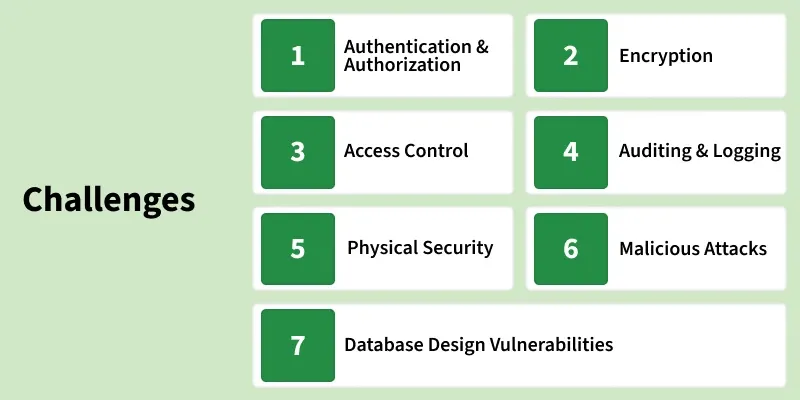
Authentication and Authorization
One of the primary challenges in database security is ensuring that only authorized users have access to the system.
- Authentication verifies the identity of users (e.g., through usernames, passwords, biometrics or multi - factor authentication).
- Authorization grants appropriate privileges to users based on their roles and responsibilities.
Note: Failure to implement strong authentication and authorization can result in unauthorized access and data breaches.
Encryption
Encryption protects sensitive data both in transit (when being transmitted across networks) and at rest (when stored in the database). While encryption is an effective measure, it also introduces challenges:
- Securely managing and storing encryption keys.
- Ensuring that performance is not heavily impacted.
- Preventing data from being decrypted or intercepted by attackers.
Access Control
Access control ensures that users can only access the data and resources necessary for their tasks. Implementing effective access control is difficult because:
- Overly restrictive controls may hinder productivity.
- Weak or misconfigured access controls may lead to unauthorized data exposure.
- Fine - grained access policies must be maintained and updated as roles and responsibilities evolve.
Auditing and Logging
Maintaining an audit trail of all database activities is essential for monitoring and forensic analysis. Logging includes tracking who accessed the database, what data was used and when the activity occurred. Challenges include:
- Handling large volumes of logs in enterprise databases.
- Securing logs against tampering.
- Analyzing and interpreting log data to detect suspicious activities.
Database Design Vulnerabilities
A poorly designed database can introduce security flaws such as:
- SQL injection attacks due to insecure query handling.
- Improper normalization or schema design leading to data leaks.
- Inadequate indexing and constraints causing data integrity issues.
Malicious Attacks
Databases are a prime target for cybercriminals. Common attacks include:
- Hacking and malware infections to steal or corrupt data.
- Phishing attacks that trick users into giving credentials.
- Denial of Service (DoS) attacks to make databases unavailable.
Note: Protecting against these attacks requires continuous monitoring, firewalls, intrusion detection systems and timely patching.
Physical Security
Even with strong software security, databases are vulnerable if attackers gain physical access to servers. Risks include:
- Theft of storage devices.
- Tampering with servers.
- Power outages or natural disasters.
Note: Thus, physical access must be strictly controlled through secure server rooms, surveillance and backup power systems.
Features to Enhance Database Security
- Backup and Recovery: Regular backups ensure data can be restored in case of breaches, corruption or system failures.
- Role - Based Access Controls (RBAC): Restrict actions based on user roles to prevent unauthorized operations.
- Auditing and Testing Tools: Monitor database activities and identify vulnerabilities.
- Data Masking: Hide sensitive information when accessed by third parties, reducing exposure.
Read related article - How to store a password in database?