
Given a positive integer N, the task is to find the largest and smallest elements, from the maximum leaf nodes of every possible binary max-heap formed by taking the first N natural numbers as the nodes' value of the binary max-heap.
Examples:
Input: N = 2
Output: 1 1
Explanation:
There is only one maximum binary heap with the nodes {1, 2}:
In the above tree, maximum leaf node value = 1.
Therefore, the largest element is 1 and the smallest element is also 1.Input: N = 3
Output: 2 2
Explanation:
There are two possible maximum binary heaps with the nodes {1, 2, 3}:
The maximum leaf nodes of first and second heaps are 2 and 2 respectively.
Therefore, the largest element is 2 and the smallest element is also 2.
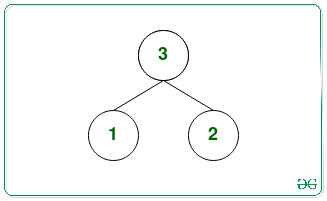
Naive Approach: The simplest approach is to generate all possible max binary heaps that can be formed from first N natural numbers and keep track of the smallest and largest leaf node values among all the maximum leaf nodes in all the heaps.
Time Complexity: O(N*N!)
Auxiliary Space: O(1)
Efficient Approach: The above approach can be optimized based on the following observations:
- The max heap is a complete binary tree, therefore, the height and count of the number of leaf nodes are fixed.
- In the max heap, the value of the node is always greater than or equal to the children of that node.
- The maximum leaf node value is always greater than or equal to the number of leaves in the tree. Therefore, the maximum value of a leaf node will be minimized if the smallest numbers are placed at the leaf nodes. And will be equal to the number of leaves node.
- One more property of the max heaps is as one will go down the tree the values of nodes decrease. Therefore, the maximum value of a node will be maximized if a number is placed at the leaf node with the least possible depth. So if D is the depth of that node then the maximum possible value of the node will be equal to the N-D.
- If D is the depth of the max Heap then the possible Depths of the leaf nodes are D and D-1 only, as the heaps are the complete binary tree.
- If V is a leaf node then (2*V) must be greater than N. Therefore, the count of leaf nodes is equal to the, (N - N/2).
Follow the steps below to solve the problem:
- Calculate the count of leaf nodes in the max heap of N nodes, as discussed above, and store it in a variable say numberOfleaves.
numberOfleaves = (N- N/2).
- Find the depth of the max heap and store it in a variable say D.
D = ceil(log2(N+1))-1
- If N+1 is not a power of 2 and D is greater than 1, then there must exit a leaf node at depth D-1. Therefore, then decrement D by 1.
- Finally, after completing the above steps, print the largest value as (N-D) and the smallest value as numberOfleaves.
Below is the implementation of the above approach:
// C++ program for the above approach
#include <bits/stdc++.h>
using namespace std;

// Function to find largest and smallest
// elements from the maximum leaf nodes
// values from all possible binary max heap
void leafNodeValues(int N)
{
    // Stores count of leaf nodes
    int numberOfLeaves = (N - N / 2);

    // Stores minDepth with N
    int minDepth = ceil(log2(N + 1)) - 1;

    // Increment N by 1
    N++;
    // If N is not power of 2 and minDepth
    // is greater than 1
    if (minDepth > 1 && (N & (N - 1)))
        minDepth--;

    // Print the smallest and largest possible
    // value of a leaf node
    cout << numberOfLeaves << ' '
         << N - minDepth - 1;
}

// Driver Code
int main()
{
    // Given Input
    int N = 2;

    // Function Call
    leafNodeValues(N);

    return 0;
}
// Java program for the above approach
class GFG{

// Function to find largest and smallest
// elements from the maximum leaf nodes
// values from all possible binary max heap
static void leafNodeValues(int N)
{

    // Stores count of leaf nodes
    int numberOfLeaves = (N - N / 2);

    // Stores minDepth with N
    int minDepth = (int)Math.ceil(Math.log(N + 1) /
                                  Math.log(2)) - 1;

    // Increment N by 1
    N++;

    // If N is not power of 2 and minDepth
    // is greater than 1
    if (minDepth > 1 && (N & (N - 1)) != 0)
        minDepth--;

    // Print the smallest and largest possible
    // value of a leaf node
    System.out.println(numberOfLeaves + " " +
                      (N - minDepth - 1));
}

// Driver code
public static void main(String[] args)
{

    // Given Input
    int N = 2;

    // Function Call
    leafNodeValues(N);
}
}

// This code is contributed by divyesh072019
# Python 3 program for the above approach
from math import ceil,log2

# Function to find largest and smallest
# elements from the maximum leaf nodes
# values from all possible binary max heap
def leafNodeValues(N):

    # Stores count of leaf nodes
    numberOfLeaves = (N - N // 2)

    # Stores minDepth with N
    minDepth = ceil(log2(N + 1)) - 1;

    # Increment N by 1
    N += 1

    # If N is not power of 2 and minDepth
    # is greater than 1
    if (minDepth > 1 and (N & (N - 1))):
        minDepth -= 1

    # Print the smallest and largest possible
    # value of a leaf node
    print(numberOfLeaves, N - minDepth - 1)

# Driver Code
if __name__ == '__main__':
    # Given Input
    N = 2

    # Function Call
    leafNodeValues(N)

    # This code is contributed by SURENDRA_GANGWAR.
// C# program for the above approach
using System;
class GFG {

    // Function to find largest and smallest
    // elements from the maximum leaf nodes
    // values from all possible binary max heap
    static void leafNodeValues(int N)
    {

        // Stores count of leaf nodes
        int numberOfLeaves = (N - N / 2);

        // Stores minDepth with N
        int minDepth = (int)Math.Ceiling(Math.Log(N + 1) /
                                      Math.Log(2)) - 1;

        // Increment N by 1
        N++;

        // If N is not power of 2 and minDepth
        // is greater than 1
        if (minDepth > 1 && (N & (N - 1)) != 0)
            minDepth--;

        // Print the smallest and largest possible
        // value of a leaf node
        Console.WriteLine(numberOfLeaves + " " +
                          (N - minDepth - 1));
    }

  static void Main()
  {

    // Given Input
    int N = 2;

    // Function Call
    leafNodeValues(N);
  }
}

// This code is contributed by decode2207.
 <script>

// JavaScript program for the above approach

// Function to find largest and smallest
// elements from the maximum leaf nodes
// values from all possible binary max heap
function log2(n)
 {
   return (Math.log(n)/Math.log(2));
 }
function leafNodeValues(N)
{
    // Stores count of leaf nodes
    let numberOfLeaves = parseInt((N - N / 2));

    // Stores minDepth with N
    let minDepth = Math.ceil(log2(N + 1)) - 1;

    // Increment N by 1
    N++;
    // If N is not power of 2 and minDepth
    // is greater than 1
    if ((minDepth > 1) && (N & (N - 1)))
        minDepth--;

    // Print the smallest and largest possible
    // value of a leaf node
    document.write(numberOfLeaves);
    document.write(' ');
    document.write( N - minDepth - 1);
}

// Driver Code

    // Given Input
    var N = 2;

    // Function Call
    leafNodeValues(N);

// This code is contributed by Potta Lokesh

</script>
Output:
1 1
Time Complexity: O(log(N))
Auxiliary Space: O(1)