

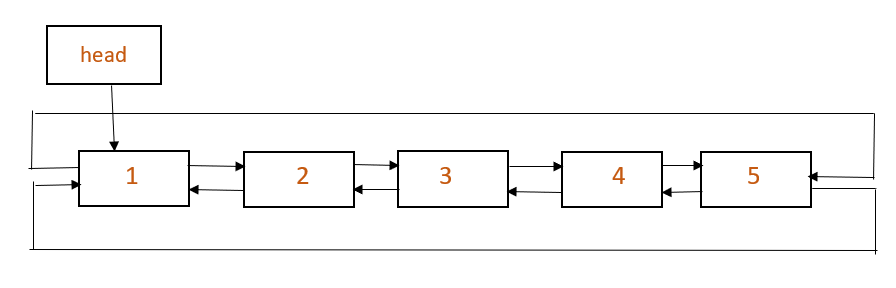
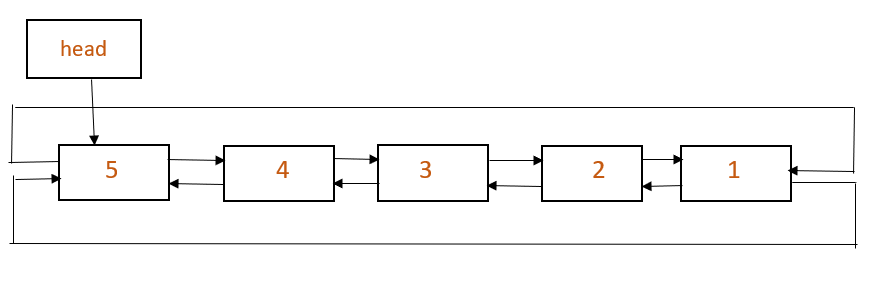
The problem is to reverse the given doubly circular linked list.
Examples:
Input:
Output:
Algorithm:
insertEnd(head, new_node)
    Declare last

    if head == NULL then
        new_node->next = new_node->prev = new_node
        head = new_node
        return

    last = head->prev
    new_node->next = head
    head->prev = new_node
    new_node->prev = last
    last->next = new_node

reverse(head)
    Initialize new_head = NULL
    Declare last

    last = head->prev
    Initialize curr = last, prev

    while curr->prev != last
        prev = curr->prev
        insertEnd(&new_head, curr)
        curr = prev
    insertEnd(&new_head, curr)

    return new_head
Explanation: The variable head in the parameter list of insertEnd() is a pointer to a pointer variable. reverse() traverses the doubly circular linked list starting with the head pointer in the backward direction and one by one gets the node in the traversal. It inserts those nodes at the end of the list that starts with the new_head pointer with the help of the function insertEnd() and finally returns the new_head.
Implementation:
// C++ implementation to reverse a
// doubly circular linked list
#include <bits/stdc++.h>

using namespace std;

// structure of a node of linked list
struct Node {
    int data;
    Node *next, *prev;
};

// function to create and return a new node
Node* getNode(int data)
{
    Node* newNode = (Node*)malloc(sizeof(Node));
    newNode->data = data;
    return newNode;
}

// Function to insert at the end
void insertEnd(Node** head, Node* new_node)
{
    // If the list is empty, create a single node
    // circular and doubly list
    if (*head == NULL) {
        new_node->next = new_node->prev = new_node;
        *head = new_node;
        return;
    }

    // If list is not empty

    /* Find last node */
    Node* last = (*head)->prev;

    // Start is going to be next of new_node
    new_node->next = *head;

    // Make new node previous of start
    (*head)->prev = new_node;

    // Make last previous of new node
    new_node->prev = last;

    // Make new node next of old last
    last->next = new_node;
}

// Utility function to reverse a
// doubly circular linked list
Node* reverse(Node* head)
{
    if (!head)
        return NULL;

    // Initialize a new head pointer
    Node* new_head = NULL;

    // get pointer to the last node
    Node* last = head->prev;

    // set 'curr' to last node
    Node *curr = last, *prev;

    // traverse list in backward direction
    while (curr->prev != last) {
        prev = curr->prev;

        // insert 'curr' at the end of the list
        // starting with the 'new_head' pointer
        insertEnd(&new_head, curr);
        curr = prev;
    }
    insertEnd(&new_head, curr);

    // head pointer of the reversed list
    return new_head;
}

// function to display a doubly circular list in
// forward and backward direction
void display(Node* head)
{
    if (!head)
        return;

    Node* temp = head;

    cout << "Forward direction: ";
    while (temp->next != head) {
        cout << temp->data << " ";
        temp = temp->next;
    }
    cout << temp->data;

    Node* last = head->prev;
    temp = last;

    cout << "\nBackward direction: ";
    while (temp->prev != last) {
        cout << temp->data << " ";
        temp = temp->prev;
    }
    cout << temp->data;
}

// Driver program to test above
int main()
{
    Node* head = NULL;

    insertEnd(&head, getNode(1));
    insertEnd(&head, getNode(2));
    insertEnd(&head, getNode(3));
    insertEnd(&head, getNode(4));
    insertEnd(&head, getNode(5));

    cout << "Current list:\n";
    display(head);

    head = reverse(head);

    cout << "\n\nReversed list:\n";
    display(head);

    return 0;
}
// Java implementation to reverse a
// doubly circular linked list
class GFG
{

// structure of a node of linked list
static class Node
{
    int data;
    Node next, prev;
};

// function to create and return a new node
static Node getNode(int data)
{
    Node newNode = new Node();
    newNode.data = data;
    return newNode;
}

// Function to insert at the end
static Node insertEnd(Node head, Node new_node)
{
    // If the list is empty, create a single node
    // circular and doubly list
    if (head == null)
    {
        new_node.next = new_node.prev = new_node;
        head = new_node;
        return head;
    }

    // If list is not empty

    // Find last node /
    Node last = (head).prev;

    // Start is going to be next of new_node
    new_node.next = head;

    // Make new node previous of start
    (head).prev = new_node;

    // Make last previous of new node
    new_node.prev = last;

    // Make new node next of old last
    last.next = new_node;
    return head;
}

// Utility function to reverse a
// doubly circular linked list
static Node reverse(Node head)
{
    if (head==null)
        return null;

    // Initialize a new head pointer
    Node new_head = null;

    // get pointer to the last node
    Node last = head.prev;

    // set 'curr' to last node
    Node curr = last, prev;

    // traverse list in backward direction
    while (curr.prev != last)
    {
        prev = curr.prev;

        // insert 'curr' at the end of the list
        // starting with the 'new_head' pointer
        new_head=insertEnd(new_head, curr);
        curr = prev;
    }
    new_head=insertEnd(new_head, curr);

    // head pointer of the reversed list
    return new_head;
}

// function to display a doubly circular list in
// forward and backward direction
static void display(Node head)
{
    if (head==null)
        return;

    Node temp = head;

    System.out.print( "Forward direction: ");
    while (temp.next != head)
    {
        System.out.print( temp.data + " ");
        temp = temp.next;
    }
        System.out.print( temp.data + " ");

    Node last = head.prev;
    temp = last;

    System.out.print( "\nBackward direction: ");
    while (temp.prev != last)
    {
        System.out.print( temp.data + " ");
        temp = temp.prev;
    }
        System.out.print( temp.data + " ");
}

// Driver code
public static void main(String args[])
{
    Node head = null;

    head =insertEnd(head, getNode(1));
    head =insertEnd(head, getNode(2));
    head =insertEnd(head, getNode(3));
    head =insertEnd(head, getNode(4));
    head =insertEnd(head, getNode(5));

    System.out.print( "Current list:\n");
    display(head);

    head = reverse(head);

    System.out.print( "\n\nReversed list:\n");
    display(head);
}
}

// This code is contributed by Arnab Kundu
# Python3 implementation to reverse a
# doubly circular linked list
import math

# structure of a node of linked list
class Node:
    def __init__(self, data):
        self.data = data
        self.next = None

# function to create and return a new node
def getNode(data):
    newNode = Node(data)
    newNode.data = data
    return newNode

# Function to insert at the end
def insertEnd(head, new_node):

    # If the list is empty, create a single node
    # circular and doubly list
    if (head == None) :
        new_node.next = new_node
        new_node.prev = new_node
        head = new_node
        return head

    # If list is not empty

    # Find last node
    last = head.prev

    # Start is going to be next of new_node
    new_node.next = head

    # Make new node previous of start
    head.prev = new_node

    # Make last previous of new node
    new_node.prev = last

    # Make new node next of old last
    last.next = new_node
    return head

# Utility function to reverse a
# doubly circular linked list
def reverse(head):
    if (head == None):
        return None

    # Initialize a new head pointer
    new_head = None

    # get pointer to the last node
    last = head.prev

    # set 'curr' to last node
    curr = last
    #*prev

    # traverse list in backward direction
    while (curr.prev != last):
        prev = curr.prev

        # insert 'curr' at the end of the list
        # starting with the 'new_head' pointer
        new_head = insertEnd(new_head, curr)
        curr = prev

    new_head = insertEnd(new_head, curr)

    # head pointer of the reversed list
    return new_head

# function to display a doubly circular list in
# forward and backward direction
def display(head):
    if (head == None):
        return

    temp = head

    print("Forward direction: ", end = "")
    while (temp.next != head):
        print(temp.data, end = " ")
        temp = temp.next

    print(temp.data)

    last = head.prev
    temp = last

    print("Backward direction: ", end = "")
    while (temp.prev != last):
        print(temp.data, end = " ")
        temp = temp.prev

    print(temp.data)

# Driver Code
if __name__=='__main__':

    head = None

    head = insertEnd(head, getNode(1))
    head = insertEnd(head, getNode(2))
    head = insertEnd(head, getNode(3))
    head = insertEnd(head, getNode(4))
    head = insertEnd(head, getNode(5))

    print("Current list:")
    display(head)

    head = reverse(head)

    print("\nReversed list:")
    display(head)

# This code is contributed by Srathore
// C# implementation to reverse a
// doubly circular linked list
using System;

class GFG
{

// structure of a node of linked list
public class Node
{
    public int data;
    public Node next, prev;
};

// function to create and return a new node
static Node getNode(int data)
{
    Node newNode = new Node();
    newNode.data = data;
    return newNode;
}

// Function to insert at the end
static Node insertEnd(Node head, Node new_node)
{
    // If the list is empty, create a single node
    // circular and doubly list
    if (head == null)
    {
        new_node.next = new_node.prev = new_node;
        head = new_node;
        return head;
    }

    // If list is not empty

    // Find last node /
    Node last = (head).prev;

    // Start is going to be next of new_node
    new_node.next = head;

    // Make new node previous of start
    (head).prev = new_node;

    // Make last previous of new node
    new_node.prev = last;

    // Make new node next of old last
    last.next = new_node;
    return head;
}

// Utility function to reverse a
// doubly circular linked list
static Node reverse(Node head)
{
    if (head == null)
        return null;

    // Initialize a new head pointer
    Node new_head = null;

    // get pointer to the last node
    Node last = head.prev;

    // set 'curr' to last node
    Node curr = last, prev;

    // traverse list in backward direction
    while (curr.prev != last)
    {
        prev = curr.prev;

        // insert 'curr' at the end of the list
        // starting with the 'new_head' pointer
        new_head=insertEnd(new_head, curr);
        curr = prev;
    }
    new_head=insertEnd(new_head, curr);

    // head pointer of the reversed list
    return new_head;
}

// function to display a doubly circular list in
// forward and backward direction
static void display(Node head)
{
    if (head == null)
        return;

    Node temp = head;

    Console.Write( "Forward direction: ");
    while (temp.next != head)
    {
        Console.Write( temp.data + " ");
        temp = temp.next;
    }
        Console.Write( temp.data + " ");

    Node last = head.prev;
    temp = last;

    Console.Write( "\nBackward direction: ");
    while (temp.prev != last)
    {
        Console.Write( temp.data + " ");
        temp = temp.prev;
    }
        Console.Write( temp.data + " ");
}

// Driver code
public static void Main(String []args)
{
    Node head = null;

    head = insertEnd(head, getNode(1));
    head = insertEnd(head, getNode(2));
    head = insertEnd(head, getNode(3));
    head = insertEnd(head, getNode(4));
    head = insertEnd(head, getNode(5));

    Console.Write( "Current list:\n");
    display(head);

    head = reverse(head);

    Console.Write( "\n\nReversed list:\n");
    display(head);
}
}

// This code contributed by Rajput-Ji
<script>

      // JavaScript implementation to reverse a
      // doubly circular linked list
      // structure of a node of linked list
      class Node {
        constructor() {
          this.data = 0;
          this.next = null;
          this.prev = null;
        }
      }

      // function to create and return a new node
      function getNode(data) {
        var newNode = new Node();
        newNode.data = data;
        return newNode;
      }

      // Function to insert at the end
      function insertEnd(head, new_node) {
        // If the list is empty, create a single node
        // circular and doubly list
        if (head == null) {
          new_node.next = new_node.prev = new_node;
          head = new_node;
          return head;
        }

        // If list is not empty

        // Find last node /
        var last = head.prev;

        // Start is going to be next of new_node
        new_node.next = head;

        // Make new node previous of start
        head.prev = new_node;

        // Make last previous of new node
        new_node.prev = last;

        // Make new node next of old last
        last.next = new_node;
        return head;
      }

      // Utility function to reverse a
      // doubly circular linked list
      function reverse(head) {
        if (head == null) return null;

        // Initialize a new head pointer
        var new_head = null;

        // get pointer to the last node
        var last = head.prev;

        // set 'curr' to last node
        var curr = last,
          prev;

        // traverse list in backward direction
        while (curr.prev != last) {
          prev = curr.prev;

          // insert 'curr' at the end of the list
          // starting with the 'new_head' pointer
          new_head = insertEnd(new_head, curr);
          curr = prev;
        }
        new_head = insertEnd(new_head, curr);

        // head pointer of the reversed list
        return new_head;
      }

      // function to display a doubly circular list in
      // forward and backward direction
      function display(head) {
        if (head == null) return;

        var temp = head;

        document.write("Forward direction: ");
        while (temp.next != head) {
          document.write(temp.data + " ");
          temp = temp.next;
        }
        document.write(temp.data + " ");

        var last = head.prev;
        temp = last;

        document.write("<br>Backward direction: ");
        while (temp.prev != last) {
          document.write(temp.data + " ");
          temp = temp.prev;
        }
        document.write(temp.data + " ");
      }

      // Driver code
      var head = null;

      head = insertEnd(head, getNode(1));
      head = insertEnd(head, getNode(2));
      head = insertEnd(head, getNode(3));
      head = insertEnd(head, getNode(4));
      head = insertEnd(head, getNode(5));

      document.write("Current list:<br>");
      display(head);

      head = reverse(head);

      document.write("<br><br>Reversed list:<br>");
      display(head);

</script>
Output
Current list:
Forward direction: 1 2 3 4 5
Backward direction: 5 4 3 2 1

Reversed list:
Forward direction: 5 4 3 2 1
Backward direction: 1 2 3 4 5
Complexity Analysis:
- Time Complexity: O(n), as we are using a loop to traverse n times. Where n is the number of nodes in the linked list.
- Auxiliary Space: O(1), as we are not using any extra space.