

Given an integer k and a matrix mat[][] of size m x n, left rotate every row by k in a circular fashion.
Examples:
Input: k = 1, mat[][] = [[1, 2, 3], [4, 5, 6], [7, 8, 9]]
Output: [[2, 3, 1], [5, 6, 4], [8, 9, 7]]
Explanation: Each row is rotated left by one position.Input: k = 2, mat[][] = [[1, 2, 3], [4, 5, 6], [7, 8, 9]]
Output: [[3, 1, 2], [6, 4, 5], [9, 7, 8]]
Explanation: Each row is rotated left by two positions.

Table of Content
[Naive Approach] Rotate Each Row One Step at a Time - O(m * n * k) Time and O(1) Space
The idea is to rotate every row left by one position, k times. In each rotation, shift the elements left and place the first element at the end.
Working of Approach:
- Find the number of rows m and columns n.
- Reduce k using k %= n.
- Traverse every row of the matrix.
- Rotate each row left by one position, k times.
- Return the updated matrix.
#include <iostream>
#include <vector>
using namespace std;

vector<vector<int>> rotateMatrix(int k, vector<vector<int>> mat)
{

    // Get the matrix dimensions.
    int m = mat.size();
    int n = mat[0].size();

    // Reduce k to avoid unnecessary rotations.
    k %= n;

    // Traverse every row.
    for (int i = 0; i < m; i++)
    {

        // Rotate the current row k times.
        for (int rotation = 0; rotation < k; rotation++)
        {

            // Store the first element of the row.
            int first = mat[i][0];

            // Shift all elements one position to the left.
            for (int j = 0; j < n - 1; j++)
            {
                mat[i][j] = mat[i][j + 1];
            }

            // Place the first element at the end.
            mat[i][n - 1] = first;
        }
    }

    // Return the rotated matrix.
    return mat;
}

int main()
{
    int k = 2;

    vector<vector<int>> mat = {{1, 2, 3}, {4, 5, 6}, {7, 8, 9}};

    vector<vector<int>> ans = rotateMatrix(k, mat);

    cout << "[";

    for (int i = 0; i < ans.size(); i++)
    {
        cout << "[";

        for (int j = 0; j < ans[i].size(); j++)
        {
            cout << ans[i][j];

            if (j + 1 < ans[i].size())
            {
                cout << ", ";
            }
        }

        cout << "]";

        if (i + 1 < ans.size())
        {
            cout << ", ";
        }
    }

    cout << "]" << endl;

    return 0;
}
class GFG {

    public int[][] rotateMatrix(int k, int[][] mat)
    {

        int m = mat.length;
        int n = mat[0].length;

        k %= n;

        for (int i = 0; i < m; i++) {
            for (int rotation = 0; rotation < k;
                 rotation++) {

                int first = mat[i][0];

                for (int j = 0; j < n - 1; j++) {
                    mat[i][j] = mat[i][j + 1];
                }

                mat[i][n - 1] = first;
            }
        }

        return mat;
    }

    public static void main(String[] args)
    {

        int k = 2;
        int[][] mat
            = { { 1, 2, 3 }, { 4, 5, 6 }, { 7, 8, 9 } };

        GFG obj = new GFG();
        int[][] ans = obj.rotateMatrix(k, mat);

        System.out.println(
            java.util.Arrays.deepToString(ans));
    }
}
def rotateMatrix(k, mat):

    # Get the matrix dimensions.
    m = len(mat)
    n = len(mat[0])

    # Reduce k to avoid unnecessary rotations.
    k %= n

    # Traverse every row.
    for i in range(m):

        # Rotate the current row k times.
        for rotation in range(k):

            # Store the first element of the row.
            first = mat[i][0]

            # Shift all elements one position to the left.
            for j in range(n - 1):
                mat[i][j] = mat[i][j + 1]

            # Place the first element at the end.
            mat[i][n - 1] = first

    # Return the rotated matrix.
    return mat


if __name__ == "__main__":

    k = 2

    mat = [
        [1, 2, 3],
        [4, 5, 6],
        [7, 8, 9]
    ]

    ans = rotateMatrix(k, mat)

    print(ans)
using System;

class GFG {
    public int[][] rotateMatrix(int k, int[][] mat)
    {
        int m = mat.Length;
        int n = mat[0].Length;

        k %= n;

        for (int i = 0; i < m; i++) {
            for (int rotation = 0; rotation < k;
                 rotation++) {
                int first = mat[i][0];

                for (int j = 0; j < n - 1; j++) {
                    mat[i][j] = mat[i][j + 1];
                }

                mat[i][n - 1] = first;
            }
        }

        return mat;
    }

    public static void Main(string[] args)
    {
        int k = 2;

        int[][] mat = { new int[] { 1, 2, 3 },
                        new int[] { 4, 5, 6 },
                        new int[] { 7, 8, 9 } };

        GFG obj = new GFG();
        int[][] ans = obj.rotateMatrix(k, mat);

        Console.Write("[");

        for (int i = 0; i < ans.Length; i++) {
            Console.Write("[");

            for (int j = 0; j < ans[i].Length; j++) {
                Console.Write(ans[i][j]);

                if (j < ans[i].Length - 1)
                    Console.Write(", ");
            }

            Console.Write("]");

            if (i < ans.Length - 1)
                Console.Write(", ");
        }

        Console.WriteLine("]");
    }
}
function rotateMatrix(k, mat)
{

    // Get the matrix dimensions.
    const m = mat.length;
    const n = mat[0].length;

    // Reduce k to avoid unnecessary rotations.
    k %= n;

    // Traverse every row.
    for (let i = 0; i < m; i++) {

        // Rotate the current row k times.
        for (let rotation = 0; rotation < k; rotation++) {

            // Store the first element of the row.
            const first = mat[i][0];

            // Shift all elements one position to the left.
            for (let j = 0; j < n - 1; j++) {
                mat[i][j] = mat[i][j + 1];
            }

            // Place the first element at the end.
            mat[i][n - 1] = first;
        }
    }

    // Return the rotated matrix.
    return mat;
}

// Driver Code
const k = 2;

const mat = [ [ 1, 2, 3 ], [ 4, 5, 6 ], [ 7, 8, 9 ] ];

const ans = rotateMatrix(k, mat);

console.log(JSON.stringify(ans).replace("],", "],\n"));
Output
[[3, 1, 2], [6, 4, 5], [9, 7, 8]]
[Expected Approach] Using Direct Circular Rotation - O(m * n) Time and O(m * n) Space
The idea is to directly calculate the new position of every element after rotating the row left by k positions using circular indexing. Store the elements at their calculated positions in a new matrix.
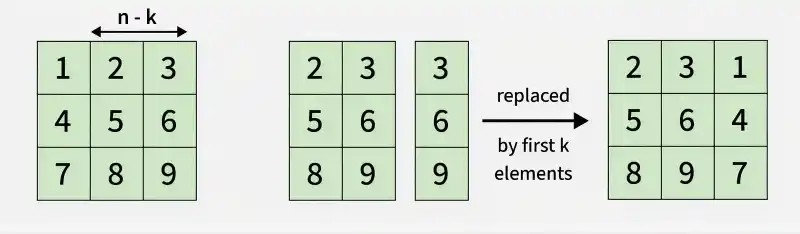
Working of Approach:
- Find the number of rows m and columns n.
- Reduce k using k %= n.
- Create a result matrix of the same size.
- For every element, calculate its new column using circular indexing.
- Place the element at its new position and return the result.
Let us understand with an example:
Input: k = 2, mat[][] = [[1, 2, 3], [4, 5, 6], [7, 8, 9]]
- Since each row has n = 3 elements, k %= n gives k = 2.
- For the first row, newCol = (j - k + n) % n, so [1, 2, 3] becomes [3, 1, 2].
- Similarly, [4, 5, 6] becomes [6, 4, 5] and [7, 8, 9] becomes [9, 7, 8].
- Output: [[3, 1, 2], [6, 4, 5], [9, 7, 8]].
#include <iostream>
#include <vector>
using namespace std;

vector<vector<int>> rotateMatrix(int k, vector<vector<int>> mat)
{

    // Get the matrix dimensions.
    int m = mat.size();
    int n = mat[0].size();

    // Reduce k to avoid unnecessary rotations.
    k %= n;

    // Create the rotated matrix.
    vector<vector<int>> res(m, vector<int>(n));

    // Rotate every row to the left by k positions.
    for (int i = 0; i < m; i++)
    {
        for (int j = 0; j < n; j++)
        {
            int newCol = (j - k + n) % n;
            res[i][newCol] = mat[i][j];
        }
    }

    // Return the rotated matrix.
    return res;
}

int main()
{
    int k = 2;

    vector<vector<int>> mat = {{1, 2, 3}, {4, 5, 6}, {7, 8, 9}};

    vector<vector<int>> ans = rotateMatrix(k, mat);

    cout << "[";

    for (int i = 0; i < ans.size(); i++)
    {
        cout << "[";

        for (int j = 0; j < ans[i].size(); j++)
        {
            cout << ans[i][j];

            if (j + 1 < ans[i].size())
            {
                cout << ", ";
            }
        }

        cout << "]";

        if (i + 1 < ans.size())
        {
            cout << ", ";
        }
    }

    cout << "]" << endl;

    return 0;
}
import java.util.Arrays;

class GFG {

    public int[][] rotateMatrix(int k, int[][] mat)
    {

        // Get the matrix dimensions.
        int m = mat.length;
        int n = mat[0].length;

        // Reduce k to avoid unnecessary rotations.
        k %= n;

        // Create the rotated matrix.
        int[][] res = new int[m][n];

        // Rotate every row to the left by k positions.
        for (int i = 0; i < m; i++) {
            for (int j = 0; j < n; j++) {
                int newCol = (j - k + n) % n;
                res[i][newCol] = mat[i][j];
            }
        }

        // Return the rotated matrix.
        return res;
    }

    public static void main(String[] args)
    {

        int k = 2;

        int[][] mat
            = { { 1, 2, 3 }, { 4, 5, 6 }, { 7, 8, 9 } };

        GFG obj = new GFG();
        int[][] ans = obj.rotateMatrix(k, mat);

        System.out.println(Arrays.deepToString(ans));
    }
}
def rotateMatrix(k, mat):

    # Get the matrix dimensions.
    m = len(mat)
    n = len(mat[0])

    # Reduce k to avoid unnecessary rotations.
    k %= n

    # Create the rotated matrix.
    res = [[0] * n for _ in range(m)]

    # Rotate every row to the left by k positions.
    for i in range(m):
        for j in range(n):
            newCol = (j - k + n) % n
            res[i][newCol] = mat[i][j]

    # Return the rotated matrix.
    return res


if __name__ == "__main__":

    k = 2

    mat = [
        [1, 2, 3],
        [4, 5, 6],
        [7, 8, 9]
    ]

    ans = rotateMatrix(k, mat)

    print(ans)
using System;

class GFG {
    public int[][] rotateMatrix(int k, int[][] mat)
    {
        // Get the matrix dimensions.
        int m = mat.Length;
        int n = mat[0].Length;

        // Reduce k to avoid unnecessary rotations.
        k %= n;

        // Create the rotated matrix.
        int[][] res = new int[m][];

        for (int i = 0; i < m; i++) {
            res[i] = new int[n];
        }

        // Rotate every row to the left by k positions.
        for (int i = 0; i < m; i++) {
            for (int j = 0; j < n; j++) {
                int newCol = (j - k + n) % n;
                res[i][newCol] = mat[i][j];
            }
        }

        // Return the rotated matrix.
        return res;
    }

    public static void Main(string[] args)
    {
        int k = 2;

        int[][] mat = { new int[] { 1, 2, 3 },
                        new int[] { 4, 5, 6 },
                        new int[] { 7, 8, 9 } };

        GFG obj = new GFG();
        int[][] ans = obj.rotateMatrix(k, mat);

        Console.Write("[");

        for (int i = 0; i < ans.Length; i++) {
            Console.Write("[");

            for (int j = 0; j < ans[i].Length; j++) {
                Console.Write(ans[i][j]);

                if (j + 1 < ans[i].Length) {
                    Console.Write(", ");
                }
            }

            Console.Write("]");

            if (i + 1 < ans.Length) {
                Console.Write(", ");
            }
        }

        Console.WriteLine("]");
    }
}
function rotateMatrix(k, mat)
{

    // Get the matrix dimensions.
    const m = mat.length;
    const n = mat[0].length;

    // Reduce k to avoid unnecessary rotations.
    k %= n;

    // Create the rotated matrix.
    const res
        = Array.from({length : m}, () => Array(n).fill(0));

    // Rotate every row to the left by k positions.
    for (let i = 0; i < m; i++) {
        for (let j = 0; j < n; j++) {
            const newCol = (j - k + n) % n;
            res[i][newCol] = mat[i][j];
        }
    }

    // Return the rotated matrix.
    return res;
}

// Driver Code
const k = 2;

const mat = [ [ 1, 2, 3 ], [ 4, 5, 6 ], [ 7, 8, 9 ] ];

const ans = rotateMatrix(k, mat);

console.log("[");

for (let i = 0; i < ans.length; i++) {
    console.log("[");

    for (let j = 0; j < ans[i].length; j++) {
        console.log(ans[i][j]);

        if (j + 1 < ans[i].length) {
            console.log(", ");
        }
    }

    console.log("]");

    if (i + 1 < ans.length) {
        console.log(", ");
    }
}

console.log("]");
Output
[[3, 1, 2], [6, 4, 5], [9, 7, 8]]