

Matrix interview questions are designed to test your understanding of matrix representation, traversal, operations, searching, and problem-solving techniques. These questions cover fundamental concepts as well as commonly used algorithms for solving matrix-based problems.
- Covers important Matrix concepts and interview questions with concise answers.
- Includes questions on matrix operations, searching, traversal, and common problem-solving techniques.
Table of Content
Theoretical Questions for Interviews on Matrix
1. What is a Matrix and How are its Elements Accessed?
A matrix is a two-dimensional data structure that stores elements in rows and columns. In programming, it is generally represented using a two-dimensional array.
For example, a matrix with 2 rows and 3 columns is:
1 2 3
4 5 6
An element is accessed using its row and column indices, such as matrix[i][j], where i represents the row index and j represents the column index.
2. What is Row-Major and Column-Major Order in a Matrix?
Row-major order stores the elements of each row consecutively before moving to the next row, while column-major order stores the elements of each column consecutively before moving to the next column.
For example, consider:
1 2 3
4 5 6
- Row-major order: 1 2 3 4 5 6
- Column-major order: 1 4 2 5 3 6
A matrix can also be represented using a one-dimensional array by mapping each (i, j) position to a single index. For a matrix with n columns, the row-major index is:
index = i × n + j
For example, the element at position (1, 2) in the above matrix is mapped to:
index = 1 × 3 + 2 = 5
Thus, the element 6 is stored at index 5 in the 1D representation.
3. What is the Transpose of a Matrix?
The transpose of a matrix is obtained by converting its rows into columns and its columns into rows. An element at position (i, j) in the original matrix moves to position (j, i) in the transpose.
For example:
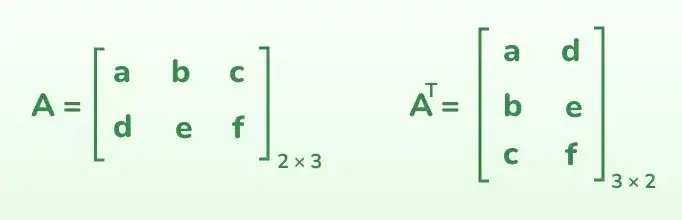
- If the original matrix has dimensions m × n, its transpose has dimensions n × m.
- The transpose is represented as T[i][j] = A[j][i].
4. What is a Symmetric Matrix?
A symmetric matrix is a square matrix that remains unchanged when it is transposed. In other words, the elements on opposite sides of the main diagonal are equal. Mathematically:
A = Aᵀ
or
A[i][j] = A[j][i]
for every valid pair of indices. For example:
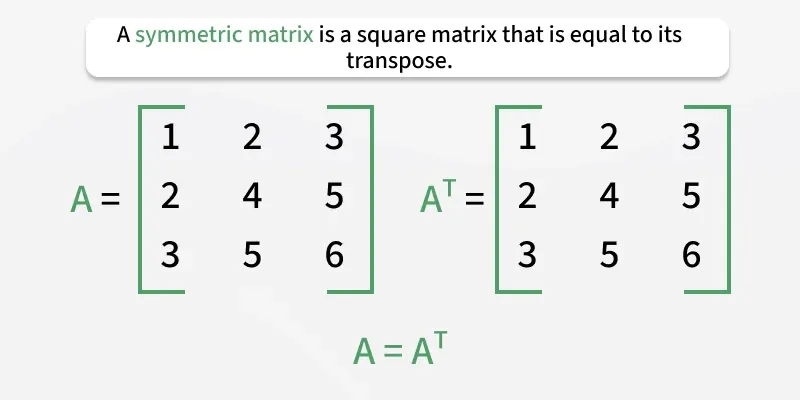
- A symmetric matrix must always be square, meaning it has the same number of rows and columns.
- Only the elements on opposite sides of the main diagonal need to be equal; diagonal elements may have any value.
5. How do you Rotate a Matrix by 90 Degrees?
For a square matrix, a 90-degree clockwise rotation can be performed by first transposing the matrix and then reversing each row. This rearranges the elements so that the first row becomes the last column. For example:
Original Transpose Rotated
1 2 1 3 3 1
3 4 2 4 4 2
- Step 1: Transpose the matrix by converting rows into columns.
- Step 2: Reverse the elements of each row to obtain the 90-degree clockwise rotation.
The time complexity is O(n²) for an n × n matrix, and the rotation uses O(1) auxiliary space when performed in-place.
6. What are the Common Ways to Traverse a Matrix?
Matrix traversal refers to visiting every element of a matrix in a specific order. Common traversal techniques include:
- Row-wise traversal: Visit elements from left to right in each row.
- Column-wise traversal: Visit elements from top to bottom in each column.
- Spiral traversal: Visit elements layer by layer from the outer boundary toward the center.
- Diagonal traversal: Visit elements along diagonals of the matrix.
Since every element is visited once, the time complexity of a complete traversal is O(m × n) for an m × n matrix.
7. What is Spiral Traversal of a Matrix?
Spiral traversal visits all elements of a matrix in a spiral order, starting from the top-left corner and moving toward the center layer by layer.

A common approach maintains four boundaries:
- top - the first unvisited row
- bottom - the last unvisited row
- left - the first unvisited column
- right - the last unvisited column
After traversing each boundary, the corresponding boundary is moved inward until all elements are visited. The time complexity is O(m × n) for an m × n matrix because every element is visited once.
8. What are the Conditions for Matrix Multiplication?
Two matrices can be multiplied when the number of columns in the first matrix is equal to the number of rows in the second matrix.
If matrix A has dimensions m × n and matrix B has dimensions n × p, their product A × B is possible and has dimensions m × p.
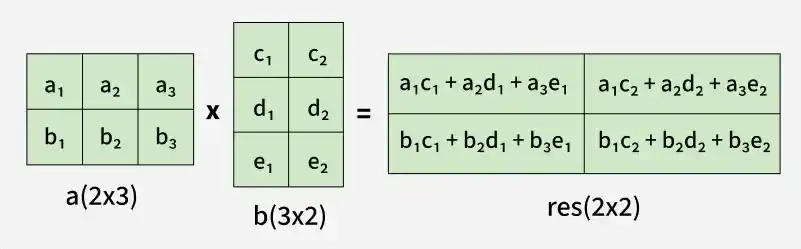
For example, a 2 × 3 matrix can be multiplied by b 3 × 2 matrix, producing a 2 × 2 matrix.
- Multiplication condition: Columns of A = Rows of B.
- Result dimensions: (m × n) × (n × p) = m × p.
The standard matrix multiplication algorithm takes O(m × n × p) time.
9. Is Matrix Multiplication Commutative?
No, matrix multiplication is generally not commutative. This means that, even when both products are defined, A × B is generally not equal to B × A.
For example:
A = 1 2 B = 5 6
3 4 7 8
Then:
A × B = 19 22
43 50
while:
B × A = 23 34
31 46
Therefore:
A × B ≠ B × A
- Matrix multiplication is associative: (A × B) × C = A × (B × C).
- Matrix multiplication is not commutative in general, although some specific matrices may satisfy A × B = B × A.
10. What is a Sparse Matrix and Why is it Useful?
A sparse matrix is a matrix in which most of the elements are zero, while only a small number of elements are non-zero.
For example:
0  0  0  5
0  0  0  0
2  0  0  0
0  0  7  0
- Sparse matrices are useful because storing only the non-zero elements reduces memory usage.
- Specialized representations, such as coordinate list (COO), compressed sparse row (CSR), and compressed sparse column (CSC), allow efficient storage and operations on large sparse matrices.
11. How do you Search in a Sorted Matrix?
The search technique depends on how the matrix is sorted.
| Matrix Type | Search Technique | Time Complexity |
|---|---|---|
| Row-wise and column-wise sorted | Staircase Search | O(m + n) |
| Fully sorted row by row | Binary Search | O(log(m × n)) |
In a row-wise and column-wise sorted matrix, start from the top-right corner:
- If the current element equals the target, the search is complete.
- If the current element is greater than the target, move left.
- If the current element is smaller than the target, move down.
A fully sorted matrix has each row sorted, and the first element of every row is greater than the last element of the previous row. Such a matrix can be treated as a sorted one-dimensional array and searched using binary search.
12. What is the Difference Between a Diagonal Matrix and an Identity Matrix?
Both are square matrices in which all elements outside the main diagonal are zero. The difference is in the values allowed on the main diagonal.
| Feature | Diagonal Matrix | Identity Matrix |
|---|---|---|
| Main diagonal | Can contain any values | All elements are 1 |
| Elements outside main diagonal | Always 0 | Always 0 |
| Example | 2 0 0 0 5 0 0 0 7 | 1 0 0 0 1 0 0 0 1 |
| Special property | No specific value is required on the diagonal | Acts as the multiplicative identity: A × I = I × A = A |
Therefore, every identity matrix is a diagonal matrix, but every diagonal matrix is not an identity matrix.
13. What is a Saddle Point in a Matrix?
A saddle point is an element that is the minimum in its row and maximum in its column.
For example, consider:
1 2 3
4 5 6
7 8 9
Here, 7 is the saddle point because it is the minimum element in its row and the maximum element in its column.
- Row containing 7: 7, 8, 9 -> 7 is the minimum.
- Column containing 7: 1, 4, 7 -> 7 is the maximum.
Note: Some definitions use the opposite convention, where a saddle point is the maximum in its row and minimum in its column. The convention should be stated clearly when solving a problem.
14. What is an In-Place Matrix Operation?
An in-place matrix operation modifies the matrix without using another matrix of comparable size for storing the result.
- For example, rotating a square matrix by 90 degrees can be performed in-place by transposing the matrix and then reversing each row.
- In-place operations help reduce auxiliary space. For an n × n matrix, a 90-degree rotation can be performed in O(n²) time and O(1) auxiliary space.
15. What is the Difference Between a Rectangular Matrix and a Square Matrix?
The difference is based on the number of rows and columns in the matrix.
| Feature | Rectangular Matrix | Square Matrix |
|---|---|---|
| Rows and columns | Number of rows and columns are different | Number of rows and columns are equal |
| Dimensions | m × n, where m ≠ n | n × n |
| Example | 2 × 3 | 3 × 3 |
| Main diagonal | May exist, but does not extend across the entire matrix | Extends from the top-left to the bottom-right |
| Determinant | Not defined for a general rectangular matrix | Defined for a square matrix |
For example, a rectangular matrix is:
1 2 3
4 5 6
while a square matrix is:
1 2
3 4
Thus, a rectangular matrix has unequal numbers of rows and columns, while a square matrix has the same number of rows and columns.
16. What are the common applications of Matrices?
Matrices are used in many areas of computer science and software development. Common applications include:
- Image processing: Images can be represented as matrices of pixels.
- Computer graphics: Matrices are used for transformations such as rotation, scaling, and translation.
- Graph representation: Adjacency matrices represent relationships between vertices.
- Machine learning: Matrices are used to represent datasets, weights, and transformations.
- Dynamic programming: 2D arrays or matrices are commonly used to store intermediate results in grid-based problems.
- Scientific computing: Matrices are used for numerical calculations and systems of equations.
- Game development: 2D arrays or matrices can represent game boards and grid-based environments.
Top coding Interview Questions on Matrix
The following list of top coding problems on Matrix covers a range of difficulty levels, from easy to hard, to help candidates prepare for interviews.
Easy Problems
- Rotate Matrix Elements
- Sort the matrix
- Multiply two matrices
- Maximum element of each row in a matrix
- Count sorted rows in a matrix
- Common elements in all rows of matrix
- Print matrix in snake pattern
- Sort a Matrix in all way increasing order
- Row with maximum 1s
- Sums of diagonals of a matrix
- Boundary elements of a Matrix
- Magic square
Medium Problems
- Peak Element in 2D matrix
- Matrix Median
- Rotate Matrix by 180 degree
- Rotate the matrix right by K times
- Print a given matrix in spiral form
- Zigzag (or diagonal) traversal of Matrix
- Search in a Row Column Sorted Matrix
- Find the number of islands
- Maximum sum rectangle in a 2D matrix
- Flood Fill Algorithm
- Count Paths in matrix
- Maximum path sum in matrix
Hard Problems
- Largest binary sub-matrix with all 1s
- Find pair in a matrix
- Maximum size square sub-matrix with all 1s
- Largest rectangle of 1's with swapping of columns
- Minimum Points to Reach Destination
- Number of paths with at-most k turns
- Boolean Matrix
- Ancestor Matrix from a Given Binary Tree
- Print K’th element in spiral form of matrix
- Size of the largest ‘+’ in a binary matrix
- Maximum sum square sub-matrix of given size
- Tic-Tac-Toe Validity