

String interview questions are commonly asked to test understanding of string concepts, operations, algorithms, and problem-solving techniques. This article covers theoretical and coding-based questions to help prepare for technical interviews.
- Includes questions from basic to advanced string concepts.
- Suitable for freshers and experienced professionals.
Theoretical Questions for Interviews
1. What is a string?
A string is a sequence of characters used to represent text or character-based data in programming. Strings are commonly implemented using character arrays or dedicated string data structures.
- Supports operations such as accessing, searching, and comparing characters.
- May be mutable or immutable depending on the language or implementation.
2. What is the difference between a character array and a string?
The key differences between a character array and a string are as follows:
| Character Array | String |
|---|---|
| A sequence of characters stored in an array. | A data type or abstract data structure for representing text. |
| Usually allows individual characters to be modified. | May be mutable or immutable depending on the implementation. |
| Requires explicit handling of its size and termination in some implementations. | Typically provides built-in operations for common string processing. |
3. What is a Substring, and How Does It Differ from a Subsequence of a String?
A substring is a contiguous sequence of characters within a string, whereas a subsequence is formed by deleting zero or more characters while preserving their original order.
| Substring | Subsequence |
|---|---|
| Characters must be contiguous. | Characters need not be contiguous. |
| No characters can be skipped between selected characters. | Characters can be skipped. |
| bcd is a substring of abcde. | ace is a subsequence of abcde. |
| Represents a continuous part of the string. | Represents characters selected in the same order. |
4. What is the Difference Between a Prefix and a Suffix of a String?
A prefix is a substring that starts from the beginning of a string, while a suffix is a substring that ends at the end of the string.
For example, in the string "abcdef":
- Prefixes: "a", "ab", "abc", "abcd", "abcde", "abcdef"
- Suffixes: "f", "ef", "def", "cdef", "bcdef", "abcdef"
5. What is a Palindrome, and How Would You Check if a String Is a Palindrome?
A palindrome string reads the same forward and backward, such as madam or level. It can be checked by comparing characters from both ends and moving toward the center.
- If any pair of characters differs, the string is not a palindrome.
- If all corresponding characters match, the string is a palindrome.
- Time Complexity: O(n)
- Space Complexity: O(1) using the two-pointer approach.
6. How Do You Check Whether Two Strings Are Anagrams?
Two strings are anagrams if they contain the same characters with the same frequencies, regardless of their order. This can be checked by comparing character frequencies in both strings.
For example, listen and silent are anagrams.
- First check whether their lengths are equal.
- Compare the frequency of every character.
- Time Complexity: O(n)
- Space Complexity: O(k), where k is the number of distinct characters.
7. What is Lexicographic Order in Strings?
Lexicographic order is a method of arranging strings by comparing their characters from left to right. The first position where two strings differ determines their order based on the relative ordering of those characters.
For example, apple comes before banana because a comes before b. Similarly, app comes before apple because app is a prefix of apple and the shorter string comes first.
- Compare characters from left to right.
- The first differing character determines the order.
- If one string is a prefix of the other, the shorter string comes first.
8. What is the Time Complexity of Accessing a Character in a String?
Accessing a character at a given index in a string typically takes O(1) time when the string supports direct index-based access.
- The position of the character is used to access it directly without traversing previous characters.
- If the string is stored in a sequential structure that requires traversal, access may take O(n) time.
9. What is the Time Complexity of Searching for a Character in a String?
Searching for a character in an unsorted string typically takes O(n) time, where n is the length of the string, as characters may need to be checked one by one.
- Best Case: O(1), when the character is found at the first position.
- Worst Case: O(n), when the character is at the end or not present.
- Space Complexity: O(1) for a simple linear search.
10. How Many Substrings Can Be Formed from a String of Length n?
For a string of length n, the total number of non-empty substrings is:
This is because there are n choices for the starting position and the number of possible ending positions decreases accordingly.
Example: For abc, the substrings are a, b, c, ab, bc, abc, giving 6 = 3 × 4 / 2 substrings.
11. How Many Subsequences Can Be Formed from a String of Length n?
A string of length n has 2ⁿ subsequences, including the empty subsequence. For each character, there are two choices: include it or exclude it.
Example: A string of length 3 has: 23=82^3 = 8 possible subsequences.
If only non-empty subsequences are counted, the number is:

12. What is String Hashing and Why Is It Used?
String hashing converts a string into a numeric hash value that represents its contents. It is useful for efficiently comparing strings, detecting duplicates, and solving pattern-matching problems.
- Equal strings should produce the same hash value.
- Hashing allows string comparisons to be performed efficiently.
- Average Time Complexity: O(1) for hash-based comparison, depending on the hashing scheme.
13. What is a Hash Collision in String Hashing?
A hash collision occurs when two different strings produce the same hash value. Since hash values are not always unique, collisions must be handled when using hashing for string comparisons.
For example:
- "abc" -> Hash value: 12345
- "xyz" -> Hash value: 12345
- Both strings have the same hash value, resulting in a hash collision.
14. What is a Rolling Hash?
A rolling hash is a hashing technique that efficiently updates the hash value when a fixed-size window moves from one part of a string to the next, instead of calculating the hash from scratch each time. It is an important technique used in the Rabin-Karp algorithm.
- Removes the contribution of the outgoing character.
- Adds the contribution of the incoming character.
- Makes substring hash calculation more efficient.
15. What is Pattern Matching in Strings?
Pattern matching is the process of finding whether a given pattern occurs in a larger string and identifying its position if it exists.
- Text: The string in which the search is performed.
- Pattern: The sequence of characters to be searched.
- Common algorithms include Naive Pattern Matching, KMP, Rabin-Karp, and Z Algorithm.
16. What is Naive Pattern Matching?
Naive pattern matching is a simple string matching algorithm that checks the pattern at every possible position in the text by comparing characters one by one.
- Compares the pattern with the text from each possible starting position.
- Shifts the pattern by one position after a mismatch.
- Time Complexity: O(n × m), where n is the text length and m is the pattern length.
17. What is the Purpose of the Knuth-Morris-Pratt (KMP) Algorithm?
The Knuth-Morris-Pratt (KMP) algorithm is used to efficiently find occurrences of a pattern within a text. It avoids unnecessary character comparisons by preprocessing the pattern to build an LPS (Longest Prefix Suffix) array.
- The LPS array determines how far the pattern can be shifted after a mismatch.
- This avoids rechecking characters that have already been matched.
- Time Complexity: O(n + m), where n is the text length and m is the pattern length.
- Space Complexity: O(m) for the LPS array.

18. What is the LPS Array in the KMP Algorithm?
The LPS (Longest Proper Prefix which is also a Suffix) array stores the length of the longest proper prefix that is also a suffix for each prefix of the pattern. It helps the KMP algorithm skip unnecessary comparisons after a mismatch.
- LPS values are calculated for each position in the pattern.
- It avoids rechecking characters that have already been matched.
- The LPS array is constructed in O(m) time, where m is the pattern length.
For example, for the pattern ABABC:
LPS = [0, 0, 1, 2, 0]
19. What is the Rabin-Karp Algorithm and How Does It Work?
The Rabin-Karp algorithm is a pattern-matching algorithm that uses hashing to compare a pattern with substrings of the same length. It uses a rolling hash to update the hash efficiently as the search window moves.
- First, the pattern's hash is calculated.
- The hash of each text window is compared with it.
- When hashes match, the actual strings are compared to handle hash collisions.
Average Time Complexity: O(n + m), while the worst case can be O(n × m).
20. What is the Z Algorithm Used for in String Matching?
The Z Algorithm is used to efficiently find occurrences of a pattern within a text. It constructs a Z-array, where each element represents the length of the longest substring starting at that position that matches the prefix of the string.
- The pattern and text are combined using a special separator, such as Pattern + "$" + Text.
- A Z-array is constructed for the combined string.
- If a Z-array value equals the length of the pattern, the pattern occurs at that position in the text.
- Time Complexity: O(n + m), where n is the text length and m is the pattern length.
- Space Complexity: O(n + m) for the combined string and Z-array.
21. What is the Difference Between Naive Pattern Matching and KMP?
Naive pattern matching checks the pattern at every possible position in the text, while KMP uses an LPS array to avoid unnecessary comparisons.
| Naive Pattern Matching | KMP |
|---|---|
| Compares the pattern at each possible position. | Uses information from previous matches. |
| Does not preprocess the pattern. | Preprocesses the pattern using the LPS array. |
| Worst-case time: O(n × m). | Time: O(n + m). |
22. What is Edit Distance Between Two Strings?
The edit distance is the minimum number of insertions, deletions, and replacements required to transform one string into another.
For example, geek can be changed to gesek using one insertion.
- It is commonly solved using Dynamic Programming.
- Time Complexity: O(n × m)
- Space Complexity: O(n × m) in the standard DP approach.

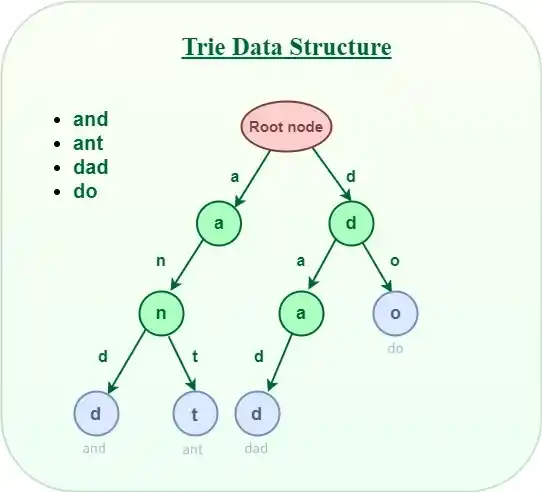
23. What is a Trie and Why Is It Used for Strings?
A Trie is a tree-based data structure that stores strings character by character, making it efficient for searching words and their prefixes.
- Each path from the root represents a sequence of characters.
- Supports efficient word and prefix searching.
- Commonly used for autocomplete, dictionary searching, and spell checking.
Coding Interview Questions
Easy Problems
- Palindrome Check
- Reverse a String
- Reverse Words
- Check for Rotation
- First Non Repeating
- Roman to Integer
- Implement Atoi
- Encrypt the String – II
- Equal Point in Brackets
- Anagram Checking
- Panagram Checking
- Validate IP Address
- Add Binary Strings
Medium Problems
- Integer to Words
- Fizz Buzz
- Palindromic Sentence Check
- Isomorphic Strings
- Check for k-anagram
- Equal 0,1, and 2
- Find and replace in String
- Look and say Pattern
- Minimum repetitions to make Substring
- Excel Sheet – I
- Find the N-th character
- Next Palindromic Number with same digits
- Length of longest prefix suffix
- Longest K unique characters substring
- Smallest window containing all
- Longest substring without repeating characters
- Substrings of length k with k-1 distinct elements
- Count number of substrings
- Interleaved Strings
- Print Anagrams together
- Rank the permutation
- A Special Keyboard
- Sum of two large numbers
Hard Problems
- Repeatedly Remove Duplicates
- Multiply Two Strings
- Search Pattern (KMP-Algorithm)
- Search Pattern (Rabin-Karp Algorithm)
- Shortest Common Supersequence
- Longest substring to form a Palindrome
- Longest Valid Parenthesis
- Longest Palindromic Subsequence
- Distinct Palindromic Substrings
- Palindrome Substring Queries
- Number of Distinct Subsequences
- Minimum Deletions for Palindrome
- Minimum Insertions for Palindrome
- Max Non-Overlapping Odd Palindrome Sum
Related Articles:
- Array Coding Problems for Interviews
- Tree Coding Problems for Interviews
- Graph Coding Problems for Interviews
- Dynamic Programming Coding Problems for Interviews
- Sorting Coding Problems for Interviews
- Searching Coding Problems for Interviews
- Binary Search Tree Coding Problems for Interviews
Related Tutorials: