
Given two graphs G1 and G2, the task is to find the union and intersection of the two given graphs, i.e. (G1 ∪ G2) and (G1 ∩ G2).
Examples:
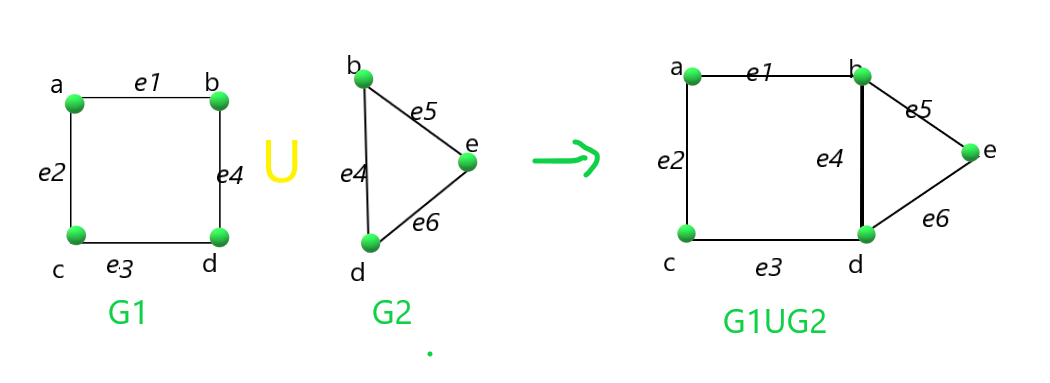
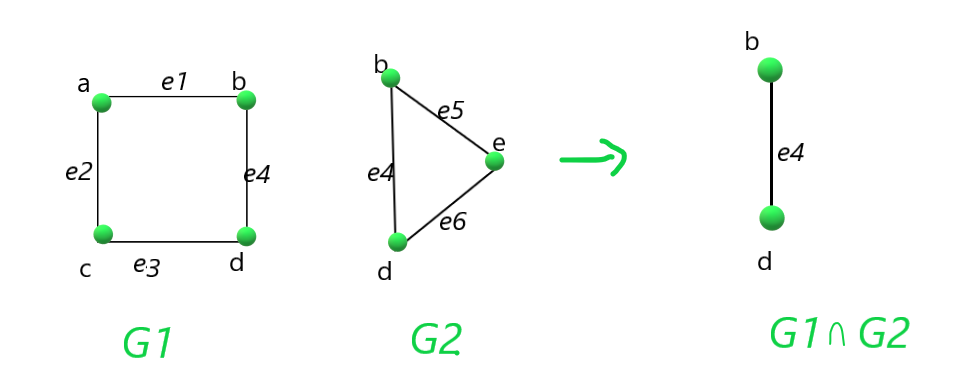
Input: G1 = { ("e1", 1, 2), ("e2", 1, 3), ("e3", 3, 4), ("e4", 2, 4) }, G2 = = { ("e4", 2, 4), ("e5", 2, 5), ("e6", 4, 5) }
Output:
G1 union G2 is
e1 1 2
e2 1 3
e3 3 4
e4 2 4
e5 2 5
e6 4 5
G1 intersection G2 is
e4 2 4
Explanation:
Union of the graphs G1 and G2:
Intersection of the graphs G1 and G2:
Approach: Follow the steps below to solve the problem:
- Define a function, say Union(G1, G2), to find the union of the G1 and G2:
- Initialize a map, say added, that stores if an edge is already been added or not.
- Iterate over the edges of the graph G1 and push all the edges in a graph, say G, and mark all the edges visited in added.
- Now, again traverse over the edges of the graph G2 and push the edge in the G if the edge is not already been added, and then mark the edge added in the map added.
- Define a function say Intersection(G1, G2) to find the Intersection of the G1 and G2:
- Initialize a map, say added , that stores if an edge is already been added or not.
- Traverse over the edges of the graph G1 and marked all the edges visited in the map added.
- Now, again traverse over the edges of the graph G2 and push the edge in the graph G, if the edge is already been added. Then, mark the edge added in the map.
- Now, print the graphs obtained after the function call of Union(G1, G2) and Intersection(G1, G2).
Below is the implementation of the above approach:
// C++ program for the above approach
#include <bits/stdc++.h>
using namespace std;

// Function to find union of two graphs
void find_union(
    vector<tuple<string, int, int> > G1,
    vector<tuple<string, int, int> > G2)
{
    // Stores an edge of the graph G1
    map<string, pair<int, int> > added;

    // Stores the union graph G1
    vector<tuple<string, int, int> > G;

    // Iterate over the edges
    // of the graph G1
    for (auto p : G1) {

        string a = get<0>(p);

        // Get the edges
        int b = get<1>(p);
        int c = get<2>(p);

        // Insert the current
        // edges into graph G
        G.push_back(
            make_tuple(a, b, c));
        added[a] = { b, c };
    }

    // Iterate over the edges
    // of the graph G1
    for (auto p : G2) {

        string a = get<0>(p);
        int b = get<1>(p);
        int c = get<2>(p);

        pair<int, int> x = { b, c };
        pair<int, int> y = { c, b };

        // If either edge x or
        // y is already added
        if (added[a] == x || added[a] == y)
            continue;

        // Otherwise
        G.push_back(make_tuple(a, b, c));
    }

    // Print the union
    cout << "G1 union G2 is\n";

    for (auto p : G) {

        string a = get<0>(p);
        int b = get<1>(p);
        int c = get<2>(p);
        cout << a << " " << b << " "
             << c << endl;
    }
}

// Function to find intersection of two graphs
void find_intersection(
    vector<tuple<string, int, int> > G1,
    vector<tuple<string, int, int> > G2)
{
    // Stores an edge
    map<string, pair<int, int> > added;

    // Stores the graph of intersection
    vector<tuple<string, int, int> > G;

    // Iterate over edges of graph G1
    for (auto p : G1) {
        string a = get<0>(p);
        int b = get<1>(p);
        int c = get<2>(p);

        added[a] = { b, c };
    }

    // Iterate over edges of graph G2
    for (auto p : G2) {

        string a = get<0>(p);
        int b = get<1>(p);
        int c = get<2>(p);

        pair<int, int> x = { b, c };
        pair<int, int> y = { c, b };

        // If either edge x or
        // y is already added
        if (added[a] == x || added[a] == y)
            G.push_back(make_tuple(a, b, c));
    }

    // Print the graph G
    cout << "G1 intersection G2 is\n";

    for (auto p : G) {

        string a = get<0>(p);
        int b = get<1>(p);
        int c = get<2>(p);

        cout << a << " " << b
             << " " << c << endl;
    }
}

// Driver Code
int main()
{
    vector<tuple<string, int, int> > G1
        = { make_tuple("e1", 1, 2),
            make_tuple("e2", 1, 3),
            make_tuple("e3", 3, 4),
            make_tuple("e4", 2, 4) };

    vector<tuple<string, int, int> > G2
        = { make_tuple("e4", 2, 4),
            make_tuple("e5", 2, 5),
            make_tuple("e6", 4, 5) };

    // Function call for finding the
    // Union of the given graph
    find_union(G1, G2);

    // Function call for finding the
    // Intersection of the given graph
    find_intersection(G1, G2);

    return 0;
}
// Java codeto implement the approach
import java.util.*;

class GFG {

  // Function to find union of two graphs
  static void findUnion(List<Edge> g1, List<Edge> g2)
  {

    // Stores an edge of the graph G1
    Map<String, Edge> added = new HashMap<>();

    // Stores the union graph G1
    List<Edge> g = new ArrayList<>();

    // Iterate over the edges of the graph G1
    for (Edge edge : g1) {
      // Insert the current edges into graph G
      g.add(edge);
      added.put(edge.label, edge);
    }

    // Iterate over the edges of the graph G2
    for (Edge edge : g2) {
      Edge x = edge;
      Edge y = new Edge(edge.label, edge.v2, edge.v1);

      // If either edge x or y is already added
      if (added.containsKey(edge.label)
          && (added.get(edge.label).equals(x)
              || added.get(edge.label).equals(y)))
        continue;

      // Otherwise
      g.add(edge);
    }

    // Print the union
    System.out.println("G1 union G2 is");
    for (Edge edge : g) {
      System.out.println(edge.label + " " + edge.v1
                         + " " + edge.v2);
    }
  }

  // Function to find intersection of two graphs
  static void findIntersection(List<Edge> g1,
                               List<Edge> g2)
  {
    // Stores an edge
    Map<String, Edge> added = new HashMap<>();

    // Stores the graph of intersection
    List<Edge> g = new ArrayList<>();

    // Iterate over edges of graph G1
    for (Edge edge : g1) {
      added.put(edge.label, edge);
    }

    // Iterate over edges of graph G2
    for (Edge edge : g2) {
      Edge x = edge;
      Edge y = new Edge(edge.label, edge.v2, edge.v1);

      // If either edge x or y is already added
      if (added.containsKey(edge.label)
          && (added.get(edge.label).equals(x)
              || added.get(edge.label).equals(y)))
        g.add(edge);
    }

    // Print the graph G
    System.out.println("G1 intersection G2 is");
    for (Edge edge : g) {
      System.out.println(edge.label + " " + edge.v1
                         + " " + edge.v2);
    }
  }

  // Driver code
  public static void main(String[] args)
  {
    List<Edge> g1 = Arrays.asList(
      new Edge("e1", 1, 2), new Edge("e2", 1, 3),
      new Edge("e3", 3, 4), new Edge("e4", 2, 4));

    List<Edge> g2 = Arrays.asList(new Edge("e4", 2, 4),
                                  new Edge("e5", 2, 5),
                                  new Edge("e6", 4, 5));

    // Function call to find the Union of the
    // given graph
    findUnion(g1, g2);

    // Function call for finding intersection
    // of the given graph
    findIntersection(g1, g2);
  }

  // Edge class definition
  static class Edge {
    String label;
    int v1, v2;

    // Constructor
    Edge(String label, int v1, int v2)
    {
      this.label = label;
      this.v1 = v1;
      this.v2 = v2;
    }

    // Implementing the equals method
    @Override public boolean equals(Object o)
    {
      if (this == o)
        return true;
      if (!(o instanceof Edge))
        return false;
      Edge edge = (Edge)o;
      return v1 == edge.v1 && v2 == edge.v2;
    }

    // Implementing the hashCode method
    @Override public int hashCode()
    {
      return Objects.hash(v1, v2);
    }
  }
}

// This code is contributed by phasing17
# Python3 code to implement the approach

# Function to find union of two graphs
def findUnion(G1, G2):
    # Stores an edge of the graph G1
    added = {}

    # Stores the union graph G1
    G = []

    # Iterate over the edges
    # of the graph G1
    for p in G1:
        a = p[0]
        b = p[1]
        c = p[2]

        # Insert the current
        # edges into graph G
        G.append([a, b, c])
        added[a] = [b, c]

    # Iterate over the edges
    # of the graph G1
    for p in G2:
        a = p[0]
        b = p[1]
        c = p[2]

        x = [b, c]
        y = [c, b]

        # If either edge x or
        # y is already added
        if added.get(a) == x or added.get(a) == y:
            continue

        # Otherwise
        G.append([a, b, c])

    # Print the union
    print("G1 union G2 is")
    for p in G:
        a = p[0]
        b = p[1]
        c = p[2]
        print(a, b, c)

# Function to find intersection of two graphs
def findIntersection(G1, G2):
    # Stores an edge
    added = {}

    # Stores the graph of intersection
    G = []

    # Iterate over edges of graph G1
    for p in G1:
        a = p[0]
        b = p[1]
        c = p[2]

        added[a] = [b, c]

    # Iterate over edges of graph G2
    for p in G2:
        a = p[0]
        b = p[1]
        c = p[2]

        x = [b, c]
        y = [c, b]

        # If either edge x or
        # y is already added
        if added.get(a) == x or added.get(a) == y:
            G.append([a, b, c])

    # Print the graph G
    print("G1 intersection G2 is")
    for p in G:
        print(*p)

# Driver code
G1 = [["e1", 1, 2], ["e2", 1, 3], ["e3", 3, 4], ["e4", 2, 4]];

G2 = [["e4", 2, 4],["e5", 2, 3], ["e6", 3, 5], ["e7", 4, 5]];

findUnion(G1, G2);
findIntersection(G1, G2);

# This code is contributed by phasing17
// C# code to implement the approach

using System;
using System.Collections.Generic;

class GFG
{
  // Function to find union of two graphs
  static void FindUnion(List<(string, int, int)> G1, List<(string, int, int)> G2)
  {

    // Stores an edge of the graph G1
    Dictionary<string, (int, int)> added = new Dictionary<string, (int, int)>();

    // Stores the union graph G1
    List<(string, int, int)> G = new List<(string, int, int)>();

    // Iterate over the edges
    // of the graph G1
    foreach ((string a, int b, int c) in G1)
    {
      // Insert the current
      // edges into graph G
      G.Add((a, b, c));
      added[a] = (b, c);
    }

    // Iterate over the edges
    // of the graph G1
    foreach ((string a, int b, int c) in G2)
    {
      (int x, int y) = (b, c);
      (int y2, int x2) = (c, b);

      // If either edge x or
      // y is already added
      if (added.ContainsKey(a) && (added[a] == (x, y) || added[a] == (y2, x2)))
        continue;

      // Otherwise
      G.Add((a, b, c));
    }


    // Print the union
    Console.WriteLine("G1 union G2 is");
    foreach ((string a, int b, int c) in G)
    {
      Console.WriteLine(a + " " + b + " " + c);
    }
  }

  // Function to find intersection of two graphs
  static void FindIntersection(List<(string, int, int)> G1, List<(string, int, int)> G2)
  {
    // Stores an edge
    Dictionary<string, (int, int)> added = new Dictionary<string, (int, int)>();

    // Stores the graph of intersection
    List<(string, int, int)> G = new List<(string, int, int)>();

    // Iterate over edges of graph G1
    foreach ((string a, int b, int c) in G1)
    {
      added[a] = (b, c);
    }

    // Iterate over edges of graph G2
    foreach ((string a, int b, int c) in G2)
    {
      (int x, int y) = (b, c);
      (int y2, int x2) = (c, b);

      // If either edge x or
      // y is already added
      if (added.ContainsKey(a) && (added[a] == (x, y) || added[a] == (y2, x2)))
        G.Add((a, b, c));
    }

    // Print the graph G
    Console.WriteLine("G1 intersection G2 is");
    foreach ((string a, int b, int c) in G)
    {
      Console.WriteLine(a + " " + b + " " + c);
    }
  }

  // Driver code
  static void Main(string[] args)
  {
    List<(string, int, int)> G1 = new List<(string, int, int)>
    {
      ("e1", 1, 2),
      ("e2", 1, 3),
      ("e3", 3, 4),
      ("e4", 2, 4)
    };

    List<(string, int, int)> G2 = new List<(string, int, int)>
    {
      ("e4", 2, 4),
      ("e5", 2, 5),
      ("e6", 4, 5)
    };

    // Function call for finding the
    // Union of the given graph
    FindUnion(G1, G2);

    // Function call for finding the
    // Intersection of the given graph
    FindIntersection(G1, G2);
  }
}


// This code is contributed by phasing17
// Function to find union of two graphs
function findUnion(G1, G2) {
    // Stores an edge of the graph G1
    var added = new Map();

    // Stores the union graph G1
    var G = [];

    // Iterate over the edges
    // of the graph G1
    for (const p of G1) {

        const a = p[0];

        // Get the edges
        const b = p[1];
        const c = p[2];

        // Insert the current
        // edges into graph G
        G.push([a, b, c]);
        added.set(a, [b, c]);
    }

    // Iterate over the edges
    // of the graph G1
    for (const p of G2) {

        const a = p[0];
        const b = p[1];
        const c = p[2];

        const x = [b, c];
        const y = [c, b];

        // If either edge x or
        // y is already added
        if (JSON.stringify(added.get(a)) === JSON.stringify(x) ||
        JSON.stringify(added.get(a)) === JSON.stringify(y))
            continue;

        // Otherwise
        G.push([a, b, c]);
    }

    // Print the union
    console.log("G1 union G2 is");

    for (const p of G) {

        const a = p[0];
        const b = p[1];
        const c = p[2];
        console.log(a + " " + b + " " + c);
    }
}

// Function to find intersection of two graphs
function findIntersection(G1, G2) {
    // Stores an edge
    var added = new Map();

    // Stores the graph of intersection
    var G = [];

    // Iterate over edges of graph G1
    for (const p of G1) {
        const a = p[0];
        const b = p[1];
        const c = p[2];

        added.set(a, [b, c]);
    }

    // Iterate over edges of graph G2
    for (const p of G2) {

        const a = p[0];
        const b = p[1];
        const c = p[2];

        const x = [b, c];
        const y = [c, b];

        // If either edge x or
        // y is already added
        if (JSON.stringify(added.get(a)) === JSON.stringify(x) ||
        JSON.stringify(added.get(a)) === JSON.stringify(y))
            G.push([a, b, c]);
    }

    // Print the graph G
    console.log("G1 intersection G2 is");

    for (const p of G) {

        const a = p[0];
        const b = p[1];
        const c = p[2];

        console.log(a + " " + b + " " + c);
    }
}

// Driver Code
const G1 = [
    ["e1", 1, 2],
    ["e2", 1, 3],
    ["e3", 3, 4],
    ["e4", 2, 4]
];

const G2 = [
    ["e4", 2, 4],
    ["e5", 2, 3],
    ["e6", 3, 5],
    ["e7", 4, 5]
];

findUnion(G1, G2);
findIntersection(G1, G2);
Output:
G1 union G2 is
e1 1 2
e2 1 3
e3 3 4
e4 2 4
e5 2 5
e6 4 5
G1 intersection G2 is
e4 2 4
Time Complexity: O(N * log(N))
Auxiliary Space: O(N)