
Given an array arr[] of size n, where arr[i] denotes the number of characters in one word. Let k be the limit on the number of characters that can be put in one line (line width). Put line breaks in the given sequence such that the lines are printed neatly.
Assume that the length of each word is smaller than the line width. When line breaks are inserted there is a possibility that extra spaces are present in each line. The extra spaces include spaces put at the end of every line except the last one.
The task is to minimize the following total cost where total cost = Sum of cost of all lines, where the cost of the line is = (Number of extra spaces in the line)2.
Examples:
Input: arr[] = [3, 2, 2, 5], k = 6
Output: 10
Explanation: Given a line can have 6 characters,
Line number 1: From word no. 1 to 1
Line number 2: From word no. 2 to 3
Line number 3: From word no. 4 to 4
So total cost = (6-3)2 + (6-2-2-1)2 = 32+12 = 10. As in the first line word length = 3 thus extra spaces = 6 - 3 = 3 and in the second line there are two words of length 2 and there is already 1 space between the two words thus extra spaces = 6 - 2 -2 -1 = 1. As mentioned in the problem description there will be no extra spaces in the last line. Placing the first and second words in the first line and the third word on the second line would take a cost of 02 + 42 = 16 (zero spaces on the first line and 6-2 = 4 spaces on the second), which isn't the minimum possible cost.Input: arr[] = [3, 2, 2], k = 4
Output: 5
Explanation: Given a line can have 4 characters,
Line 1: From word no. 1 to 1
Line 2: From word no. 2 to 2
Line 3: From word no. 3 to 3
Same explaination as above total cost = (4 - 3)2 + (4 - 2)2 = 5.

Table of Content
Why Greedy fails?
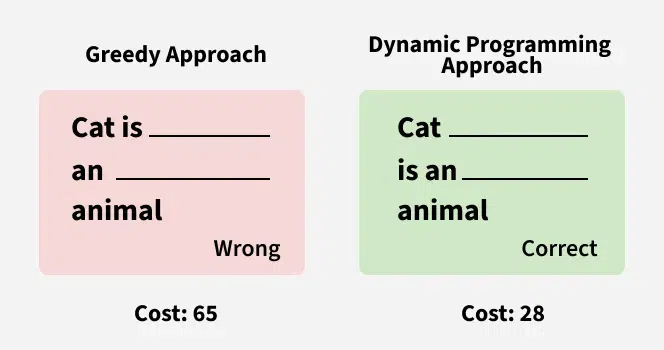
Greedy algorithms fail in this problem because they focus on filling the current line with as many words as possible, without considering that the last line has no cost. This is a crucial point for finding the best solution.
For example, with words[] = [3, 2, 2, 5] and k = 6, a greedy approach would put word[0] and word[1] on the first line, leaving 1 extra space (since the total length of the words plus spaces equals 6). The second line would have only word[2], leaving 4 extra spaces. The last line would have word[3], which doesn’t contribute to the cost.
This greedy method gives a total cost of 1*1 + 4*4 = 17, which is incorrect. The optimal arrangement is placing word[0] on the first line, word[1] and word[2] on the second line, and word[3] on the last line. This would result in a total cost of 10(explained in the first example).
Using recursion
This approach is based on recursively trying to place words on each line while ensuring that the total length of words, including spaces between them, does not exceed the maximum line width k. For each possible line configuration, we calculate the extra spaces at the end of the line and recursively solve the problem for the remaining words. The final cost is the sum of the squared extra spaces for all lines, with the last line contributing no cost. By exploring all possible ways of arranging the words across lines, we minimize the total cost and return the optimal result.
The recurrence relation for the word wrapping problem can be stated as follows: calculateCost(curr) represents the minimum cost for wrapping words starting from index curr to the end of the array.
The recurrence is:
- calculateCost(curr) = min { [(k - tot)^2 + calculateCost(i + 1)] } for all values of i from curr to n-1, where the total number of characters in the line (including spaces between words) does not exceed the width limit k.
Where:
- tot is the total number of characters in the current line, including the sum of word lengths and the spaces between them.
- k is the maximum allowed line width.
- (k - tot)^2 is the cost, calculated as the square of the extra spaces on the current line (if it fits within the width limit).
Base Case:
calculateCost(curr) = 0 if curr >= n, meaning when all words have been placed, no further cost is incurred.
// C++ program to minimize the cost to
// wrap the words.

#include <bits/stdc++.h>
using namespace std;

int calculateCost(int curr, int n, vector<int> &arr, int k) {

   // Base case: If current index is beyond or at the
   // last word, no cost
    if (curr >= n)
        return 0;

    // Keeps track of the current line's total character count
    int sum = 0;

    // Initialize with a large value to find the minimum cost
    int ans = INT_MAX;

    // Try placing words from the current position to the next
    for (int i = curr; i < n; i++) {

        // Add the length of the current word
        sum += arr[i];

        // Including spaces between words
        int tot = sum + (i - curr);

        // If the total exceeds the line width,
      	// break out of the loop
        if (tot > k)
            break;

       // If this is not the last word in the array, compute the
       // cost for the next line
        if (i != n - 1) {
            int temp = (k - tot) * (k - tot) +
              calculateCost(i + 1, n, arr, k);
            ans = min(ans, temp);
        }
        else {

           // If it's the last word, there's no cost added
            ans = 0;
        }
    }

    return ans;
}

int solveWordWrap(vector<int> &arr, int k) {
    int n = arr.size();
    return calculateCost(0, n, arr, k);
}

int main() {
    int k = 6;

    vector<int> arr = {3, 2, 2, 5};
    int res = solveWordWrap(arr, k);
    cout << res << endl;
    return 0;
}
// Java program to minimize the cost to
// wrap the words.

import java.util.*;

class GfG {

    static int calculateCost(int curr, int n, int[] arr,
                             int k) {

        // Base case: If current index is beyond or at the
        // last word, no cost
        if (curr >= n)
            return 0;

        // Keeps track of the current line's total character
        // count
        int sum = 0;

        // Initialize with a large value to find the minimum
        // cost
        int ans = Integer.MAX_VALUE;

        // Try placing words from the current position to
        // the next
        for (int i = curr; i < n; i++) {

            // Add the length of the current word
            sum += arr[i];

            // Including spaces between words
            int tot = sum + (i - curr);

            // If the total exceeds the line width, break
            // out of the loop
            if (tot > k)
                break;

            // If this is not the last word in the array,
            // compute the cost for the next line
            if (i != n - 1) {
                int temp
                    = (k - tot) * (k - tot)
                      + calculateCost(i + 1, n, arr, k);
                ans = Math.min(ans, temp);
            }
            else {

                // If it's the last word, there's no cost added
                ans = 0;
            }
        }

        return ans;
    }

    static int solveWordWrap(int[] arr, int k) {
     int n = arr.length;
     return calculateCost(0, n, arr, k);
    }

    public static void main(String[] args) {

        int[] arr = { 3, 2, 2, 5 };
        int k = 6;
        int res = solveWordWrap(arr, k);
        System.out.println(res);
    }
}
# Python program to minimize the cost to wrap the words.

import sys

def calculateCost(curr, n, arr, k):

    # Base case: If current index is beyond or at the last
    # word, no cost
    if curr >= n:
        return 0

    # Keeps track of the current line's total character count
    sum = 0

    # Initialize with a large value to find the minimum cost
    ans = sys.maxsize

    # Try placing words from the current position to the next
    for i in range(curr, n):

        # Add the length of the current word
        sum += arr[i]

        # Including spaces between words
        tot = sum + (i - curr)

        # If the total exceeds the line width, break out of the
        # loop
        if tot > k:
            break

        # If this is not the last word in the array, compute the
        # cost for the next line
        if i != n - 1:
            temp = (k - tot) * (k - tot) + calculateCost(i + 1, n, arr, k)
            ans = min(ans, temp)

        # If it's the last word, there's no cost added
        else:
            ans = 0

    return ans

def solveWordWrap(arr, k):
    n = len(arr)
    return calculateCost(0, n, arr, k)


if __name__ == "__main__":
    arr = [3, 2, 2, 5]
    k = 6
    res = solveWordWrap(arr, k)
    print(res)
// C# program to minimize the cost to
// wrap the words.

using System;

class GfG {

    static int calculateCost(int curr, int n, int[] arr,
                             int k) {

        // Base case: If current index is beyond or at the
        // last word, no cost
        if (curr >= n)
            return 0;

        // Keeps track of the current line's total character
        // count
        int sum = 0;

        // Initialize with a large value to find the minimum
        // cost
        int ans = int.MaxValue;

        // Try placing words from the current position to
        // the next
        for (int i = curr; i < n; i++) {

            // Add the length of the current word
            sum += arr[i];

            // Including spaces between words
            int tot = sum + (i - curr);

            // If the total exceeds the line width, break
            // out of the loop
            if (tot > k)
                break;

            // If this is not the last word in the array,
            // compute the cost for the next line
            if (i != n - 1) {
                int temp
                    = (k - tot) * (k - tot)
                      + calculateCost(i + 1, n, arr, k);
                ans = Math.Min(ans, temp);
            }
            else {
             // If it's the last word, there's no cost added
                ans = 0;
            }
        }

        return ans;
    }

    static int solveWordWrap(int[] arr, int k) {
        int n = arr.Length;
        return calculateCost(0, n, arr, k);
    }

    public static void Main(string[] args) {
         int[] arr = { 3, 2, 2, 5 };
        int k = 6;
        int res = solveWordWrap(arr, k);
        Console.WriteLine(res);
    }
}
// JavaScript program to minimize the cost to wrap the
// words.

function calculateCost(curr, n, arr, k) {

    // Base case: If current index is beyond or at the last
    // word, no cost
    if (curr >= n) {
        return 0;
    }

    // Keeps track of the current line's total character
    // count
    let sum = 0;

    // Initialize with a large value to find the minimum
    // cost
    let ans = Infinity;

    // Try placing words from the current position to the
    // next
    for (let i = curr; i < n; i++) {

        // Add the length of the current word
        sum += arr[i];

        // Including spaces between words
        let tot = sum + (i - curr);

        // If the total exceeds the line width, break out of
        // the loop
        if (tot > k) {
            break;
        }

        // If this is not the last word in the array,
        // compute the cost for the next line
        if (i !== n - 1) {
            let temp = (k - tot) * (k - tot)
                       + calculateCost(i + 1, n, arr, k);
            ans = Math.min(ans, temp);
        }
      else {

        // If it's the last word, there's no cost added
            ans = 0;
        }
    }

    return ans;
}

function solveWordWrap(arr, k) {
    let n = arr.length;
    return calculateCost(0, n, arr, k);
}

const arr = [ 3, 2, 2, 5 ];
const k = 6;
const res = solveWordWrap(arr, k);
console.log(res);
Output
10
The above approach will have a exponential time complexity.
Using Top-Down DP (Memoization) - O(n^2) Time and O(n) Space
If we observe closely, the recursive function calculateCost() in the word wrap problem also follows the overlapping subproblems property, meaning that the same subproblems are being solved repeatedly in different recursive calls. We can optimize this using memoization. Since the only changing parameter in the recursive calls is curr, which ranges from 0 to n-1 (where n is the number of words), we can use a 1D array of size n to store the results of previously computed subproblems. By initializing this array with -1 to indicate that a subproblem hasn't been computed yet, we can avoid redundant calculations and improve efficiency.
// C++ program to minimize the cost to
// wrap the words.

#include <bits/stdc++.h>
using namespace std;

int calculateCost(int curr, int n, vector<int> &arr,
                  int k, vector<int> &memo) {

	// Base case: If current index is beyond or at
	// the last word, no cost
	if (curr >= n)
		return 0;

	if (memo[curr] != -1)
		return memo[curr];

	// Keeps track of the current line's total character
	// count
	int sum = 0;

	// Initialize with a large value to find the minimum cost
	int ans = INT_MAX;

	// Try placing words from the current position to the next
	for (int i = curr; i < n; i++) {

		// Add the length of the current word
		sum += arr[i];

		// Including spaces between words
		int tot = sum + (i - curr);

		// If the total exceeds the line width,
		// break out of the loop
		if (tot > k)
			break;

		// If this is not the last word in the array, compute
		// the cost for the next line
		if (i != n - 1) {
			int temp = (k - tot) * (k - tot) +
			           calculateCost(i + 1, n, arr, k, memo);
			ans = min(ans, temp);
		}
		else {

			// If it's the last word, there's no cost added
			ans = 0;
		}
	}

	return memo[curr] = ans;
}

int solveWordWrap(vector<int> &arr, int k) {
	int n = arr.size();
	vector<int> memo(n, -1);
	return calculateCost(0, n, arr, k, memo);
}

int main() {
	int k = 6;
	vector<int> arr = {3, 2, 2, 5};
	int res =  solveWordWrap(arr, k);
	cout << res << endl;
	return 0;
}
// Java program to minimize the cost to
// wrap the words.

import java.util.*;

class GfG {

	static int calculateCost(int curr, int n, int[] arr,
	                         int k, int[] memo) {

		// Base case: If current index is beyond or at the
		// last word, no cost
		if (curr >= n) {
			return 0;
		}

		// If the value is already computed, return the
		// memoized result
		if (memo[curr] != -1) {
			return memo[curr];
		}

		// Keeps track of the current line's total character
		// count
		int sum = 0;

		// Initialize with a large value to find the minimum
		// cost
		int ans = Integer.MAX_VALUE;

		// Try placing words from the current position to
		// the next
		for (int i = curr; i < n; i++) {

			// Add the length of the current word
			sum += arr[i];

			// Including spaces between words
			int tot = sum + (i - curr);

			// If the total exceeds the line width, break
			// out of the loop
			if (tot > k) {
				break;
			}

			// If this is not the last word in the array,
			// compute the cost for the next line
			if (i != n - 1) {
				int temp = (k - tot) * (k - tot)
				           + calculateCost(i + 1, n, arr, k,
				                           memo);
				ans = Math.min(ans, temp);
			}
			else {

				// If it's the last word, there's no cost added
				ans = 0;
			}
		}
		memo[curr] = ans;
		return ans;
	}

	static int solveWordWrap(int[] arr, int k) {
		int n = arr.length;
		int[] memo = new int[n];
		Arrays.fill(memo,
		            -1);
		return calculateCost(0, n, arr, k, memo);
	}

	public static void main(String[] args) {
		int k = 6;
		int[] arr = { 3, 2, 2, 5 };
		int res = solveWordWrap(arr, k);
		System.out.println(res);
	}
}
# Python program to minimize the cost to wrap the words.

def calculateCost(curr, n, arr, k, memo):

    # Base case: If current index is beyond or at the
    # last word, no cost
    if curr >= n:
        return 0

    # If the value is already computed, return the
    # memoized result
    if memo[curr] != -1:
        return memo[curr]

    # Keeps track of the current line's total
    # character count
    sumChars = 0

    # Initialize with a large value to find the minimum cost
    ans = float('inf')

    # Try placing words from the current position to the next
    for i in range(curr, n):

        # Add the length of the current word
        sumChars += arr[i]

        # Including spaces between words
        total = sumChars + (i - curr)

        # If the total exceeds the line width,
        # break out of the loop
        if total > k:
            break

        # If this is not the last word in the array, compute
        # the cost for the next line
        if i != n - 1:
            temp = (k - total) * (k - total) + \
                calculateCost(i + 1, n, arr, k, memo)
            ans = min(ans, temp)

        # If it's the last word, there's no cost added
        else:
            ans = 0

    # Memoize the result before returning
    memo[curr] = ans
    return ans


def solveWordWrap(arr, k):
    n = len(arr)
    memo = [-1] * n
    return calculateCost(0, n, arr, k, memo)

if __name__ == "__main__":
    k = 6
    arr = [3, 2, 2, 5]
    print(solveWordWrap(arr, k))
// C# program to minimize the cost to wrap the words.

using System;
using System.Collections.Generic;

class  GfG {

	static int calculateCost(int curr, int n, List<int> arr,
	                         int k, int[] memo) {

		// Base case: If current index is beyond or at the
		// last word, no cost
		if (curr >= n)
			return 0;

		// If the value is already computed, return the
		// memoized result
		if (memo[curr] != -1)
			return memo[curr];

		// Keeps track of the current line's total character
		// count
		int sumChars = 0;

		// Initialize with a large value to find the minimum
		// cost
		int ans = int.MaxValue;

		// Try placing words from the current position to
		// the next
		for (int i = curr; i < n; i++) {

			// Add the length of the current word
			sumChars += arr[i];

			// Including spaces between words
			int total = sumChars + (i - curr);

			// If the total exceeds the line width, break
			// out of the loop
			if (total > k)
				break;

			// If this is not the last word in the array,
			// compute the cost for the next line
			if (i != n - 1) {
				int temp = (k - total) * (k - total)
				           + calculateCost(i + 1, n, arr, k,
				                           memo);
				ans = Math.Min(ans, temp);
			}
			else {

				// If it's the last word, there's no cost added
				ans = 0;
			}
		}

		// Memoize the result before returning
		memo[curr] = ans;
		return ans;
	}


	static int solveWordWrap(List<int> arr, int k) {
		int n = arr.Count;
		int[] memo = new int[n];
		for (int i = 0; i < n; i++)
			memo[i] = -1;

		return calculateCost(0, n, arr, k, memo);
	}


	static void Main()  {
		int k = 6;
		List<int> arr = new List<int> { 3, 2, 2, 5 };
		int res = solveWordWrap(arr, k);
		Console.WriteLine(res);
	}
}
// JavaScript program to minimize the cost to wrap the words.

function calculateCost(curr, n, arr, k, memo) {

	// Base case: If current index is beyond or at the last
	// word, no cost
	if (curr >= n) {
		return 0;
	}

	// If the value is already computed, return the memoized
	// result
	if (memo[curr] !== -1) {
		return memo[curr];
	}

	// Keeps track of the current line's total character
	// count
	let sumChars = 0;

	// Initialize with a large value to find the minimum
	// cost
	let ans = Number.MAX_VALUE;

	// Try placing words from the current position to the
	// next
	for (let i = curr; i < n; i++) {

		// Add the length of the current word
		sumChars += arr[i];

		// Including spaces between words
		let total = sumChars + (i - curr);

		// If the total exceeds the line width, break out of
		// the loop
		if (total > k) {
			break;
		}

		// If this is not the last word in the array,
		// compute the cost for the next line
		if (i !== n - 1) {
			let temp
			    = (k - total) * (k - total)
			      + calculateCost(i + 1, n, arr, k, memo);
			ans = Math.min(ans, temp);
		}

		// If it's the last word, there's no cost added
		else {
			ans = 0;
		}
	}

	// Memoize the result before returning
	memo[curr] = ans;
	return ans;
}

function solveWordWrap(arr, k) {

	const n = arr.length;
	const memo = new Array(n).fill(
	    -1);
	return calculateCost(0, n, arr, k, memo);
}

const k = 6;
const arr = [ 3, 2, 2, 5 ];
const res = solveWordWrap(arr, k);
console.log(res);
Output
10
Using Bottom-Up DP (Tabulation) - O(n*n) Time and O(n) Space
The approach is similar to the previous one. Just instead of breaking down the problem recursively, we iteratively build up the solution by calculating in bottom-up manner.
Refer to Word Wrap problem (Tabulation Approach) for explanation and code.