
A register is a small, fast storage unit inside the CPU used to hold data and instructions for immediate processing. It plays a vital role in holding the data required by the CPU for immediate processing and is made up of flip-flops. It usually holds a limited amount of data ranging from 8 to 64 bits, depending on the processor architecture. Registers are utilized for a variety of functions in handling and controlling instructions and data, and play an important role in the operation of a computer's CPU.
- Registers act as intermediate storage for data during arithmetic logic and other processing operations.
- A register is a tiny, fast storage memory within the central processing unit (CPU) or the arithmetic logic unit (ALU) of a computer.
- The Registers are used to buffer data during input/output operations.
Memory Hierarchy
Computer systems have a memory hierarchy that includes multiple levels of memory with varying access speeds and capacities. At the top of this hierarchy are the CPU registers, which play a vital role in enhancing CPU performance. Registers are small, high-speed storage units located within the CPU itself, providing fast access to frequently used data.
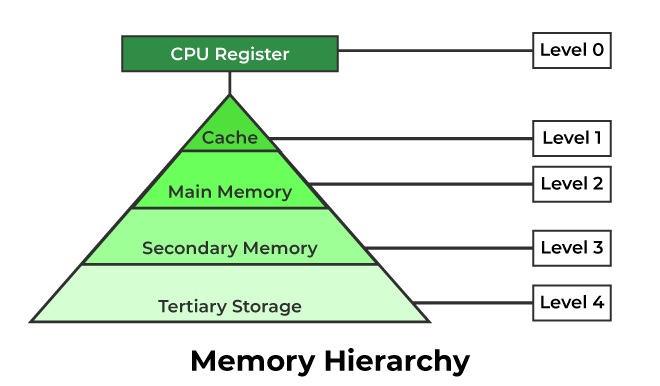
The memory hierarchy typically includes the following levels:
- CPU Registers: The temporary storage units within the CPU are directly accessible by the processor. They hold data required for immediate processing and act as intermediate storage during operations.
- Cache Memory: The fast memory located between the CPU and main memory. Cache memory exploits the principle of temporal locality, caching frequently accessed data to reduce the need to access slower main memory frequently.
- logic, (RAM): Slower than cache memory but larger in capacity the main memory holds data and instructions that are currently being used by the CPU.
- Secondary Storage: The slowest but highest-capacity memory used for the long-term storage of data and programs.
Types of Registers
- Accumulator Register
- Program Counter (PC) Register
- General-Purpose Registers
- Instruction Register (IR)
- Memory Address Register (MAR)
- Memory Data Register (MDR)
- Stack Pointer (SP)
- Floating-Point Registers
Accumulator Register
The accumulator acts as a central point for arithmetic and logical operations within the CPU. It fetches data from memory and stores intermediate results during calculations. Arithmetic operations such as addition, subtraction, multiplication, and division often take place in the accumulator. The final result may be stored in the accumulator or transferred to other registers or memory locations.
Program Counter (PC) Register
The program counter is a special register that keeps track of the memory address of the next instruction to be fetched and executed. As the CPU executes each instruction in sequence the program counter is updated to indicate the next instruction's address in memory. This process continues until the program's execution is complete.
General-Purpose Registers
General-purpose registers are versatile because they can hold data and memory addresses. They are used for various calculations and data manipulation tasks during program execution. General-purpose registers are essential for performing arithmetic and logical operations on data stored in the CPU.
Instruction Register (IR)
The instruction register holds the currently fetched instruction from memory. It allows the CPU to decode and execute the instruction based on its opcode and operands.
Memory Address Register (MAR)
The memory address register stores the memory address of data or instructions to be accessed or written in memory. It plays a crucial role in memory operations by indicating the location of the data or instruction the CPU needs to access.
Memory Data Register (MDR)
Holds the actual data fetched from or written to memory. When the CPU retrieves data from memory, it is temporarily stored in the MDR before being processed further.
Stack Pointer (SP)
The stack pointer is used in stack-based memory operations. It keeps track of the top of the stack. which is a region of memory used for temporary storage of data and return addresses during function calls.
Floating-Point Registers
Specialized for handling floating-point numbers and performing floating-point arithmetic operations. These registers can store and manipulate floating-point numbers with higher precision.
Applications of Registers
- Arithmetic and Logic Operations: The Registers are extensively used during arithmetic and logic operations in the CPU. They temporarily store operands, intermediate results, and flags facilitating quick and efficient calculations.
- Instruction Execution: The Registers play a crucial role in the execution of machine instructions. They hold instructions and data needed for immediate processing ensuring smooth program execution.
- CPU Pipelining: The pipelining is employed to increase performance by overlapping the execution of multiple instructions. Registers help in holding intermediate results and data between different stages of the pipeline.
- Context Switching: The CPU switches between different processes or threads.Registers are used to store the CPU's state including the program counter stack pointer and general-purpose registers during context switching.
- Memory Addressing: The memory address register (MAR) and memory data register (MDR) are involved in memory operations. MAR holds the memory address being accessed. while MDR temporarily stores data fetched from or written to memory.
- Floating-Point Operations: To Specialized floating-point registers are used for handling floating-point arithmetic operations. These registers can store and manipulate floating-point numbers with higher precision.
- Control Unit Operations: The Registers play a critical role in the control unit of the CPU. They hold control signals and flags that determine the control flow and sequencing of the instructions during program execution.
Advantages
- Speed: The Registers offer fast access times due to their proximity to the CPU, enhancing overall system performance.
- Data Processing Efficiency: They enable quick data manipulation, reducing the need to access slower main memory frequently.
Disadvantages
- Limited Capacity: The Registers have a small size, restricting the amount of data they can hold at a time.
- Cost: The Registers are made from flip-flops and require more hardware, contributing to the overall cost of the processor.