
The Graduate Aptitude Test in Engineering (GATE) is one of India’s most competitive exams, opening pathways to M.Tech admissions, PSU recruitment, and research opportunities. The GATE Result 2026 will be announced on March 19, 2026. To make the waiting period easier, the GATE Score Calculator 2026 by GeeksforGeeks helps aspirants get an early estimate of their score and plan their next steps with clarity and confidence.
Get accurate estimate of your rank, use our GATE Rank Predictor Tool - GATE RANK PREDICTOR 2026
In this article, we’ll explain everything you need to know about the Free GATE Score Predictor 2026, how it works, and how you can use it to estimate your GATE exam results.

What is GATE Score Predictor? Accurate GATE 2026 Rank Prediction Tool
A GATE Score Predictor is a reliable online tool developed by GeeksforGeeks that helps candidates estimate their GATE 2026 score based on their expected exam performance. It analyzes multiple factors, including:
- Your response sheet (section-wise marks obtained)
- The difficulty level of the GATE paper
- Previous year trends and the official normalization process
Unlike a GATE Rank Predictor, which estimates your All India Rank (AIR), a GATE Score Predictor focuses on calculating your final GATE score a key metric used for M.Tech admissions, PSU recruitment, and research opportunities.
Why Use a GATE Score Calculator 2026 by GeeksforGeeks
GeeksforGeeks, a trusted technology education platform, offers an advanced GATE Score Calculator 2026 to help aspirants estimate their expected GATE score before the official results are released in March 2026. This tool provides a reliable performance prediction, enabling candidates to make informed decisions early.
The tool offers several valuable features that make it particularly valuable for GATE Aspirants:
- Early Planning: This score predictor gives you an early indication of how you might have performed. This can be especially useful in understanding your strengths and weaknesses before the official results are out.
- Reduce Anxiety: The waiting period can be emotionally challenging. An estimated score can help alleviate reduce your anxiety by providing a concrete, though unofficial, benchmark.
- Strategic Planning: Knowing your estimated score can help you start planning your next steps. Whether it's further preparation, exploring potential colleges, or considering other options, you can begin planning based on your predicted performance.
- Self-Assessment: A score predictor can help you identify areas where you excelled and areas where you might have struggled. This self-assessment is valuable for future exam preparation, regardless of the official results.
How the GATE Score Predictor 2026 Works
The GATE Score Predictor 2026 estimates your expected performance by analyzing key exam-related factors. These typically include:
- Correct and Incorrect Answers: Based on the official GATE marking scheme, the tool calculates your raw score using your response accuracy.
- Exam Difficulty Level: The overall difficulty of the paper is considered to provide a more realistic score estimate, especially for tougher question sets.
- Section-wise Performance (Advanced Tools): Some predictors also evaluate performance across individual sections to improve prediction accuracy.
How to Use the GATE Rank Predictor 2026 by GeeksforGeeks
The GATE Rank Predictor 2026 by GeeksforGeeks estimates your expected rank using your response sheet, marks, and the normalization process. Follow the steps below to get your predicted rank:
Step 1: Download Your Response Sheet
- After taking the GATE 2026 exam, download your response sheet from the official GATE website.
Step 2: Open the GATE Rank Predictor
- Visit the GeeksforGeeks GATE Rank Predictor 2026 page in your browser.

Step 3: Enter Your Details
Fill in the required information:
- Country code and phone number
- Your GATE branch
- Paste the response sheet URL from the official GATE site
Branch Options You May See:
- Computer Science Engineering
- Electronics and Communication Engineering
- Electrical Engineering
- Mechanical Engineering
- Civil Engineering
- Chemical Engineering
- Instrumentation Engineering
- Data Analytics / Data Science Engineering
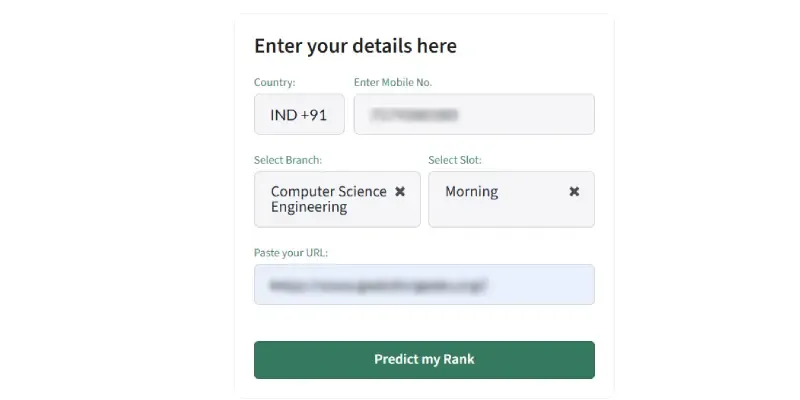
Step 4: Click Predict My Rank
- Once all details are entered, click the Predict My Rank button.
Step 5: Preview GATE Exam 2026 Results
- Now You can preview your results based on your Response Sheet.
Note: It's absolutely important to remember that GATE score predictors are not official. They are based on algorithms and estimations, and the actual results might vary. Treat the predicted score as a helpful estimate, not as a definitive prediction. The official GATE results released by the conducting authorities are the only valid measure of your performance
Step 6: Plan Your Next Steps
- Use your predicted rank to start evaluating admission possibilities, PSU opportunities, or future exam strategies. Remember, actual rank and cutoff trends may vary each year depending on overall performance and seat availability.
Factors Affecting GATE Score Prediction
Several factors influence the accuracy of your GATE score prediction:
- Normalization Process: GATE uses a normalization formula to ensure fairness across different sessions. This formula considers the mean and standard deviation of scores.
- Difficulty Level: The difficulty of your paper affects the normalization process and, consequently, your final score.
- Number of Candidates: Higher competition can impact cutoff trends and score distribution.
- Previous Year Trends: Analyzing past cutoff scores and trends can help refine your prediction.
What to Do After Estimating Your GATE Score Prediction
Once you have an estimated score, here’s how you can plan your next steps:
- Research Colleges: Use your predicted score to shortlist colleges and programs that match your score range.
- Prepare for Counseling: Start gathering documents and preparing for the counseling process.
- Explore PSU Opportunities: Check the eligibility criteria for PSU jobs and apply accordingly.
- Have a Backup Plan: If your score is lower than expected, explore alternative options like state-level exams or private institutions.
GATE Score-Rank Trends and College/Institute Details in 2026
Understanding the relationship between GATE Score and GATE Rank is essential for every aspirant. While your score reflects your exam performance, your rank determines your position among all candidates and plays a crucial role in college admissions and PSU recruitment.
Below is an approximate GATE score rank trend table based on recent years’ data and admission patterns. These ranges help aspirants assess their possibilities and plan accordingly.
| GATE Score Range | Expected Rank Range | Admission & Opportunities |
|---|---|---|
| 950–1000 | 1–50 | Top ranks; eligible for IISc Bengaluru and top IITs (IIT Bombay, Delhi, Madras) |
| 900–950 | 50–150 | Excellent rank; IITs and IISc in core branches |
| 850–900 | 150–400 | High rank; IITs, top NITs, and top PSUs (BARC, ONGC) |
| 800–850 | 400–800 | Good rank; IITs (select branches), NITs, IIITs |
| 750–800 | 800–1500 | Competitive rank; NITs, IIITs, and top state universities |
| 700–750 | 1500–3000 | Moderate rank; NITs, IIITs, and reputed state universities |
| 650–700 | 3000–6000 | Average rank; mid-tier NITs and state universities |
| 600–650 | 6000–12,000 | Below-average rank; state universities and private colleges |
| 550–600 | 12,000–25,000 | Low rank; limited options in state/private colleges |
| Below 550 | Above 25,000 | Very low rank; focus on private colleges or reappearing for GATE |
Note: The above table is designed to help GATE aspirants understand their admission possibilities and plan accordingly.
Key Notes:
- Top IITs and IISc: These institutes typically require ranks below 500 for most specializations.
- NITs and IIITs: Ranks between 500-5000 are generally sufficient for admission to top NITs and IIITs.
- State Universities and Private Colleges: Ranks above 5000 can still secure admission in reputed state universities and private colleges.
- PSU Jobs: Many PSUs have specific rank cutoffs, usually between 1-2000 for top PSUs like BARC, ONGC, and IOCL.
Understanding College Categories for GATE Aspirants
- Top-Tier Colleges (IITs, IISc, etc.): These institutes have very high cutoffs and intense competition. Admission typically requires an excellent GATE score and rank.
- Mid-Tier Colleges (NITs, IIITs, other reputed institutions): These colleges have competitive but relatively lower cutoffs than top-tier institutes. A strong GATE score significantly improves your admission chances.
- Other Institutions: Many government and private universities accept GATE scores for postgraduate programs and usually have more flexible cutoff requirements.
Example Scenario:
If your GATE score is around 780, your expected rank range may fall between 500–1000.
- With this score, you can target NITs, IIITs, and top state universities for M.Tech admissions.
- You may also be eligible for PSU recruitment through organizations such as ONGC, IOCL, and BARC.
Crucial Reminders and Disclaimer
- Official Cutoffs Matter: The rank and college information provided is based on previous years’ trends and is meant for reference only. It does not guarantee admission, as actual cutoffs vary each year.
- Admissions Depend on Multiple Factors: Final admission decisions are influenced by overall candidate performance, seat availability, and individual institute admission policies.
- Always Check Official Sources: For the most accurate and up-to-date details on cutoffs, eligibility, and admission procedures, refer to the official websites of the respective colleges and institutes.