
A Half Adder and a Full Adder are fundamental building blocks of digital electronics used to perform binary addition. They form the basis of arithmetic operations inside computers and digital systems.
Half Adder
Half Adder is a combinational logic circuit that is designed by connecting one EX-OR gate and one AND gate. The half-adder circuit has two inputs: A and B, which add two input digits and generate a carry and a sum.
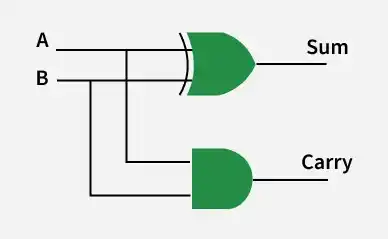
The output obtained from the EX-OR gate is the sum of the two numbers while that obtained by AND gate is the carry. There will be no forwarding of carry addition because there is no logic gate to process that. Thus, this is called the Half Adder circuit.
Logical Expression of Half Adder
The Logical Expression for half added is given as
Sum = A ⊕ B
Carry = A AND B
Truth Table of Half Adder
The Truth Table for Half Added is Given as 
Advantages
- Flexible and easy when it comes to design.
- Involves the use of fewer logic gates thus, is cheaper.
Disadvantages
- Fails to process a carry input from the previously added numbers.
- Restricted to the addition of only two bits.
Applications
- Arithmetic operations like addition, subtraction, and multiplication in low level dynamic circuits.
- Three types of rectifiers: half-wave, full-wave, and full-wave with a center tapped secondary. Used in small integration circuits.
Full Adder
Full Adder is the circuit that consists of two EX-OR gates, two AND gates, and one OR gate. Full Adder is the adder that adds three inputs and produces two outputs which consist of two EX-OR gates, two AND gates, and one OR gate. The first two inputs are A and B and the third input is an input carry as C-IN. The output carry is designated as C-OUT and the normal output is designated as S which is SUM.
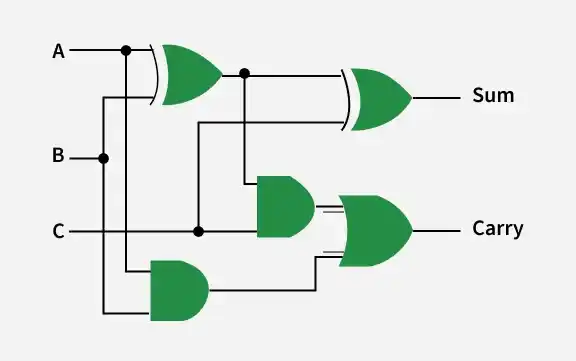
The equation obtained by the EX-OR gate is the sum of the binary digits. While the output obtained by AND gate is the carry obtained by addition.
Logical Expression of Full Adder
Given Below is the Logical Expression of Full Adder
SUM = (A XOR B) XOR Cin = (A ⊕ B) ⊕ Cin
CARRY-OUT = A AND B OR Cin(A XOR B) = A.B + Cin(A ⊕ B)
Truth Table of Full Adder
Sum and Carry Operation
In both Half Adders and Full Adders, Sum is the output of the addition of the two inputs and Carry is the output which is an overflow of the output position and needs to be shifted to the next higher position while adding successive bit inputs.
- Sum (S) : It results from the XOR gate, which is a logic gate that adds two or more bits together in the same way that you add in base 2 with no acknowledgement of carry from the previous bit.
- Carry (C or Cout): It is the output of the AND operation in the case of the Half Adder or both AND and OR Operations in the case of the Full Adder to indicate that a ‘1’ has to be carried over to the next bit position.
Advantages
- Can add 3 bits, it includes one carry input and a carry output, which can perform more elaborate computations.
- It can be cascaded to produce adders for a number of bit additions which makes it suitable for multi bit arithmetic.
Disadvantages
- Complex and needs more gates, hence making the design more complicate and expensive.
- Yeah man, slightly slower because normally 2 gate process are used instead of 1.
Applications
- Carry-look ahead adders in digital processors that utilize multi-bit binary addition.
- Present in the arithmetic logic units (ALU) and other complicated digital systems.
Half Adder vs Full Adder
| Half Adder | Full Adder |
|---|---|
| Half Adder is a combinational logic circuit that adds two 1-bit digits. | A full adder is a combinational logic circuit that performs an addition operation on three one-bit binary numbers. |
| The previous carry is not used. | The previous carry is used. |
| In Half adder, there are two input bits ( A, B). | In full adder, there are three input bits (A, B, C-in). |
| The generated output is of two bits-Sum and Carry from the input of 2 bits. | The generated output is of two bits-Sum and Carry from the input of 3 bits. |
| A half adder circuit cannot be used in the same way as a full adder circuit. | A full adder circuit can be used in place of a half adder circuit. |
| It is simple and easy to implement | The design of a full adder is not as simple as a half adder. |
| Logical Expression for half adder is : S=a⊕b ; C=a*b. | Logical Expression for Full adder is : S=a⊕b⊕Cin; Cout=(a*b)+(Cin*(a⊕b)). |
| It consists of one EX-OR gate and one AND gate. | It consists of two EX-OR, two AND gates, and one OR gate. |
| It is used in Calculators, computers, digital measuring devices, etc. | It is used in Multiple bit addition, digital processors, etc. |
| There is no alternate name for half adder. | Full adder is also known as ripple-carry adder. |