
AdaBoost (Adaptive Boosting) is an ensemble learning technique that combines multiple weak classifiers to build a strong model. It works by sequentially focusing more on the misclassified data points from previous models.
- Trains models sequentially, each correcting previous errors
- Assigns higher weights to misclassified samples
- Final prediction is made using weighted voting
Adaboost Working
AdaBoost (Adaptive Boosting) assigns equal weights to all training samples initially and iteratively adjusts these weights by focusing more on misclassified data points for the next model. It effectively reduces bias and variance making it useful for classification tasks but it can be sensitive to noisy data and outliers.
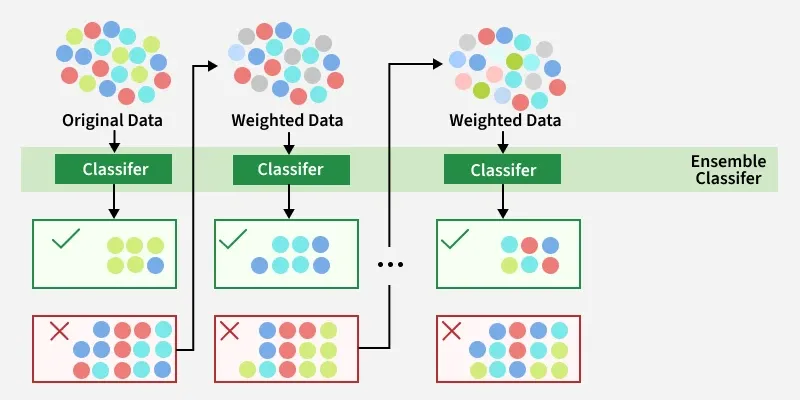
The above diagram explains the AdaBoost algorithm in a very simple way. Let’s try to understand it in a stepwise process:
Step 1: Initial Model (B1)
- The dataset consists of multiple data points (red, blue and green circles).
- Equal weight is assigned to each data point.
- The first weak classifier attempts to create a decision boundary.
- 8 data points are wrongly classified.
Step 2: Adjusting Weights (B2)
- The misclassified points from B1 are assigned higher weights (shown as darker points in the next step).
- A new classifier is trained with a refined decision boundary focusing more on the previously misclassified points.
- Some previously misclassified points are now correctly classified.
- 6 data points are wrongly classified.
Step 3: Further Adjustment (B3)
- The newly misclassified points from B2 receive higher weights to ensure better classification.
- The classifier adjusts again using an improved decision boundary and 4 data points remain misclassified.
Step 4: Final Strong Model (B4 - Ensemble Model)
- The final ensemble classifier combines B1, B2 and B3 to get strengths of all weak classifiers.
- By aggregating multiple models the ensemble model achieves higher accuracy than any individual weak model.
Now that we have learned how boosting works using Adaboost now we will learn more about different types of boosting algorithms.
Types Of Boosting Algorithms
There are several types of boosting algorithms some of the most famous and useful models are as :
- Gradient Boosting: Gradient Boosting constructs models in a sequential manner where each weak learner minimizes the residual error of the previous one using gradient descent. Instead of adjusting sample weights like AdaBoost Gradient Boosting reduces error directly by optimizing a loss function.
- XGBoost: XGBoost is an optimized version of Gradient Boosting that uses regularization to prevent overfitting. It is faster, efficient and supports handling both numerical and categorical variables.
- CatBoost: CatBoost is particularly effective for datasets with categorical features. It employs symmetric decision trees and a unique encoding method that considers target values, making it superior in handling categorical data without preprocessing.
Advantages of Boosting
- Improved Accuracy: By combining multiple weak learners it enhances predictive accuracy for both classification and regression tasks.
- Robustness to Overfitting: Unlike traditional models it dynamically adjusts weights to prevent overfitting.
- Handles Imbalanced Data Well: It prioritizes misclassified points making it effective for imbalanced datasets.
- Better Interpretability: The sequential nature of helps break down decision-making making the model more interpretable.
By understanding Boosting and its applications we can use its capabilities to solve complex real-world problems effectively.