
Support Vector Regression predicts continuous values by fitting a function within a defined error margin. It uses kernel functions to handle both linear relationships and complex non-linear patterns in data.
- Works well with high-dimensional data
- Uses linear and kernel-based transformations
- Controls model flexibility using regularization parameters
- Effective for real-world datasets with limited samples
Linear Kernel SVR
Linear SVR is used when the relationship between input features and the target variable is approximately linear. It fits a straight regression function in the original feature space without transforming the data into higher dimensions.
Kernel Function:
K(x_i,x_j)=x_i.x_j
When to use
- Data shows a linear trend
- Large datasets with many features
- Interpretability is important
Linear SVR is computationally efficient, interpretable and suitable for datasets where features have a direct and proportional relationship with the output.
Non-Linear Kernel SVR
Non-linear SVR is applied when the relationship between input and output is complex and cannot be captured by a straight line. It uses kernel functions to implicitly map data into higher-dimensional spaces where a linear relationship can be learned.
This enables SVR to model curved patterns and complex feature interactions commonly found in real-world data.
Common Non-Linear Kernels
- RBF (Gaussian) Kernel: The RBF kernel is the most widely used non-linear kernel in SVR. It measures similarity based on distance and allows the model to create smooth, flexible regression curves. It is highly effective for capturing localized and non-linear patterns.
- Polynomial Kernel: The polynomial kernel models polynomial relationships between features and targets. It is useful when interactions between features follow polynomial behaviour but can become computationally expensive for higher degrees.
- Sigmoid Kernel: The sigmoid kernel resembles neural network activation functions and is less commonly used in regression tasks due to stability issues.
Implementation
Let's see a step-by-step SVR implementation.
Step 1: Import Libraries
We need to import the necessary libraries such a NumPy, Matplotlib, sklearn,
import numpy as np
import matplotlib.pyplot as plt

from sklearn.datasets import load_diabetes
from sklearn.model_selection import train_test_split
from sklearn.preprocessing import StandardScaler
from sklearn.svm import SVR
from sklearn.metrics import mean_squared_error, mean_absolute_error
Step 2: Load Dataset
Here:
- The diabetes dataset is loaded directly from Scikit-Learn
- X contains medical input features
- y contains disease progression values
data = load_diabetes()

X = data.data
y = data.target
Step 3: Select One Feature
Here:
- Only the BMI feature is selected from the dataset
- Data is reshaped into a 2D array as required by Scikit-Learn
- Simplifies visualization to a 1D regression curve
X = X[:, 2].reshape(-1, 1)
Step 4: Train-Test Split
Dataset is split into training and testing subsets, 80% data is used for training and 20% for testing.
X_train, X_test, y_train, y_test = train_test_split(
    X, y, test_size=0.2, random_state=42
)
Step 5: Feature Scaling
- Separate scalers are created for input features and target values
- Training data is standardized to zero mean and unit variance
- Test data is transformed using the same scaling parameters
- Target values are also scaled for stable SVR optimization
scaler_X = StandardScaler()
scaler_y = StandardScaler()

X_train = scaler_X.fit_transform(X_train)
X_test = scaler_X.transform(X_test)

y_train = scaler_y.fit_transform(y_train.reshape(-1, 1)).ravel()
y_test = scaler_y.transform(y_test.reshape(-1, 1)).ravel()
Step 6: Train Linear Kernel SVR
Here:
- A Linear SVR model is created
- C=100 controls error penalty strength
- epsilon=0.1 defines the tolerance margin
- Model learns a straight regression function
- Predictions are generated on test data
svr_linear = SVR(kernel='linear', C=100, epsilon=0.1)
svr_linear.fit(X_train, y_train)

y_pred_linear = svr_linear.predict(X_test)
Step 7: Train RBF Kernel SVR
- An RBF (non-linear) SVR model is created
- gamma controls influence range of data points
- Model learns a smooth, non-linear regression curve
- Predictions are generated for comparison
svr_rbf = SVR(kernel='rbf', C=100, gamma=0.5, epsilon=0.1)
svr_rbf.fit(X_train, y_train)

y_pred_rbf = svr_rbf.predict(X_test)
Step 8: Sort Test Data
- Test input values are sorted in ascending order
- Corresponding actual and predicted values are reordered
sorted_idx = np.argsort(X_test[:, 0])

X_test_sorted = X_test[sorted_idx]
y_test_sorted = y_test[sorted_idx]

y_pred_linear_sorted = y_pred_linear[sorted_idx]
y_pred_rbf_sorted = y_pred_rbf[sorted_idx]
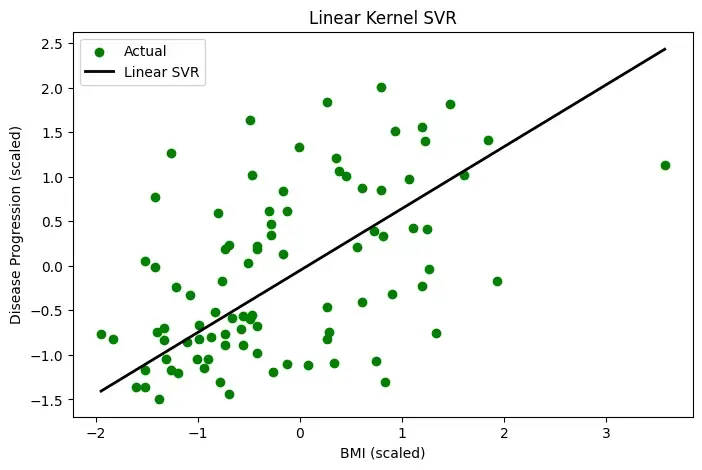
Step 9: Plot Linear SVR
Here we plot the linear SVR:
plt.figure(figsize=(8, 5))
plt.scatter(X_test_sorted, y_test_sorted, color='green', label='Actual')
plt.plot(X_test_sorted, y_pred_linear_sorted,
         color='black', linewidth=2, label='Linear SVR')

plt.title("Linear Kernel SVR")
plt.xlabel("BMI (scaled)")
plt.ylabel("Disease Progression (scaled)")
plt.legend()
plt.show()
Output:
Step 10: Plot RBF SVR
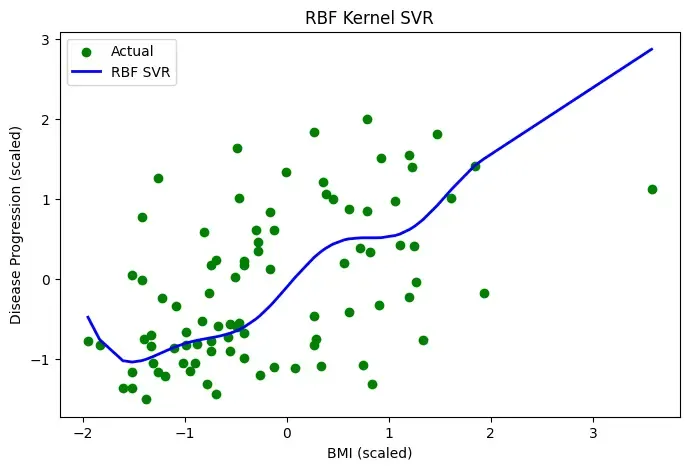
We plot the RBF SVR:
plt.figure(figsize=(8, 5))
plt.scatter(X_test_sorted, y_test_sorted, color='green', label='Actual')
plt.plot(X_test_sorted, y_pred_rbf_sorted,
         color='blue', linewidth=2, label='RBF SVR')

plt.title("RBF Kernel SVR – Diabetes Dataset")
plt.xlabel("BMI (scaled)")
plt.ylabel("Disease Progression (scaled)")
plt.legend()
plt.show()
Output:
Step 11: Evaluate Models
a. Linear SVR
- RMSE measures average prediction error magnitude
- MAE measures absolute deviation from actual values
- Higher values indicate weaker performance
rmse_linear = np.sqrt(mean_squared_error(y_test, y_pred_linear))
mae_linear = mean_absolute_error(y_test, y_pred_linear)

print("Linear SVR RMSE:", rmse_linear)
print("Linear SVR MAE:", mae_linear)
Output:
Linear SVR RMSE: 0.8423305650413904
Linear SVR MAE: 0.6735880994376383
b. RBF SVR
- Same metrics are computed for fair comparison
- Lower RMSE and MAE indicate better model fit
- Confirms numerical superiority of Linear SVR for this dataset
rmse_rbf = np.sqrt(mean_squared_error(y_test, y_pred_rbf))
mae_rbf = mean_absolute_error(y_test, y_pred_rbf)

print("RBF SVR RMSE:", rmse_rbf)
print("RBF SVR MAE:", mae_rbf)
Output:
RBF SVR RMSE: 0.8753416035431131
RBF SVR MAE: 0.6797975426553673
Applications
- Medical Prediction: Used to estimate disease progression and patient health outcomes from clinical data.
- Financial Forecasting: Applied in predicting stock prices, returns and market trends with non-linear behavior.
- Energy Demand Estimation: Helps forecast electricity load and energy consumption patterns.
- Sales Forecasting: Used to predict product demand and future sales in business analytics.
- Engineering Modelling: Applied in modeling physical systems and scientific regression problems.
Advantages
- Good Generalization: Margin-based learning helps SVR perform well on unseen data.
- Handles Non-Linearity: Kernel functions allow SVR to model complex relationships.
- Robust to Noise: ε-insensitive loss reduces sensitivity to small errors and noise.
- Effective with Small Data: Performs well even with limited training samples.
- Kernel Flexibility: Different kernels can be chosen based on problem requirements.
Limitations
- Hyperparameter Sensitivity: Requires careful tuning of C, ε and kernel parameters.
- High Computational Cost: Training becomes slow for large datasets.
- Scaling Requirement: Feature scaling is mandatory for good performance.
- Low Interpretability: Non-linear SVR models are hard to interpret.
- Kernel Selection Difficulty: Choosing the right kernel often needs experimentation.