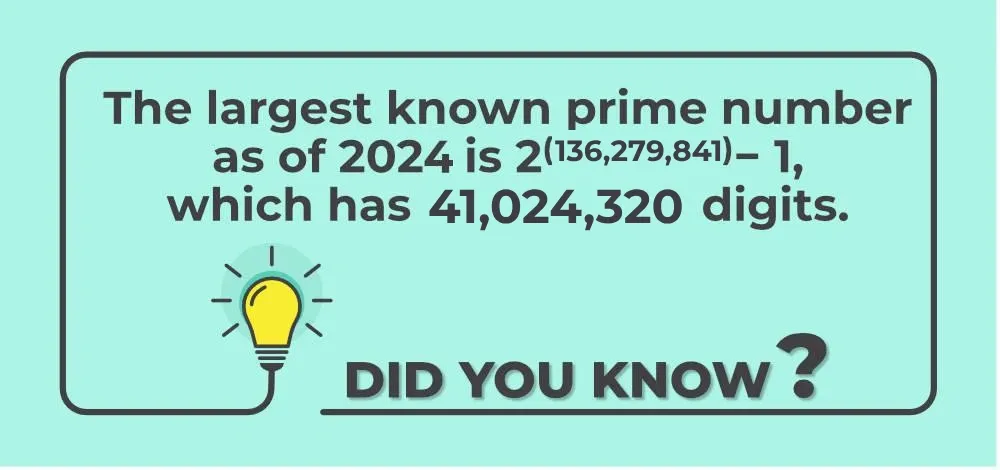
Prime numbers are natural numbers greater than 1 that can be divided only by themselves and 1. For instance, numbers 2, 3, 5, 7, and 11 are the prime numbers since they can only be divided by 1 and themselves; there is no other number that can fully divide them.
Prime numbers have fundamental features and a vast range of uses that make them essential in many domains, from number theory to encryption.
Some amazing facts related to prime numbers are
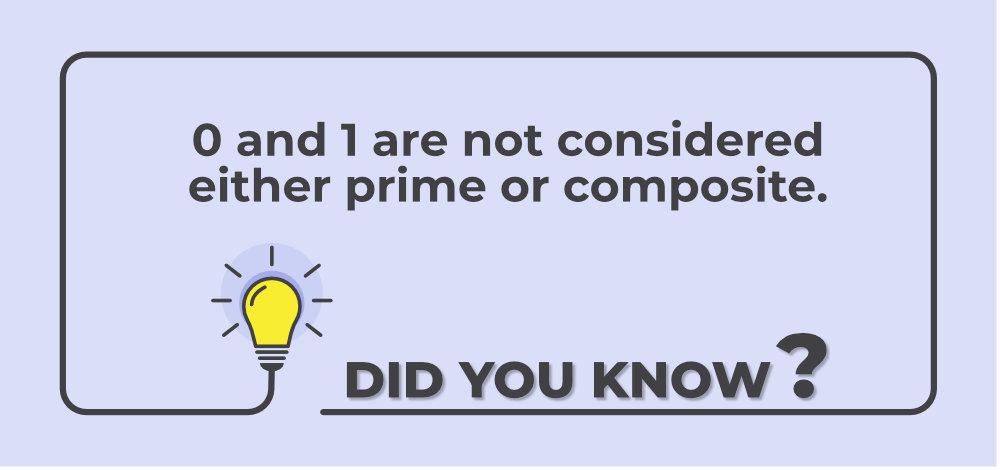
- Every natural number is either a prime or a composite except 0 or 1.
- All numbers in the universe are either prime numbers or prime number products.
- 2 is the smallest prime number.
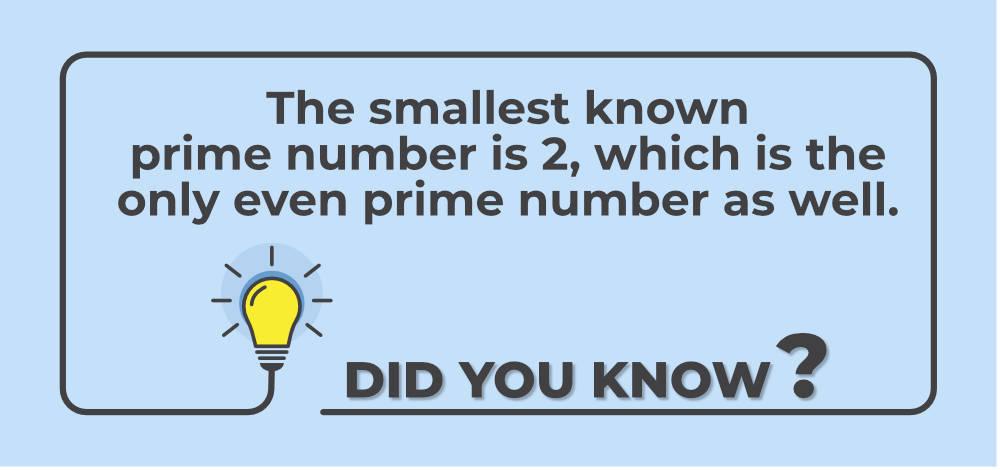
- With the exception of 2, which is an even prime number, all prime numbers are odd.
- There is just a single prime number that has 5 in its first position. With the exception of 5, no other prime number has 5 as the last digit.
- Goldbach's conjecture states that every even natural number greater than 2 is the sum of two prime numbers. The conjecture has been shown to hold for all integers less than 4×10¹⁸ but remains unproven despite considerable effort. For example, 13 can be written as 11 + 2.
- GCD of two prime numbers is always 1.
- All prime numbers, with the exception of 2 and 5, end with 1, 3, 7, or 9 (remaining odd digits)
- A product of two prime numbers is always a composite number.
- All other prime numbers, with the exception of two and three, are either 6n+1 or 6n-1. For a natural number n. Let's take some examples: 5 = 6 - 1, 7 = 6 + 1, 11 = 6 × 2 – 1, and 13 = 6 × 2 + 1. A point to note is that all numbers larger than 3 are of the form (6n+1 OR 6n-1) but not all numbers of this form are prime numbers.
- All other prime numbers, with the exception of two, are either 4n+1 or 4n-1, where n is a natural number.
- There is at least one prime number between an integer and it doubles for every number greater than 1.
- From 1 to 100, there are a total of 25 prime numbers, From 100 to 200, 21 prime numbers, From 200 to 300, 16 prime numbers. From 300 to 500, 33 prime numbers. From 1 to 1000, 168 prime numbers. From 1 to 10,000, 1229 prime numbers.
- As per, the Prime Number Theorem, the nth prime number pn satisfies pn approximates to n log n. The relative error of this approximation approaches 0 as n increases without bounds. For example, the 2×10¹⁷th prime number is 8512677386048191063, and (2×10¹⁷)log(2×10¹⁷) rounds to 7967418752291744388, a relative error of about 6.4%.
- Mersenne Primes There are prime numbers of the form 2p - 1 where p is a prime number. This theorem is useful in finding out large primes.
- Euler Published a formula k2 − k + 41. When we put k = 1 to 40, we get prime numbers. These numbers are 41, 43, 47, 53, 61, 71, 83, 97, 113, 131, ... These numbers are called Euler's Lucky Primes.
- The popular RSA algorithm which is used in HTTPS and many other places in Internet is based on the fact that it is easy to multiply two number, but difficult to find prime factors of the multiplication.
- Lemoine’s Conjecture: Any odd integer greater than 5 can be expressed as a sum of an odd prime (all primes other than 2 are odd) and an even semiprime. A semiprime number is a product of two prime numbers. This is called Lemoine’s conjecture.
- To calculate the sum of factors (or divisors) of a number, we can find the number of prime factors and their exponents. Let p1, p2, … pk be prime factors of n. Let a1, a2, .. ak be the highest powers of p1, p2, .. pk respectively that divide n, i.e., we can write n as n = (p1a1)*(p2a2)* … (pkak).
Sum of divisors = (1 + p1 + p12 ... p1a1) *
(1 + p2 + p22 ... p2a2) *
.............................................
(1 + pk + pk2 ... pkak)
We can notice that individual terms of above formula are Geometric Progressions (GP). We can rewrite the formula as.
Sum of divisors = (p1a1+1 - 1)/(p1 -1) *
(p2a2+1 - 1)/(p2 -1) *
..................................
(pkak+1 - 1)/(pk -1)