

A quadrilateral is a two-dimensional polygon with four sides, four vertices, and four angles, formed by joining four points with straight line segments. Various types of quadrilaterals based on their properties include:

The area of a quadrilateral is the space enclosed within its four sides, measured in square units.
It can be calculated by dividing the quadrilateral into two triangles using a diagonal. If the length of the diagonal and the perpendicular heights from the other two vertices are known, the area is given by:
A = ½ × Diagonal × (Sum of heights)
Area of a Quadrilateral Formula
In a quadrilateral ABCD, the length of the diagonal BD is 'd'. ABCD can be divided into two triangles Δ ABD, and Δ BCD by the diagonal BD. For calculating the area of the quadrilateral ABCD we calculate the area of individual triangles and add them accordingly. But for calculating area of a triangle, its height must be known. Let us assume that the heights of the triangles ABD and BCD are h1 and h2 respectively.
Area of the triangle ABD = (1/2) × d × h1.
Area of the triangle BCD = (1/2) × d × h2.

From the figure, the area of the quadrilateral ABCD = area of ΔABD + area of ΔBCD.
Area of the quadrilateral ABCD = (1/2) × d × h1 + (1/2) × d × h2 = (1/2) × d × ( h1 + h2 ).
Thus, the formula used to find the area of a quadrilateral is,
Area of Quadrilateral = (1/2) × Diagonal × (Sum of heights) = (1/2) × d × ( h1 + h2 )
Area of Quadrilateral with Vertices
If vertices of a quadrilateral are given suppose A(x1, y1), B(x2, y2), C(x3, y3), and D(x4, y4) be the vertices of a quadrilateral ABCD.
Then its area is calculated by using two different methods which are:
- Shoelace Theorem
- Area using Triangles

Area of a the Quadrilateral Using Coordinate Geometry (or Shoelace Theorem)
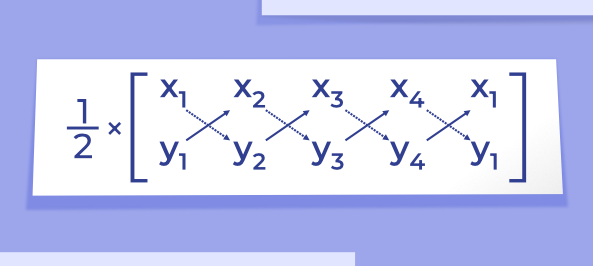
Follow the directions of the arrow, and add the diagonal products, i.e., x1y2, x2y3, x3y4, and x4y1.
(x1y2 + x2y3 + x3y4 + x4y1)….(i)
Now, follow the dotted arrows and add the diagonal products, i.e., x2y1, x3y2, x4y3, and x1y4.
(x2y1 + x3y2 + x4y3 + x1y4)….(ii)
Now, subtract equation (ii) from (i) and multiply the result by 1/2.
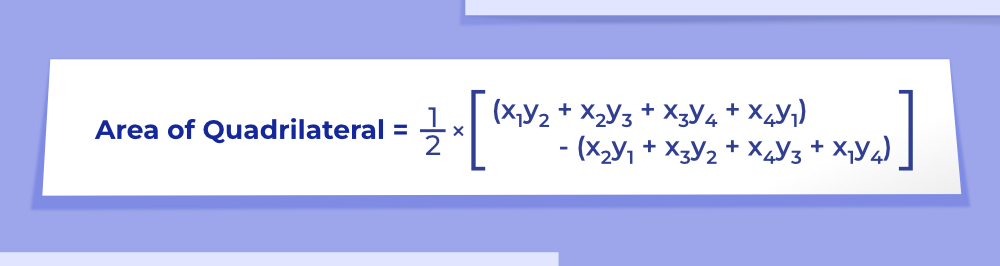
(1/2) × [(x1y2 + x2y3 + x3y4 + x4y1) – (x2y1 + x3y2 + x4y3 + x1y4)]
Thus, the formula for the area of the quadrilateral when the areas are given:
Area of Quadrilateral Using Area of Triangle
For this method, we divide the given quadrilateral into two triangles and then find the area of each triangle separately. At last, both the triangles are added to find the final area of the quadrilateral.
Area of quadrilateral ABCD = Area of triangle ABD + Area of triangle BCD
Area of a triangle with vertices P(x1, y1), Q(x2, y2), and R(x3, y3) is given by

Area of a Quadrilateral Using Bretschneider′s Formula
When two opposite angles and all the sides of a quadrilateral are given, we can calculate its area using Bretschneider's Formula,, which is the extension of Heron's formula for quadrilaterals and is given as follows:

Area Formulas for Common Quadrilaterals
Some specific quadrilaterals are very common and are used in our daily life, and their formula for areas are explained in the article given below:
Area of a Square
A square is a special case of a rectangle in which all four sides are equal and opposite sides are parallel. In a square, the side is a.

Read More:Area of a Square
Area of a Rectangle
A rectangle is a closed figure with four sides in which opposite sides are equal and parallel, and its diagonals bisect each other.

Read More: Area of a Rectangle
Area of a Rhombus
A Rhombus is a special case of a, square in which all the four sides and opposite angles are the same in measure and the opposite sides are parallel, and the sum of the adjacent angles of a rhombus is equal to 180 degrees.

Read More: Area of a Rhombus
Area of a Parallelogram
A parallelogram is a quadrilateral in which opposite sides are equal and parallel. In a parallelogram, diagonals bisect each other, opposite angles are equal, and adjacent angles are supplementary (sum to 180°).

Read More: Area of a Parallelogram
Area of a Trapezium
This quadrilateral is different from others as it has only one pair of opposite sides parallel; the adjacent angles along each leg are supplementary, while the diagonals do not generally bisect each other in the same ratio.

Read More: Area of a Trapezium
Area of a Kite
A kite is a special quadrilateral in which each pair of consecutive sides is congruent, but the opposite sides are not congruent. In this, the largest diagonal of a kite bisects the smallest diagonal.

Also Read: Area of Kite
Solved Examples
Example 1: Find the area of the quadrilateral ABCD when its vertices are (1, 2), (5, 6), (4, -6), and (−5, 2).
Solution:
Let A(1, 2), B(5, 6), C(4, -6), and D(-5, 2) be the vertices of a quadrilateral ABCD.
A(1, 2) = (x1, y1), B(5, 6) = (x2, y2), C(4, -6) = (x3, y3), D(-5, 2) = (x4, y4)
We know that,
Area of Quadrilateral = (1/2) × [(x1y2 + x2y3 + x3y4 + x4y1) – (x2y1 + x3y2 + x4y3 + x1y4)]
⇒ Area of Quadrilateral = (½). {[1(6) + 5(-6) + 4(2) + (-5)2] – {[5(2) + 4(6) + (-5)(-6) + 1(2)]}
⇒ Area of Quadrilateral = (½).[(6 – 30 + 8 – 10) – (10 + 24 + 30 + 2)]
⇒ Area of Quadrilateral = (½) [-26 - 66]
⇒ Area of Quadrilateral = 92/2 (area is never negative)
⇒ Area of Quadrilateral = 46 unit2
Example 2: Find the area of the trapezium if the ,height is 5 cm and AB and CD are given as 10 and 6 cm respectively.
Solution:
Given, AB = 10cm, CD = 6cm, height = 5cm
According to the formulae,
Area of Trapezium = (1/2) h (AB + CD)
⇒ Area of Trapezium = 1/2 x 5 x (10 + 6)
⇒ Area of Trapezium = 40 cm2
Example 3: Find the area of a kite whose longest and shortest diagonals are 20cm and 10cm respectively.
Solution:
Length of longest diagonal, D1= 20 cm
Length of shortest diagonal, D2= 10 cm
So, Area of kite =1/2 x D1 x D2
⇒ Area of kite = 1/2 x 20 x 10
⇒ Area of kite = 100 cm2
Example 4: Calculate the area of the rhombus if the base and height are 10 m and 15, respectively.
Solution:
Given, base = 10 m and height = 15 m
Area of Parallelogram = Base × Height⇒ Area of Parallelogram = 10 x 15
⇒ Area of Parallelogram = 150 m2
Practice Problems
Question 1: Find the area of a parallelogram with base 6 cm and a height 8 cm.
Question 2: A rectangle has a length of 10 meters and a width of 4 meters. Calculate its area.
Question 3: Calculate the area of a trapezoid with bases of lengths 6 cm and 10 cm, and a height of 5 cm.
Question 4: Given that the diagonals of a rhombus are 8 cm and 10 cm, find the area of the rhombus.
Question 5: You are given the coordinates of the vertices of an irregular quadrilateral: A(0,0), B(4,3), C(6,7), D(2,5). Calculate its area.
Answer Key
Answer 1: Area of parallelogram is 48 cm².
Answer 2: Area of rectangle is 40 m².
Answer 3: Area of trapezoid is 40 cm².
Answer 4: Area of rhombus is 40 cm².
Answer 5: Area of irregular quadrilateral is 15 square units.