

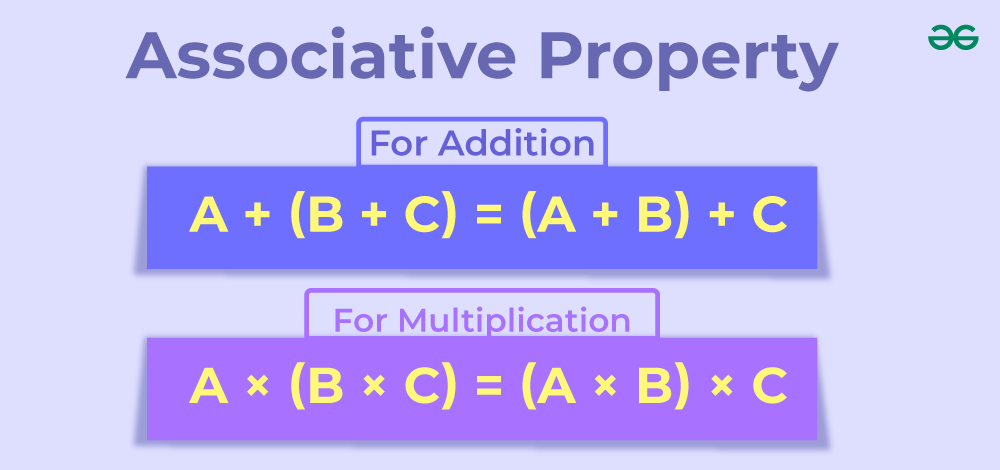
The associative law states that the sum or product of any three or more numbers is unaffected by how the numbers are grouped by parenthesis. It applies only to addition and multiplication.
In other words, even if the same numbers are grouped differently for addition and multiplication, the outcome will be the same.
Associative Property of Addition
As per the associative property of addition or Associative Law of Addition, the sum of three or more numbers remains the same regardless of how the numbers are grouped. Assume we have three numbers: a, b, and c. So, formula of Associative property is,
(A + B) + C = A + (B + C)
Associative Property of Addition Example
Example: Verify Associative Law of Addition for 5, 8 and 6
Solution:
We have (A + B) + C = A + (B + C)
Suppose a= 5 , b = 8 , c = 6
{(5 + 8) + 6} = {5 + (8 + 6)}
{13 + 6} = {5 + 14}
19 = 19
Hence Proved
It does not matter how the numbers are grouped , the sum of three numbers will remain same .
Associative Property of Multiplication
As per associative property of multiplication, product of three or more numbers remains the same regardless of how the numbers are grouped.
Assume we have three numbers: a, b, and c. The following formula can be used to express the associative property of multiplication
(A × B) × C = A × (B × C)
Associative Property of Multiplication Example
Example: Verify if (5 × 8) × 6 = 5 × (8 × 6)
Solution:
We have (A × B) × C = A × (B × C)
Here we suppose : a = 5 , b = 8 , c = 6
{(5 × 8 ) × 6 } = {5 × ( 8 × 6)}
{40 × 6} = {5 × 48}
240 = 240
Hence Proved
It does not matter how numbers are grouped, product of three numbers will remain same
Commutative Property
The commutative property states that the order of the numbers involved in the operation does not affect the result. This property applies to both addition and multiplication.
Commutative Property of Addition:
a + b = b + a
For example, 3 + 5 = 5 + 3
Commutative Property of Multiplication:
a × b = b × a
For example, 4 × 6 = 6 × 4
Associative Property of Subtraction
Associative Property is not valid for Subtraction i.e (A - B) - C ≠ A - (B - C). Let's see this with an example.
Example: Check if (15 - 7) - 5 = 15 - ( 7 - 5)
Solution:
Suppose , a = 15 , b = 7 , c = 5
LHS = (A - B) - C = ( 15 - 7) - 5 = 8 - 5 = 3
RHS = A - (B - C) = 15 - (7 - 5) = 15 - 2 = 13
Here, 3 ≠ 13
⇒ LHS ≠ RHS
Hence, (A - B) - C ≠ A - (B - C)
Hence proved that Associative property is not applicable in case of subtraction
Associative Property of Division
Associative Property is not valid for Division i.e. (A ÷ B) ÷ C ≠ A ÷ (B ÷ C). Let's see this with an example
Example: Check if {(9 ÷ 3) ÷ 2} = {9 ÷ (3 ÷ 2)}
Solution:
Let a = 9, b = 3 and c = 2
LHS = (a ÷ b) ÷ c = (9 ÷ 3) ÷ 2 = 3/2
RHS = a ÷ (b ÷ c) = 9 ÷ (3 ÷ 2) = 9 x 2/3 = 6
Here,3/2 ≠ 6
⇒ LHS ≠ RHS
Hence, (A ÷ B) ÷ C ≠ A ÷ (B ÷ C)
Hence proved associative property is not applicable for division method
Associative Property of Matrix Multiplication
Associative Property is also valid for multiplication of matrices. We know that matrices are rectangular arrays of numbers. When three matrices are multiplied their product remains same irrespective of pair of matrices taken for multiplication.
Let's say we have three matrices A, B and C then associative property of matrix multiplication is given as (A × B) × C = A × (B × C). Let's understand it with an example
Let Check Associative for above given three matrices
LHS We have (A × B) × C =
On RHS we have A × (B × C) =
Hence, we see that product of matrices on both LHS and RHS are equal. Hence, we say that the Matrix Multiplication Follows Associative Property.
Learn More :Matrix Multiplication
Associative and Commutative P
Let's discuss the key differences between both Associative and Commutative Property.
Associative vs Commutative Property | |
|---|---|
Commutative Property | Associative Property |
Commutative property derives from the phrase "commute," which means "move around," and refers to the ability to switch numbers that are being added or multiplied regardless of their order. | Term "associative" derives from the word "associate". The association property may be utilized for performing basic mathematical operations such as addition and multiplication. This is usually applicable to more than two numbers. |
Formula of Commutative Property is : (a+ b) = (b + a) | formula of Associative property is : (A + B) + C = A + (B + C) |
Formula of Commutative Property is : (a × b) = (b × a) | Associative Property of Multiplication : (A × B) × C = A × (B × C) |
Related Articles:
Associative Property Examples
Example 1: If 2 × (3 × 4) = 24, then find the product of (2 × 3) × 4 using the associative property.
Solution:
As we know Associative property is applicable for multiplication, It states that product of three or more numbers remains the same regardless of how the numbers are grouped
(2 × 3) × 4 = 2 × (3 × 4)
⇒ 24 = 24
Example 2: Prove the associative property of multiplication for the whole numbers 5, 0, and 15.
Solution:
According to the associative property of multiplication:
(A × B) × C = A × (B × C)
⇒ 5 × (0 × 15) = (5 × 0) × 15
⇒ 5 × 0 = 0 × 15
⇒ 0 = 0
Hence, Proved
Example 3: Solve the equation 12 + (10 + 2) using the Associative property.
Solution:
We know that Associative property are:
(A + B) + C = A + (B + C)
So, (12 + 10) + 2 = 12 + (10 + 2)
⇒ 22 + 2 = 12 + 12
⇒ 24 = 24
Practice Questions on Associative Property
1. If (30 × 10) × 15 = 4500, then use associative property to find (15 × 30) × 10.
2. Check whether the associative property of addition is applicable in the given equations or not .
- 5 + (60 + 10) = (5 + 60) + 10
- 55 + (30 + 20) = (55 + 30) + 25
3. Prove that : 2 ×(2×5) = (2×2)×5
4. By using these numbers 12 × 14 × 15 , Proof Associative Property of Multiplication .