

The closure property concerns the operations and their results within a given set of numbers. A set is said to be closed under an arithmetic operation, such as addition, subtraction, multiplication, or division, if performing that operation on any two elements of the set always gives a result that also belongs to the same set.
Note: When an arithmetic operation is performed on any two elements of a set, the set is said to be closed under that operation if the result also belongs to the same set.
Example:
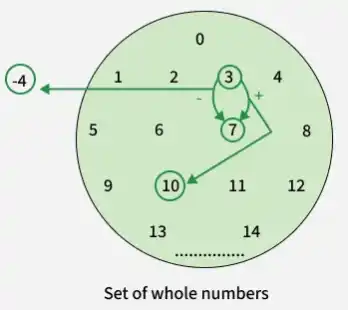
As shown in the above figure, the set of whole numbers is closed under addition. Here, 3 and 7 are whole numbers, and:
3 + 7 = 10
Since 10 is also a whole number, the result remains within the same set. Therefore, whole numbers are closed under addition.
However, whole numbers are not closed under subtraction. For example: 3 - 7 = -4
Since -4 is not a whole number, the result does not belong to the set of whole numbers. Therefore, whole numbers are not closed under subtraction.
The closure property is mainly divided into 4 parts:
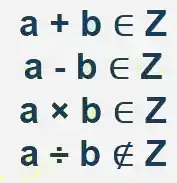
Closure Property of Addition
The closure property of addition states that the sum of any two elements of a given set always belongs to the same set.
Examples:
- For whole numbers, if a and b are whole numbers, then a + b is also a whole number.
- For integers, the sum of any two integers is always an integer.
Take another 2 even numbers, 4 + 6 = 10. The result is also an even number. Hence, the closure property under addition is satisfied.
| Closure Property of Addition | |
|---|---|
| Real Numbers | a + b = Real number (a, b are real numbers.) |
| Rational Numbers | a + b = Rational number (a, b are Rational Numbers.) |
| Integers Numbers | a + b = Integer (a, b are integers.) |
| Natural Numbers | a + b = Natural number (a, b are natural numbers) |
| Whole Numbers | a + b = Whole number (a, b are whole numbers) |
Closure Property of Subtraction
The closure property under subtraction means that the difference of any two elements of a set must also belong to the same set. For example, integers are closed under subtraction because the difference of any two integers is always an integer.
| Closure Property of Subtraction | |
|---|---|
| Real Numbers | a - b = Real number (a, b are real numbers.) |
| Rational Numbers | a - b = Rational number (a, b are Rational Numbers.) |
| Integers Numbers | a - b = Integer (a, b are integers.) |
Closure Property of Multiplication
In closure under multiplication, you will multiply within the numbers in the set. Consider the set {2, 4, 8}. Although 2 × 4 = 8 belongs to the set, 2 × 8 = 16 does not belong to the set. Therefore, {2, 4, 8} is not closed under multiplication.
| Closure Property of Multiplication | |
|---|---|
| Real Numbers | a × b = Real number (a, b are real numbers.) |
| Rational Numbers | a × b = Rational number (a, b are Rational Numbers.) |
| Integers Numbers | a × b = Integer (a, b are integers.) |
| Natural Numbers | a × b = Natural number (a, b are natural numbers) |
| Whole Numbers | a × b = Whole number (a, b are whole numbers) |
Closure Property of Division
A set is closed under division if dividing any two elements of the set gives a result that also belongs to the same set, provided the divisor is not zero.
Example: Consider the set {8, 16, 24}.
16 ÷ 8 = 2
Since 2 does not belong to the set {8, 16, 24}, the set is not closed under division.
Formula
If we take two numbers a, and b from a set S then closure property formula states that, a (operator) b also belongs to set S. This is explained as,
"∀ a, b ∈ S ⇒ a (operator) b ∈ S"
Real numbers are closed under addition, subtraction, and multiplication. However, they are not closed under division because division by zero is undefined.
Related Articles
Solved Examples
Example 1: Consider the set {1, 2, 3, 4, 5}. Is this set closed under addition?
Solution:
No, the set is not closed under addition. For example, 3 + 4 = 7, but 7 does not belong to the set {1, 2, 3, 4, 5}. Therefore, the set is not closed under addition.
Example 2: Given a set {6, 12, 18}. Is it closed under multiplication?
Solution:
No, it is not closed. Since 6 × 18 = 108 and 108 is not in the set, closure fails.
Example 3: Is the set {1, 3, 5} closed under addition modulo 6?
Solution:
No, the set is not closed under addition modulo 6. For example:
1 + 3 = 4 (mod 6)
Since 4 does not belong to the set {1, 3, 5}, the closure property is not satisfied. Therefore, the set is not closed under addition modulo 6.
Example 4: Compute if {0, 4, 8} is closed under addition (mod 10).
Solution:
0 + 4 = 4 (in the set)
4 + 8 = 2 (violates closure as 2 is not in the set)
Hence, {0, 4, 8} is not closed under addition (mod 10).
Example 5: Verify the closure property of {1, 4, 7} under addition (mod 5).
Solution:
1 + 4 = 5 ≡ 0 (mod 5)
Since 0 does not belong to the set {1, 4, 7}, the closure property is not satisfied.
Therefore, {1, 4, 7} is not closed under addition modulo 5.