

A coefficient is a number or symbol written before a variable in a mathematical expression that indicates how many times the variable is multiplied.
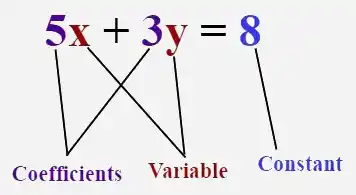
Coefficients can be positive, negative, or zero.
It is a scalar value that indicates the variable's impact on an expression. When a variable in an expression has no written coefficient, it is assumed to be one, because multiplying by 1 does not change its value.
For example, in the given expression 10x + x2 + 7, it has two coefficients:
- 10, which is the coefficient of x.
- 1, which is the coefficient of x2, as it doesn't have a number with it, we automatically assume it to be one.
- 7 is the constant.
Types of Coefficients
Coefficients are grouped into different types based on their usage in expressions.
1. Numerical Coefficient
A numerical coefficient is the number part of a term that multiplies the variable.
- In 4x, the numerical coefficient is 4
- In −7ab, the numerical coefficient is -7
2. Leading Coefficient
The leading coefficient is the coefficient of the term with the highest degree in a polynomial.
- In 3x3 − 5x2 + 2x + 1, the leading coefficient is 3
Properties of Coefficients
- Linearity: Coefficients exhibit linearity, meaning they distribute over addition and subtraction. For example, in (ax + by), the coefficient (a) multiplies (x), and (b) multiplies (y).
- Commutativity: The order of coefficients and variables does not affect the result when multiplying. For example, 2 × y and y × 2 both represent the product of 2 and y.
- Associativity: Coefficients are associative with multiplication. For instance, in (2 × 3x), the result is the same as (3 × 2x), yielding (6x) in both cases.
- Identity Property: Coefficient (1) serves as the identity element in multiplication. Multiplying any variable by (1) leaves the variable unchanged.
- Additive Identity: Adding (0) as a coefficient does not alter the value of the expression. For example, (3x + 0 = 3x).
- Scalar Multiplication: Coefficients can be multiplied by scalars. For example, 2(3x) = 6x.
- Zero Coefficient: A coefficient of (0) nullifies the variable's contribution to the expression. For instance, (0x = 0)
➢Practice: Solved Examples