
In geometry, two angles are known as complementary angles if their sum is a right angle, i.e., 90° (90 degrees). In other words, when two angles add to 90°, they are called complementary angles.
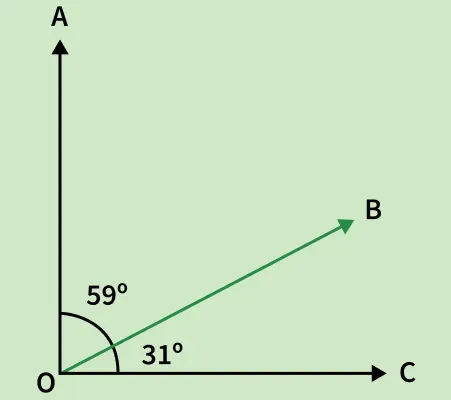
In the above figure, 59° and 31° are complementary angles, as the sum of 59° and 31° equals 90°, or we can say that 59° is the complement of 31° and 31° is the complement of 59°.
If ∠A = 40°, then its complementary angle is ∠A = 50° and 40° + 50° = 90°. In this case, 40° and 50° are complements of each other. i.e.
- 40° is the complement of 50°, and
- 50° is the complement of 40°.
Sum of Complementary Angles
If ∠A and ∠B are complementary angles, then their sum will be 90° i.e., ∠A + ∠B = 90°
Let us take another example: 25° and 65° are also complementary angles, as the sum of 25° and 65° equals 90°. Here, we can say that 25° and 65° are complements of each other.
Types of Complementary Angles
Complementary angles are the pair of angles whose sum is equal to the measurement of a right angle. There are two types of complementary angles, which are given below:
1. Adjacent Complementary Angles
Adjacent means close or near something, and complementary means 90°. So, if a pair of complementary angles have a common vertex and a common arm, they are known as adjacent complementary angles.

In the figure shown above, ∠XOZ and ∠ZOY have a common vertex "O" and a common arm "OZ." Also, they add up to 90°, i.e., ∠XOZ + ∠ZOY = 30° + 60° = 90°. Hence, these two angles are adjacent and complementary.
2. Non-Adjacent Complementary Angles
"Non-adjacent" means something that is not close, and "complementary" means 90°. So, if a pair of complementary angles does not have a common vertex or a common arm, they are known as non-adjacent complementary angles.

In the figure given above, ∠GFE and ∠JIH do not have a common vertex or a common arm. But, they add up to 90°, i.e., ∠GFE + ∠JIH = 22° + 68° = 90°. Hence, these two angles are non-adjacent complementary angles.
Properties of Complementary Angles
- Complementary angles are the pair of angles whose sum of the measures is equal to 90°.
- If two angles are known as complementary, we call each angle the “complement” or “complement angle” of the other angle.
- There are two types of complementary angles - adjacent and non-adjacent.
- Three or more angles cannot be considered as complementary angles even if their sum is 90°. Complementary angles always appear in pairs.
- Complementary angles are always acute, but acute angles are not always complementary.
- Two right angles or two obtuse angles can not form a complementary pair.
How to Find the Complement of an Angle?
Complementary angles are the pairs of angles whose sum equals 90°. Also, each angle in the pair is considered to be the "complement" of the other. Suppose the angle given is y°. To find its complement, you subtract its value from 90°, i.e., we can use the formula given below.
Complement of y° = (90 - y)°
For example, to determine the complement of an angle measuring 59°, you subtract 59° from 90°, yielding a complement of 33°. So, the complement of 59° is 33°.
Complementary Angle Theorem
If the sum of a pair of angles equals 90°, then they are said to be complementary. Each of the complement angles is acute and has positive measure. Now, let us study the complementary angles theorem along with its proof.
According to the Complementary Angle Theorem, "if two angles are complementary to the same angle, then they are congruent or equal to each other."
Proof of Complementary Angles Theorem
We know that complementary angles always exist in pairs and add up to 90°. Let us consider the following figure.

Let us assume that ∠POQ is complementary to ∠AOP and ∠QOR.
According to the definition of complementary angles, ∠POQ + ∠AOP = 90° and ∠POQ + ∠QOR = 90°.
From the above two equations, we can say that "∠POQ + ∠AOP = ∠POQ + ∠QOR."
On subtracting '∠POQ' from both sides, we get ∠AOP = ∠QOR.
Thus, the complementary angle theorem is proved.
Complementary Angles in Trigonometry
Let us observe the following figure.

In △ABC, ∠A + ∠C = 90°
So, we can say that ∠A and ∠C are complementary angles.
Trigonometric Ratios of Complementary Angles
Let us consider △ABC again.
If ∠A = θ, then ∠C = 90° - θ
So, sin θ = cos (90° - θ)
Similarly, the following also holds true for θ
- cos θ = sin (90° - θ)
- tan θ = cot (90° - θ)
- cot θ = tan (90° - θ)
- cosec θ = sec (90° - θ)
- sec θ = cosec (90° - θ)
Suppose we have to find the value of sin 52° - cos 38°.
We know that sin θ = cos (90° - θ)
sin 52° = cos (90° - 52°) = cos 38°
sin 52° - cos 38° = cos 38° - cos 38° = 0
Complementary Angles vs Supplementary Angles
The comparison between complementary and supplementary angles is summarized in the table below:
Complementary Angles | Supplementary Angles |
|---|---|
| Two angles are known as complementary angles if the sum of angles is 90°. | Two angles are known as supplementary angles if the sum of angles is 180°. |
| Both complementary angles are acute and have positive measures. | Both supplementary angles can be neither acute nor obtuse. Either both of them can be 90° each, or one is an acute angle whereas other is obtuse angle. |
| The complement of angle x° = (90 - x)°. | Supplement of angle x° = (180 - x)° |
Related Articles:
Solved Examples on Complementary Angles
Example 1: Are 46° and 44° complementary angles? Give a reason.
Solution:
Given two angles i.e., 46° and 44° .
We know that two angles are said to be complementary if their sum is 90°.
Since 46° + 44° = 90°
Thus, 46° and 44° are complementary angles.
Example 2: Find the complement of 61°.
Solution:
We know that the complement of an angle measuring x° = (90 - x)°.
Here, x° = 61°
Complement of 61° = (90 - 61)° = 29°
Thus, the complement of 61° = 29°
Example 3: Find the value of x if (x + 3)° and (x - 5)° form complementary angles.
Solution:
We know that two angles are said to be complementary if their sum is 90°.
So, (x + 3)° + (x - 5)° = 90°
(x + x + 3 - 5)° = 90°
(2x - 2)° = 90°
2(x - 1)° = 90°
(x - 1)° = 45°
x = (45 + 1)°
x = 46°
Hence, the value of x is = 46°.
Example 4: Find the value of sec 37° cosec 53° - tan 37° cot 53°.
Solution:
sec 37° cosec 53° - tan 53° cot 37°
We know that cot θ = tan (90° - θ) and cosec θ = sec (90° - θ)
cot 53° = tan (90° - 53°) and cosec 53° = sec (90° - 53°)
cot 53° = tan 37° and cosec 53° = sec 37°
On substituting the values, we get
sec 37° sec 37° - tan 37° tan 37°
= sec237° - tan237° = 1
Hence, sec 37° cosec 53° - tan 37° cot 53° = 1
Example 5: If sin 2A = cos (A - 27°), where A is an acute angle, find A.
Solution:
sin 2A = cos (A - 27°)
We know that sin θ = cos (90° - θ)
sin 2A = cos (90° - 2A)
On substituting the value, we get
cos (90° - 2A) = cos (A - 27°)
90° - 2A = A - 27°
90° + 27° = 3A
A=\frac{117^{\circ}}{3}
A = 39°
Practice Problems on Complementary Angles
Problem 1: Find the complement of 16°.
Problem 2: Two complementary angles are equal. Find the measure of each angle.
Problem 3: Find the value of cos 23° cosec 67°.
Problem 4: If tan 6θ = cot 9θ, then what is the value of θ?
Problem 5: Find the value of sin 15° sin 25° sin 45° sec 65° sec 75°.