
Composite numbers are positive integers greater than 1 that have more than two positive divisors. In other words, a composite number can be expressed as the product of two smaller positive integers, unlike prime numbers, which have exactly two positive divisors: 1 and the number itself.
Interesting Facts about Composite Numbers:
- All even numbers greater than 2 are composite numbers.
- Every composite number that has only 3 factors is a perfect square.
Composite Numbers Examples
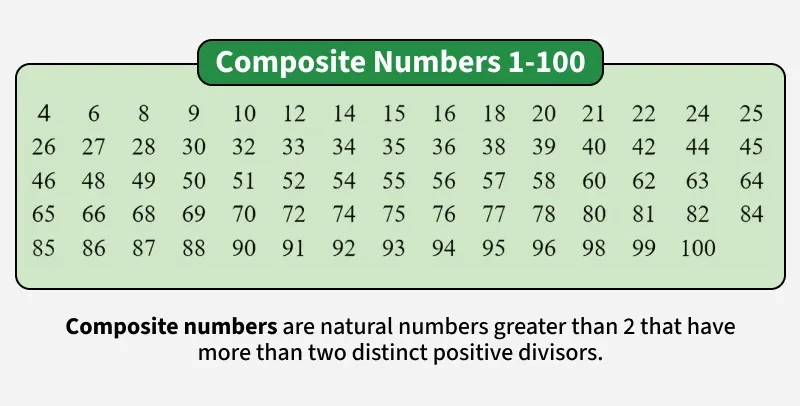
The following chart lists all composite numbers between 1 and 100, illustrating numbers that have more than two factors.
Properties of Composite Numbers
Various properties of composite numbers that are very useful for students are,
- Composite numbers consist of more than two factors.
- Of all composite numbers, 4 is the smallest.
- Composite numbers can be divided evenly by smaller numbers, either prime or composite.
- If n is a composite number, then 2n - 1 is always composite. However, if n is prime, then 2n - 1 may or may not be prime.
- Perfect Squares are the only numbers that have an odd number of distinct divisors. For example, 9 has divisors as 1, 3, and 9. 4 has divisors as 1, 2, and 4. For all other numbers, divisors appear in pairs, so the total number of divisors is always even for other numbers.
- Every Composite number has at least 3 distinct divisors.
Please refer to Composite Numbers: Interesting Facts for more interesting facts about Composite Numbers and Applications of Composite Numbers for real-life applications.
Prime Factorization of Composite Numbers
Prime factorization is a process of breaking down a composite number into its prime factors, which are the prime numbers that, when multiplied together, result in the original composite number.
Some examples of prime factorization of composite numbers are:
Prime factorization of 24: 24 = 2 × 2 × 2 × 3
Prime factorization of 56: 56 = 2 × 2 × 2 × 7
Prime factorization of 90: 90 = 2 × 3 × 3 × 5
Prime factorization of 120: 120 = 2 × 2 × 2 × 3 × 5
Prime factorization of 210: 210 = 2 × 3 × 5 × 7
Prime factorization of 360: 360 = 2 × 2 × 2 × 3 × 3 × 5
List of Composite Numbers
Between 1 and 100, there are 74 composite numbers in total. Below is a list of every composite number from 1 to 100.
4, 6, 8, 9, 10, 12, 14, 15, 16, 18, 20, 21, 22, 24, 25, 26, 27, 28, 30, 32, 33, 34, 35, 36, 38, 39, 40, 42, 44, 45, 46, 48, 49, 50, 51, 52, 54, 55, 56, 57, 58, 60, 62, 63, 64, 65, 66, 68, 69, 70, 72, 74, 75, 76, 77, 78, 80, 81, 82, 84, 85, 86, 87, 88, 90, 91, 92, 94, 95, 96, 98, 99, 100
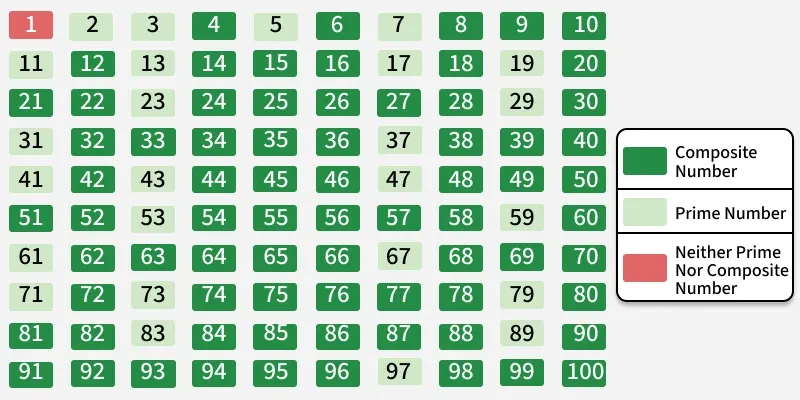
Composite Number Chart
The following chart provides all the composite numbers from 1 to 100.
How to Check if a Number is Composite?
Here are the easy steps for checking if the number is composite:
- Step 1: Find all the factors of the given number.
- Step 2: Count the total numbers of factors for the given number
- Step 3: If the given number has more than two factors then the number is a composite
Example: Determine whether 16 is a composite number.
Let us look for the elements of 16.
16÷1 = 16
16÷2 = 8
16÷4 = 4
16÷8 = 2
16÷16 = 1
As can be seen, the factors of 16 are 1,2,4,8, and 16 which is more than 2
thus, we can say that 16 is a composite number.
Types of Composite Numbers
In mathematics, composite numbers come in two primary varieties:
- Even Composite Numbers: Composite numbers are divisible by 2 (except 2, which is prime).
Examples: 4, 6, 8, 10, 12, …
- Odd Composite Numbers: Composite numbers not divisible by 2.
Examples: 9, 15, 21, 25, 27, …
Prime Numbers vs Composite Numbers

Prime Numbers are natural numbers higher than one with just two different divisors: the number itself and 1. Prime numbers include 2, 3, 5, 7, 11, and 13 since their only divisors are 1 and the number itself.
Composite Numbers, on the other hand, are natural numbers bigger than one that have more than two different divisors. For example, 4, 6, 8, 9, and 12 are composite numbers because they have divisors other than 1 and the number itself.
Real Life Applications of Composite Numbers
Various applications of composite numbers include:
- Cryptographic Systems
- Engineering and Construction
- Finance and Economics
- Data Encryption and Security
- Load Balancing in Cloud Computing, etc.
Related Articles:
Solved Examples on Composite Numbers
Question 1: Determine the product of the first four composite numbers.
Solution:
The initial four composite numbers are 4, 6, 8, and 9.
As a result, the product of the first four composite numbers equals 4 x 6 x 8 x 9 = 1728
As a result, the sum of the first four composite numbers is 1728.
Question 2: Determine which of the following is not a composite number. 16, 36, 53, 78, 94.
Solution:
The correct answer is number 53. 53 is not a composite number because it can only be divided by one and itself.
Question 3: Determine whether 196 is a composite number.
Solution:
1, 2, 4, 7, 14, 28, 49, 98, and 196 are the factors of 196.
As a result, 196 is a composite number.
Question 4: What is 98's prime factorization?
Solution:
98's prime factorization is:
98 = 2 × 7 × 7
Question 5: Determine if 183 and 196 are composite numbers.
Solution:
183 is divisible by 3, and 196 is divisible by 2, so both are composite numbers.
Question 6: Which of the following is a composite number: 13, 19, 22, 31?
Solution:
The correct answer is 22. Because a composite number is a positive integer larger than one with several divisors. In the example of 22, it may be divided evenly by 1, 2, 11, and 22, yielding a composite number.
Practice Problems on Composite Numbers
Problem 1. Determine if 15 is a composite number.
Problem 2. List all composite numbers between 20 and 40.
Problem 3. Find the prime factorization of 60.
Problem 4. Find the sum of all divisors of 24.
Problem 5. What is the difference between the smallest composite number greater than 50 and the largest composite number less than 50?
Problem 6. List out the composite numbers from the given set of numbers 2, 4, 9, 11, 21, 31, 44, 53, 67, 88, 101, 108.
Problem 7. Find the product of the two smallest prime numbers.
Problem 8. Find if 364 is a composite number.
Problem 9. How many composite numbers are there between 1 and 50?
Problem 10. What is the largest composite number less than 100?