

A definite integral is used to find the exact area under a curve between two fixed points on the x-axis. It gives a single numerical value that represents the total area or accumulation of a function over a given interval.

A definite integral is written as:
\int^{b}_{a}f(x)dx .where,
- a is the lower limit (starting point),
- b is the upper limit (ending point),
- f(x) is the function, and
- dx represents the variable of integration.
According to the Fundamental Theorem of Calculus,
\int^{b}_{a}f(x)dx = F(b) - F(a)where, F'(x) = f(x).
Definite Integral using Riemann Sum
Definite integral of a function f(x) from a to b using the Riemann sum is defined as the limit of the sum of areas of rectangles under the curve as the number of rectangles becomes infinitely large and their width approaches zero. Formally,
\int_{a}^{b} f(x) \, dx = \lim_{n \to \infty} \sum_{i=1}^{n} f(c_i) \Delta x_i Where,
- [a, b] is the interval of integration.
- The interval is divided into n small subintervals, each with width Δxi.
- ci is a chosen point within the ith subinterval.
- As n approaches infinity, Δxi becomes very small.
Definite Integral as Limit of a Sum
Assuming that ƒ is a continuous function and positive on the interval [a, b]. So, its graph is above the x-axis.
Definite integral
\int^{b}_{a}f(x)dx is the area bounded by the curve y = f(x), the ordinates x = a and x = b and x-axis.
Now to evaluate this area, consider the region ABCD in the figure below,
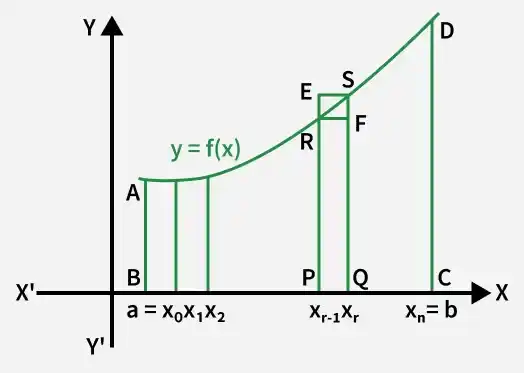
Let x0 = a and xn = b.
Now divide the interval [a, b] into n equal subintervals denoted by [x0, x1], [x1, x2], [x2, x3] ....[xr-1, xr] .....[xn-1, xn]
where x0 = a, x1 = a + h, x2 = a + 2h .... and xn = a + nh or n =
The region ABCD under consideration is the sum of n subregions, where each subregion is defined on subintervals [xr – 1, xr], where, r = 1, 2, 3, …, n.
It can be seen in the above figure that, now the area of the rectangle PQFR is calculated as,
A = PQ × PR
⇒ A = (xr– xr–1) × f(xr-1)
As xr– xr–1 → 0, i.e., h → 0, the area above becomes a nearly perfect rectangle. Now the area under the curve can be broken into n different rectangles adding all these rectangles' areas we get the area under the curve.
s_{n} = h[f(x_{0}) + .... + f(x_{n})]
= h\sum^{n-1}_{r=0}f(x_{r})
S_{n} = h[f(x_{1}) + .... + f(x_{n})]
= h\sum^{n}_{r=1}f(x_{r})
sn and Sn denote the sum of areas of all lower rectangles and upper rectangles raised over subintervals [xr-1, xr] for r = 1, 2, 3,.... respectively.
As n → ∞ strips become narrower and narrower, so, the limiting values of (2) and (3) are the same in both cases and the common limiting value is the required area under the curve.
So,
\lim_{n \to \infty}s_{n}
\\= lim_{n \to \infty}S_{n} \ = \int^{b}_{a}f(x)\ dx
Now, this equation can also be re-written as,
\int^{b}_{a}f(x)dx = \lim_{n \to ∞}[f(a) + f(a + h) + f(a + 2h) + f(a + 3h) ......f(a + (n-1)h)] \\ where,
h = \frac{b-a}{n} \to 0 \text{ as } n \to \infty This expression is knows as definition of definite integral as limit of sum.
Example: Find
Solution:
By the definition given above,
\int^{b}_{a}f(x) = \lim_{h \to 0}[f(x) + f(a + h) + f(a + 2h) + f(a + 3h) ......f(a + (n-1)h)] Where
h = \frac{b-a}{n} \to 0 \text{ as } n \to \infty Here, a = 0 and b =2, f(x) = x2 + 1, h =
\frac{2 - 0}{n} = \frac{2}{n}
\int^{2}_{0}(x^{2} + 1) = 2\lim_{n \to \infty}\frac{1}{n}[f(0) + f(\frac{2}{n}) + f(\frac{4}{n}) + ......f(\frac{2(n-1)}{n})]
= 2\lim_{n \to \infty}\frac{1}{n}[1 + (\frac{2}{n}^{2} + 1) + \frac{4}{n}^{2} + 1 + ......\frac{2(n-1)}{n}^{2} + 1]
= 2\lim_{n \to \infty}\frac{1}{n}[\underbrace{(1 + 1+ .... 1)}_\text{n terms} + \frac{1}{n^{2}}(2^{2} + 4^{2} + ..... (2n - 2)^{2}]
= 2\lim_{n \to \infty}\frac{1}{n}[n + \frac{4}{n^{2}}(1^{2} + 2^{2} + .... (n-1)^{2}]
= 2\lim_{n \to \infty}\frac{1}{n}[n + \frac{4}{n^{2}}\frac{((n-1)n(2n-1)}{6}]
\text{Evaluating above limit} = \frac{14}{3}
Steps to Solve a Definite Integral
Steps for Calculating the definite integral using the Fundamental theorem of calculus are given below,
Step 1: Find the indefinite integral
\int f(x)dx . Let's call it F(x). There is no need to keep a constant "C", it will cancel out anyway in the end.Step 2: Find F(b) - F(a) =
[F(x)]^a_b which is the value of this definite integral.
Example: Calculate the integral:
Solution:
Solving Indefinite Integral we get,
F(x) = \int x^{2}dx \\= \frac{x^{3}}{3} Let the value of definite integral be S. and a= 2 and b = 3
S = F(b) - F(a)
⇒ S = (3)3/3 - (2)3/3
⇒ S = 9 - 8/3
⇒ S = 19/3
Understanding Positive and Negative Areas
In a definite integral, the area above the x-axis is considered positive, while the area below the x-axis is considered negative. Therefore, a definite integral gives the net (signed) area between the curve and the x-axis.
For the function f(x) = sin(x) over the interval [0, 2π]:
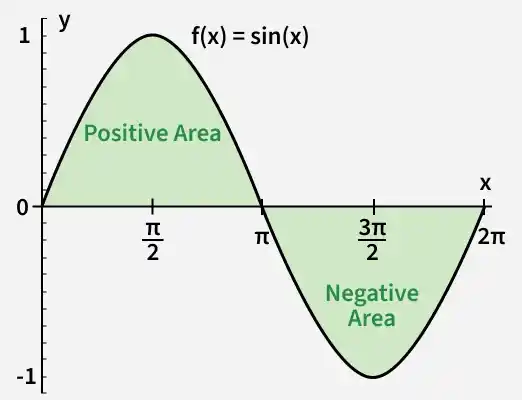
- From 0 to π, the curve lies above the x-axis, so the area is positive.
- From π to 2π, the curve lies below the x-axis, so the area is negative.
Since the positive and negative areas are equal in magnitude, they cancel each other. Therefore,
\int_{0}^{2\pi} \sin(x)\,dx = 0
Solution:
Given,
\int_{0}^{2\pi} \sin(x)\,dx = 0 The antiderivative of sin(x) is −cos(x).
Using the Fundamental Theorem of Calculus,
\int_{0}^{2\pi} \sin(x)\,dx=\left[-\cos(x)\right]_{0}^{2\pi} = −cos(2π) − (−cos(0))
= −1 + 1
= 0.
Note: A definite integral gives the net (signed) area, not always the total area. To find the total area, calculate the areas above and below the x-axis separately and add their absolute values.
➢Practice: Solved Examples