

The degree of a polynomial is defined as the highest power of the variable in the polynomial expression.
Example: 5x3 + 2x2 + 7x + 1
- Highest power of x = 3
- Degree = 3
Degree of Polynomial with more than One Variable
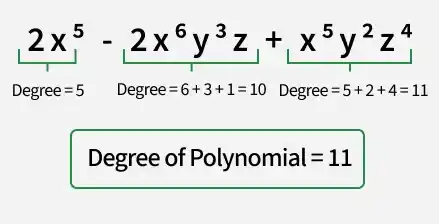
If a polynomial has more than one variable, then its degree is calculated by adding the exponents of each variable.
Degree of Zero Polynomial
A polynomial is said to be a zero polynomial if the coefficients of all the variables are equal to zero. Let the zero polynomial be f (x) = 0. Now, we can write it as f(x) = 0x0, f(x) = 0x1, f(x) = 0x2, f(x) = 0x3, etc. So, we can say that the degree of a zero polynomial is undefined. Sometimes it is defined as negative (-1 or -∞).
Degree of Constant Polynomial
A polynomial is said to be a constant polynomial if its value remains the same. Let the constant polynomial be P(x) = c, or we can write it as P(x) = Cx0 since the value of x₀ is 1. So, we can say that the degree of constant polynomial is zero.
Example: P(x) = 13 = 13x0.
So, the degree of P(x) is zero.
Classification of Polynomials Based on its Degree
The following are some polynomial expressions depending on the degree of a polynomial, with examples.
Degree | Name of the Polynomial | Examples |
|---|---|---|
Polynomials with Degree 0 | Constant Polynomial | 7x0 |
Polynomials with Degree 1 | Linear Polynomial | 5x-8 |
Polynomials with Degree 2 | Quadratic Polynomial | 25x2+10x+1 |
Polynomials with Degree 3 | Cubic Polynomial | x3-3x2+9x+16 |
Polynomials with Degree 4 | Quartic Polynomial | 16x4-64 |
Polynomials with Degree 5 | Quintic Polynomial | 6x5+3x3+7x+11 |
How to find the degree of a polynomial?
The following are the steps to determine the degree of a polynomial expression. Now, let us find the degree of the polynomial expression 7x4+6x3-2x4+12x2+9x+3
Step 1: Combine all the like terms of the given polynomial expression, where like terms are the terms that have the same variables and powers. Here, 7x4 and -2x4 are like terms:
(7x4 - 2x4) + 6x3 + 12x2 + 9x + 3 = 5x4 + 6x3 + 12x2 + 9x + 3.
Step 2: Ignore the coefficients of all the variables.
x4 + x3 + x2 + x1 + x0
Step 3: Now arrange all the variables in the descending order of their powers, i.e., from the greatest exponent to the least.
x4 + x3 + x2 + x1 + x0
Step 4: Now identify the largest power of the variable x, as the degree of a polynomial expression is the highest exponent of the variable.
So, the degree of the given polynomial expression is 4.
Related Articles
- How to Find the Degree of a Polynomial with More Than One Variable?
- Polynomial Functions
- Types of Polynomials
- Polynomial Formula
- Implementation of Polynomial Regression
Degree of polynomial function examples
Example 1: Determine the degree, constant, and leading coefficient of the polynomial expression 7x − 8x + 2x + 5.
Solution:
Given Polynomial Expression = 7x4 − 8x3 + 2x + 5
The highest exponent of variable x = 4
So, the degree of the given polynomial expression = 4
The leading coefficient of the polynomial is the coefficient with the highest exponent.
So, the leading coefficient of given the polynomial expression = 7
Constant = 5
Example 2: Determine the degree of the polynomial expression 2x + 6x − x + 3x + x + 9.
Solution:
Given polynomial expression = 2x4 + 6x5 − x3 + 3x2 + x6 + 9
The polynomials are not arranged from greatest exponent to least. So, let us arrange them in descending order of their exponents first.
So, the obtained expression = x6 + 6x5 + 2x4 − x3 + 3x2 + 9
Now, the highest exponent of the variable x = 6
So, the degree of the given polynomial expression = 6.
Example 3: Find the degree and constant of the polynomial expression 3x − 16x + 21x − 7x.
Solution:
Given polynomial expression = 3x8 − 16x5 + 21x2 − 7x
The highest exponent of the variable x = 8
So, the degree of the given polynomial expression = 8
The constant of the given polynomial expression = 0
Example 4: Determine the degree, constant, and leading coefficient of the polynomial expression 13x − 15x − 11x + 9.
Solution:
Given polynomial expression = 13x3 − 15x2 − 11x + 9
The highest exponent of the variable x = 3
So, the degree of the given polynomial expression = 3
The leading coefficient of the polynomial is the coefficient with the highest exponent.
So, the leading coefficient of given the polynomial expression = 13
Constant = 9.
Example 5: Calculate the degree of polynomial 4x3 + 7x3y1 + 11x2y3 + 17xy + 21y3.
Solution:
The given polynomial expression is 4x3 + 7x3y1 + 11x2y3 + 17xy2 + 21y3.
Now, let's calculate the degree of each term.
4x3 has a degree of 3 since the power of x is 3.
7x3y1 has a degree of 4 since the power of x is 3 and the power of y is 1. So, by adding the exponents of x and y, we get 4.
11x2y3 has a degree of 5 since the power of x is 2 and the power of y is 3. So, by adding the exponents of x and y, we get 5.
17xy2 has a degree of 3 since the power of x is 1 and the power of y is 2. So, by adding the exponents of x and y, we get 3.
21y3 has a degree of 3 since the power of y is 3.
The largest degree out of these is 5, so the degree of the given polynomial expression is 5.
Example 6: Calculate the degree of the polynomial 13x4 + 8xy + 7xy2 + 11xy.
Solution:
The given polynomial expression is 13x4 + 8x3y2 + 7x2y+11xy.
Now, let's calculate the degree of each term.
13x4 has a degree of 4 since the power of x is 3.
8x3y2 has a degree of 5 since the power of x is 3 and the power of y is 3. So, by adding the exponents of x and y, we get 5.
7x2y has a degree of 3 since the power of x is 2 and the power of y is 1. So, by adding the exponents of x and y, we get 3.
11xy has a degree of 2 since the power of both x and y is 1. So, by adding the exponents of x and y, we get 2.
The largest degree out of these is 5, so the degree of the given polynomial expression is 5.