
Descending order means arranging numbers or objects from biggest to smallest. It is also called decreasing order.
The greater than symbol (>) where the open side faces the bigger number, and the pointed side faces the smaller number.
Another symbol used to indicate descending order is an arrow pointing downwards (↓).
Example: Arrange 3, 5, 7, 2, 6, and 8 in decreasing order
8 > 7 > 6 > 5 > 3 > 2
Descending Order on Number Line
Let's arrange the numbers -2, -4, 0, 1, and 3 on the Number Line.
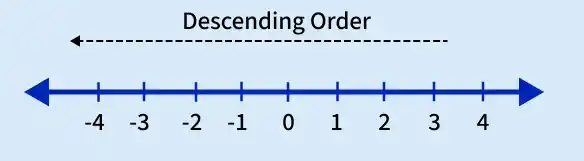
This sequence shows the descending order because each number to the left is smaller than the number to its right. This indicates a progression from larger values to smaller values along the number line.
How to Arrange Numbers in Decreasing Order?
We can arrange numbers in descending order for various types of numbers.
1. Integers in Descending Order
The integers are the group of numbers containing both positive and negative numbers including zero. The integers are easily arranged in descending order by following the basic rule,
- Positive numbers are greater than Zero(0) and Negative integers are less than Zero(0).
- Positive numbers are always greater than negative numbers.
- Positive numbers in integers are compared normally and arranged in descending order.
- Negative numbers are arranged in ascending order after taking the absolute values of the given function and applying the negative sign changes the number in descending order.
Let's arrange in descending order as, -7, -9, -23, 11, 5, 0.
11 > 5 > 0 > -7 > -9 > -23
2. Negative Numbers in Descending Order
Negative numbers follow the following rules and can be easily arranged in descending order,
- Negative numbers are arranged in descending order by first taking the absolute values of these numbers and then arranging the same in ascending order.
- Then we put the negative sign to get the required series in Descending order.
This can be understood with the example as, arrange -11, -45, -32, -23 in descending order
-11 > -23 > -32 > -45
3. Fractions in Descending Order
Fractions are arranged in decreasing order by first making all the fractions like fractions and then arranging these on the basis of their numerator.
This can be understood with the example as, arrange 1/6, 2/3, 5/12, 7/4 in descending order.
Given fractions are changed into like fractions by making the denominators of the fractions equal.
LCM of 6, 3, 12, 4 = 12
- 1/6 = 2/12
- 2/3 = 8/12
- 5/12 = 5/12
- 7/4 = 21/12
Then in descending order, they are arranged as,
21/12 > 8/12 > 5/12 > 2/12
4. Decimals in Descending Order
To arrange decimals in descending order:
- First, compare the whole number part.
- If the whole numbers are the same, compare the decimal digits from left to right (tenths, hundredths, thousandths).
- Add zeros if needed to make decimal places equal.
- Write the numbers from largest to smallest.
Arrange in descending order: 5.3, 5.35, 5.03, 4.9
Make decimal places equal: 5.30, 5.35, 5.03, 4.90
Now compare: 5.35 > 5.30 > 5.03 > 4.90
Related Articles
Solved Questions on Descending Order
Example 1: Arrange the following fractions in descending order, 1/2, 2/3, 3/4, and 4/5
Solution:
The fraction as discussed above is arranged in descending order by making all the fraction to be like fractions.
Given fractions, 1/2, 2/3, 3/4, and 4/5
LCM of 2, 3, 4, and 5 = 60
- 1/2 = 30/60
- 2/3 = 40/60
- 3/4 = 45/60
- 4/5 = 48/60
Now for the like fractions, the descending order is found by arranging the numerator in the descending order.
48 > 45 > 40 > 30, thus
48 /60 > 45 /60 > 40 / 60 > 30/60
The required fractions in descending order are arranged as, 4/5 < 3/4 < 2/3 < 1/2.
Example 2: Arrange the following decimals in decreasing order, 1.3, 4.5, 5.6, and 2.8
Solution:
In decimals, the numbers are arranged in descending order by comparing their whole part, i.e.
5 > 4 > 3 > 2 > 1, so
The required decimals in descending order are 5.6 > 4.5 > 2.8 > 1.3.
Example 3: Arrange the following integers in descending order, -1, -4, 5, and 2
Solution:
The integers are arranged in descending order as positive integers are greater than the negative integers so,
The required integers in the descending order are 5 > 2 > -1 > -4.
Example 4: Arrange the following negative numbers in decreasing order, -2, -45, -23, and -17
Solution:
In the case of the negative numbers, the modulus part is compared and the modules part of the negative number in the ascending order is equal to the descending order of the negative numbers.
The required negative numbers in descending order are, -2 > -17 > -23 > -45.