

Logarithms (log) and natural logarithms (ln) simplify complex calculations involving exponential relationships. These are essential for solving equations where an unknown variable appears as the exponent of some other quantity.
A logarithm can have any positive base, with the common log having a base 10, while the natural log exclusively uses the mathematical constant (e ≈ 2.718) as its base.
Example- log of base 2 is written as log2 while log of base e is represented as loge= ln (natural log).
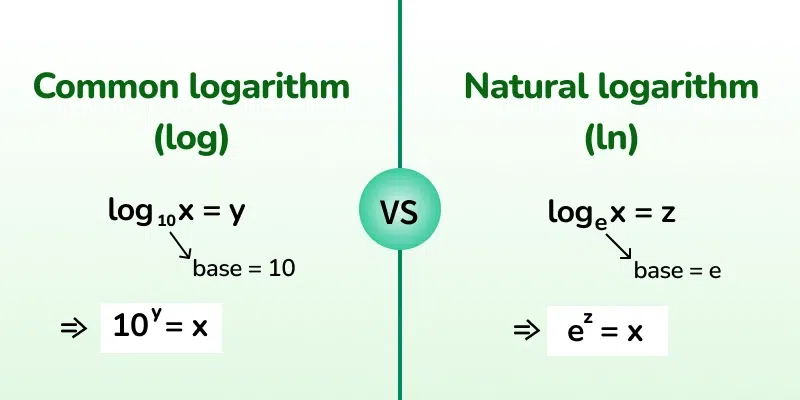
Log vs Ln
Some of the important differences between Log and natural log are given below:
log | ln |
|---|---|
| Log generally refers to a logarithm to the base 10 | Ln generally refers to a logarithm to the base e |
| Also known as the common logarithm | Also called the natural logarithm |
| The common log is represented as log10(x) | The natural log is represented as loge(x) |
| The exponential form for this log is 10x = y | It has the exponential form as ex = y |
| The interrogative statement for the common logarithm is “At which number should we raise 10 to get y?” | The interrogative statement for the natural logarithm is “At which number should we raise Euler’s constant number to get y?” |
| It is mostly used in physics as compared to ln | It has much less use in physics |
| It is represented as log base 10 in math | This is represented as log base e. |
Step to Convert
To convert the common log ( log) into natural log(ln) we can simply use the base change formula to change the base from 10 to e.
Base change formula for Logarithm: logba = logca / logcb
To convert Log10(x) into ln
ln(x) = \frac{\log_{10}(x)}{\log_{10}(e)}
To convert lne(x) into Log:
\log_{10}(x) = \frac{\ln_{e}(x)}{\ln_{e}(10)}