

In mathematics, a function represents a relationship between a set of inputs and their corresponding outputs. Functions are fundamental in various fields, from algebra to calculus and beyond, as they help model relationships and solve real-world problems.
A function represents a relationship between a set of inputs (domain) and their corresponding outputs (range), where each input has exactly one output.
- Domain: The set of all possible input values for which the function is defined.
- Range: The set of all possible output values produced by the function when the input values from the domain are plugged in.
- Co-domain: The co-domain of a function is the set of all possible output values that the function could potentially produce.
For example, For the given function f(x) = x3.
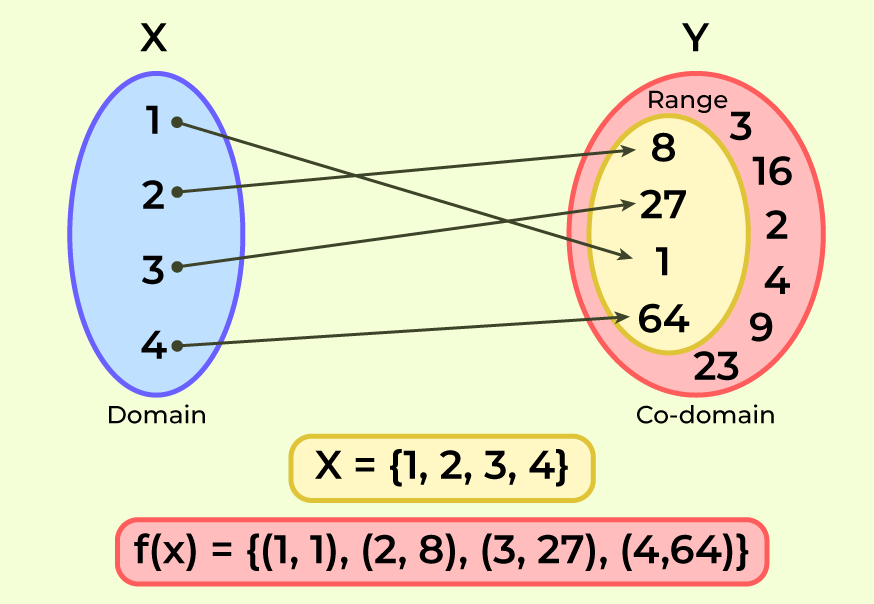
Given the function f(x) = x3, the set of ordered pair is:
- f(x) = {(1, 1), (2, 8), (3, 27), (4, 64)}
- Domain = {1, 2, 3, 4}
- Co-domain = {1, 2, 3, 4, 8, 9, 16, 23, 27, 64}
- Range = {1, 8, 27, 64}
Domain of a Function
The domain of a function is the set of all possible input values (usually x) that the function can accept without causing any issues, such as division by zero or taking the square root of a negative number.
Example:
1) Function f(x) = 1/x,
Domain: All real numbers except x = 0(division by zero is undefined).
Rules for Finding Domain
Check the Function's Expression: Start by analyzing the function’s formula to identify the type of function (e.g., quadratic, square root, rational, etc.)
- Domain of the Polynomial functions (linear, quadratic, cubic, etc) function is R (all real numbers).
- Domain of the square root function √x is x ≥ 0.
- Domain of the exponential function is R.
- Domain of the logarithmic function is x > 0.
- We know that, the domain of a rational function y = f(x), denominator ≠ 0.
Finding the Domain of a Function
To find the domain of a function, use the following steps:
Step 1: First, check whether the given function can include all real numbers.
Step 2: Then check whether the given function has a non-zero value in the denominator of the fraction and a non-negative real number under the denominator of the fraction.
Step 3: In some cases, the domain of a function is subjected to certain restrictions, i.e., these restrictions are the values where the given function cannot be defined. For example, the domain of a function f(x) = 2x + 1 is the set of all real numbers (R), but the domain of the function f(x) = 1/ (2x + 1) is the set of all real numbers except -1/2.
Step 4: Sometimes, the interval at which the function is defined is mentioned along with the function. For example, f (x) = 2x2 + 3, -5 < x < 5. Here, the input values of x are between -5 and 5. As a result, the domain of f(x) is (-5, 5).
Solved Example: Find the domain of f(x) = 1/(x2 - 1)
Given, f(x) = 1/(x2 - 1)
Now, putting x = -1, 1 in f(x)
- f(-1) = 1/{(-1)2 - 1} = 1/0 = ∞
- f(1) = 1/{(1)2 - 1} = 1/0 = ∞
Thus, on -1 and 1 the function is f(x) is undefined and apart form that at all points the f(x) is defined. Thus, the domain of f(x) is R - {-1, 1}
Range of a Function
The Range of a Function is the set of all possible output values (usually y) that the function can produce when you plug in the values from the domain.
Example:
1) Function f(x) = 1/x,
Range: All real numbers except y = 0(the output 1/x never equals zero).
Rules of Finding Range
Check the Function’s Type: Identify the type of function you’re working with (e.g., quadratic, square root, rational, trigonometric, etc.)
1) For linear function the range is R.
2) For quadratic function y = a(x - h)2 + k the range is:
- y ≥ k, if a > 0
- y ≤ k, if a < 0
3) For the square root function, the range is y ≥ 0.
4) For the exponential function, the range is y > 0.
5) For the logarithmic function, the range is R.
Finding the Range of a Function
The range or image of a function is a subset of a co-domain and is the set of images of the elements in the domain.
To find the Range of a Function use the following steps
Let us consider a function y = f(x).
Step 1: Write the given function in its general representation form, i.e., y = f(x).
Step 2: Solve it for x and write the obtained function in the form of x = g(y).
Step 3: Now, the domain of the function x = g(y) will be the range of the function y = f(x).
Thus, the range of a function is calculated.
Example: Find the range of the function f(x) = 1/ (4x − 3).
Given, f(x) = 1/ (4x − 3)
Let the function be f(x) = y = 1/ (4x − 3)
y(4x − 3) = 1
4xy - 3y = 1
4xy = 1 + 3y
x = (1 + 3y)/4yHere, we observe that x is defined for all the values except of y for y = 0 as on y = 0, we get an undefined value of x (division by zero).
So, the range of f(x) = 1/ (4x − 3) is (−∞, 0) U (0 , ∞ ).
Interval Notation of Domain and Range
The domain and range of a function can be written in Interval Notation. For example, for f(x) = sin(x):
- Domain: (−∞,+∞)
- Range: [−1, 1]
We use (), [], and { } to represent the domain and range of a function.
Co-Domain and Range
Co-domain is the set of the values including the range of the function nd it can have some additional values. Range is the Subset of the Codomain. This is explained using the example,
Given function, f(x) = cos x, such that, f:R→R, then
- Codomain of f(x) = R
- Range of R = (-1, 1)
Solved Example
Now to calculate the domain and range of any given function study the following example carefully:
Given:
- X = {1, 2, 3, 4, 5}
- Y = {1, 2, 4, 5, ..., 45, 46, 47, 48, 49, 50}
- Function: f(x) = x2
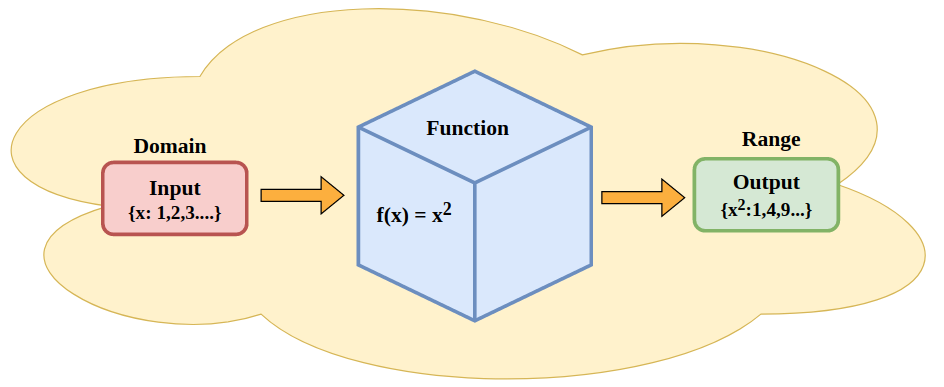
Domain: The domain of the function consists of all the input values that the function can accept. In this case, the domain is the set X, which is= {1, 2, 3, 4, 5}
Range: The range consists of the set of output values produced by the function. For f(x) = x2, we calculate the outputs for each element in the domain:
- f(1) = 12 = 1
- f(2) = 22 = 4
- f(3) = 32 = 9
- f(4) = 42 = 16
- f(5) = 52 = 25
So, the range is:
- Range of F(x) = {2, 3, 4, 5, 6}
Explanation: The domain of a function is the set of possible input values. The range is the set of possible output values the function can produce based on the domain. In this example, the range of f(x) is a subset of Y, but it does not cover all values in Y.
For example, if we are given a function F: X → Y, such that F(x) = y + 1, and X = {1, 2, 3, 4, 5} and Y = {1, 2, 3, 4, 5, 6}. Here,
- Domain of F(x) = X = {1, 2, 3, 4, 5}
- Range of F(x) = {2, 3, 4, 5, 6}
Y is the codomain of F(x) but not the range.
Domain and Range of Some Common Functions
| Function Type | Example | Domain | Range |
|---|---|---|---|
| Linear Function | f(x) = 2x + 3 | All real numbers (R) | All real numbers (R) |
| Quadratic Function | f(x) = x2 | All real numbers (R) | y ≥ 0 |
| Polynomial Function | f(x) = x4 - 2x + 1 | All real numbers (R) | Depends on the function (may be all real or restricted) |
| Rational Function | f(x) = 1/x | All real numbers except x = 0 | All real numbers except y = 0 |
| Square Root Function | f(x) = √x | x ≥ 0 | y ≥ 0 |
| Exponential Function | f(x) = ex | All real numbers (R) | y > 0 |
| Logarithmic Function | f(x) = ln(x) | x > 0 | All real numbers (R) |
| Absolute Value Function | f(x) = ∣ax + b∣ | All real numbers (R) | [0,∞) or y ≥ 0 |
| Greatest Integer Function | f(x) = ⌊x⌋ | All real numbers (R) | All integers (Z) |
| Signum Function | f(x) = sgn(x) | All real numbers (R) | -1, 0, 1 |
Domain and Range Trigonometric & Inverse Trigonometric Functions
For trigonometric functions, the domain is a set of all real numbers (except some values in some functions) and the range of the trigonometric functions varies with different trigonometric functions
Read More:Domain and Range of Trigonometric & Inverse Functions
Related Aritcles
Practice Problems
Question 1: Find the domain of a function f(x) = (2x + 1)/ (x2 − 4x + 3).
Given Function:
f(x) = (2x + 1)/ (x2 − 4x + 3)
f(x) = (2x + 1)/ (x − 1)(x − 3)Observing the function we can say that the function f(x) is defined for all the values of x except for the values where, the denominator of the function is zero.
So f(x) is not defined when, (x − 1)(x − 3) = 0
This can be acheived if of the bracket is zero, i.e.
x − 1 = 0 => x = 1 is where the function f(X) is undefined.
x − 3 = 0 => x = 3 is where the function f(X) is undefined.Thus, the domian of f(x) is all the values except {1, 3}
Domain of f(x) = R − {1, 3}
Hence, the domain of the given function f(x) is R − {1, 3}.
Question 2: Find the domain and range of a function f(x) = x2 + 1.
Given Function:
f(x) = x2 + 1This is a polynomial function and we know that a polynomial function is defined for all the values of x.
Thus, f(x) is defined for all x
Domain of f(x) = R = (-∞, ∞)
For Range,
Let f(x) = y = x2 + 1
y = x2 + 1
⇒ x2 = y − 1
⇒ x = √(y − 1)The square root of the function is defined for all the vaues except for the negative values.
So, (y − 1) ≥ 0
y ≥ 1
Thus, the range of the function is, [1, ∞)
Question 3: Find the domain and range of a function f(x) = (x + 2)/ (x – 3).
Given Function, f(x) = (x + 2)/ (x – 3)
Observing the function we can say that the function f(x) is defined for all the values of x except for the values where, the denominator of the function is zero.
Thus the function is defined for all the values of x but not where x - 3 = 0
x - 3 = 0
⇒ x = 3So, the domain of f(x) is R - {3}
For Range,Let y = f(x)
⇒ y = (x + 2)/ (x – 3)
⇒ y(x - 3) = (x + 2)
⇒ xy – 3y = x + 2
⇒ xy – x = 3y + 2
⇒ x (y – 1) = 3y + 2
⇒ x = (3y + 2)/ (y – 1)Observing the above equation we can say that x is defined for all the values except for the values where the denominator of the functiuon is zero, i.e.
y - 1 = 0
⇒ y = 1Range of f(x) = R - {1}
Question 4: Find the domain and range of a function f(x) = 3ex/7.
Given Function,
f(x) = 3ex/7It is an exponential function which is defined for all the values of x.
So, Domain of f(x) is RFor Range
Let f(x) = y
y = 3ex/7
⇒ ex = 7y/3
⇒ x = loge(7y/3)We know that logarithmic functions are defined only for the positive values of x.
So, x is defined only when y > 0Thus, range of f(x) is (0, ∞)
Domain and Range Worksheets