

Euclid's Division Lemma states that for any two positive integers a and b, where a ≥ b, there exists a unique set of integers q and r such that:
a = bq + r
Where
- a = Dividend
- b = Divisor
- q = Quotient
- r = Remainder
- 0 ≤ r < b
It is based on the fact that "Dividend = (Divisor × Quotient) + Remainder"
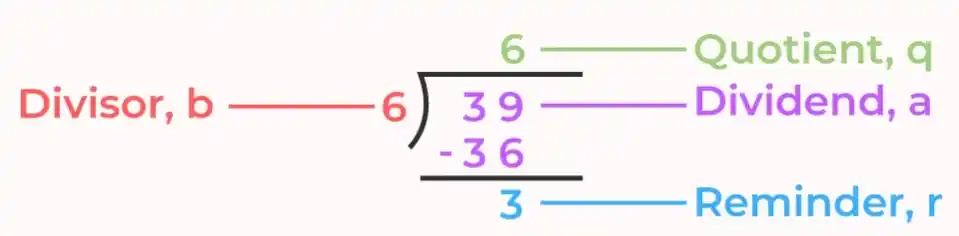
For example, consider the division of 39 by 6, as shown in the image. We can express it in the form a = bq + r as 39 = 6 × 6 + 3
Similarly, the division lemma can be applied to other numbers, as shown below.
Proof
Consider the following arithmetic progression.
………, a − 3b, a − 2b, a − b, a, a + b, a + 2b, a + 3b, ……
The above arithmetic progression has a common difference ‘b′, and it extends indefinitely in both directions.
Now, Let's consider the smallest non-negative term of this arithmetic progression to be r.
The difference between the smallest non- negative term r and a will be in multiple of the common difference 'b' as they both are in A.P.
So we can write it as,
a – r = bq
a = bq + rWhere, r is the smallest non-negative integer satisfying the above result.
Therefore, 0 ≤ r < b
Thus, we have a = bq + r, where 0 ≤ r < b
Now, to prove the Uniqueness of q and r:
Let's Consider another pair q′ and r′ such that a = bq′ + r′ and 0 ≤ r′<b, then we would have:
bq + r = bq′ + r′
b(q − q′) = r′ − rSince 0≤r′<b and 0≤r<b,
then, ∣r′−r∣<bTherefore, the only possible way for this equation to hold true is if q = q′ and r = r′.
Therefore it is proved that q and r are unique .
Thus, for every two numbers a and b we have unique value of q and r such that 'a = bq + r', as defined in the Euclid's Division Lemma.
Solved Examples
Example 1: Find the quotient and remainder when 315 is divided by 17 using Euclid's Division Algorithm.
Solution:
Given: Dividend = 315, Divisor = 17
Using Euclid's Division Lemma, Divide 315 by 17
⇒ 315 = 17 × 18 + 9Thus, quotient is 18 and remainder is 9.
Example 2: Find the quotient and remainder when 73 is divided by 9 using Euclid's Division Algorithm.
Solution:
Given: Dividend = 73, Divisor = 9
Using Euclid's Division Lemma, Divide 73 by 9
⇒ 73 = 9 × 8 + 1Therefore, when 73 is divided by 9, the quotient is 8 and the remainder is 1.
- Next Article - Euclidean Algorithm
- For Programmer: Euclidean Algorithms basic and extended