Euclidean Distance is defined as the distance between two points in Euclidean space. To find the distance between two points, the length of the line segment that connects the two points should be measured.
Euclidean distance is like measuring the straightest and shortest path between two points. Imagine you have a string and you stretch it tight between two points on a map; the length of that string is the Euclidean distance. It tells you how far apart the two points are without any turns or bends, just like a bird would fly directly from one spot to another.
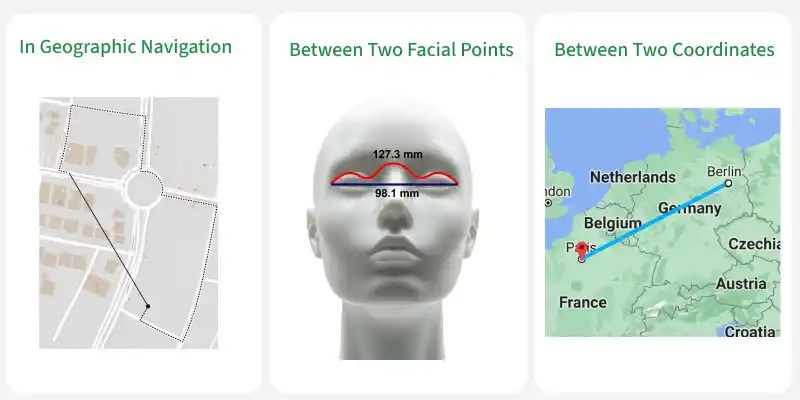
This metric is based on the Pythagorean theorem and is widely utilized in various fields such as machine learning, data analysis, computer vision, and more.
.webp)
Euclidean Distance Formula
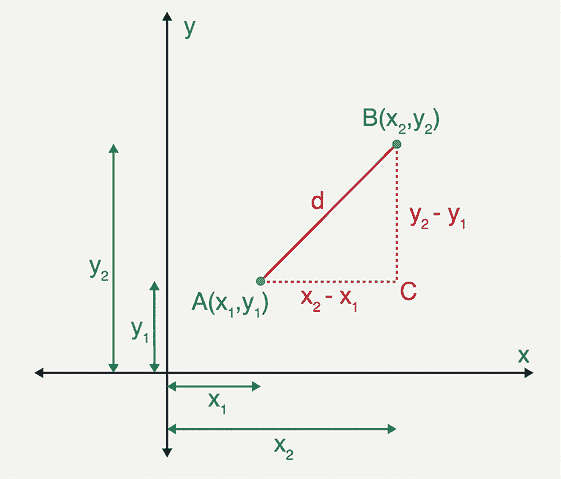
Consider two points (x1, y1) and (x2, y2) in a 2-dimensional space; the Euclidean Distance between them is given by using the formula:
d = \sqrt{(x_2 - x_1)^2 + (y_2 - y_1)^2}
Where,
- d is Euclidean Distance,
- (x1, y1) is the Coordinate of the first point,
- (x2, y2) is the Coordinate of the second point.
Euclidean Distance in 3D
If the two points (x1, y1, z1) and (x2, y2, z2) are in a 3-dimensional space, the Euclidean Distance between them is given by using the formula:
d = \sqrt{(x_2 - x_1)^2 + (y_2 - y_1)^2+ (z_2 - z_1)^2}
Where,
- d is Euclidean Distance,
- (x1, y1, z1) is the Coordinate of the first point,
- (x2, y2, z2) is the Coordinate of the second point.
Euclidean Distance in nD
In general, the Euclidean Distance formula between two points (x11, x12, x13, ...., x1n) and (x21, x22, x23, ...., x2n) in an n-dimensional space is given by the formula:
d = \sqrt{∑^{n}_{i=1}(x_{2i} – x_{1i})^2}
Where,
- i Ranges from 1 to n,
- d is Euclidean distance,
- (x11, x12, x13, ...., x1n) is the Coordinate of the First Point,
- (x21, x22, x23, ...., x2n) is the Coordinate of the Second Point.
Euclidean Distance Formula Derivation
Euclidean Distance Formula is derived by following the steps added below:
- Step 1: Let us consider two points, A (x1, y1) and B (x2, y2), and d is the distance between the two points.
- Step 2: Join the points using a straight line (AB).
- Step 3: Now, let us construct a right-angled triangle whose hypotenuse is AB, as shown in the figure below.

Step 4: Now, using Pythagoras theorem we know that,
(Hypotenuse)2 = (Base)2 + (Perpendicular)2
⇒ d 2 = (x2 – x1) 2 + (y2 – y1) 2
Now, take the square root on both sides of the equation, and we get the Euclidean distance d.
d = \sqrt{(x_2 - x_1)^2 + (y_2 - y_1)^2}
Also Read:
Euclidean Distance Vs Manhattan Distance
Differences between the Euclidean and Manhattan distances are listed in the following table:
| Aspect | Euclidean Distance | Manhattan Distance |
|---|---|---|
| Definition | Measures the shortest straight-line distance between two points. | Measures the distance between two points along axes at right angles. |
| Formula (2D) | d = √[(x2 - x1)2 + (y2 - y1)2] | d = [|x2 - x1| + |y2 - y1|] |
| Path | Direct straight line. | The path that resembles city blocks or a grid pattern. |
| Metric Name | L2 norm or Euclidean norm. | L1 norm or Manhattan norm. |
| Use Cases | Used in scenarios where direct distances are needed (e.g., physics). | Commonly used in planning, urban design, and certain optimization algorithms. |
| Sensitivity to Scaling | Less sensitive to the scaling of axes. | More sensitive to the scaling of axes since it adds absolute differences. |
Read More:
Solved Questions on Euclidean Distance
Here are some sample questions based on the Euclidean distance formula to help you understand the application of the formula in a better way-
Question 1: Calculate the distance between the points (4,1) and (3,0).
Using Euclidean Distance Formula:
⇒ d = √(x2 – x1)2 + (y2 – y1)2
⇒ d = √(3 – 4)2 + (0 – 1)2
⇒ d = √(1 + 1)
⇒ d = √2 = 1.414 unit
Question 2: Show that the points A (0, 0), B (4, 0), and C (2, 2√3) are the vertices of an Equilateral Triangle.
To prove that these three points form an equilateral triangle, we need to show that the distances between all pairs of points, i.e., AB, BC, and CA, are equal.
Distance between points A and B:
AB = √[(4– 0)2 + (0-0)2]
⇒ AB = √16AB = 4 unit
Distance between points B and C:
BC = √[(2-4)^2 + (2√3-0)^2]
⇒ BC = √[4+12] = √16BC = 4 unit
Distance between points C and A:
CA = √[(0-2)2 + (0-2√3)2]
⇒ CA = √[4 + 12] = √16CA = 4 unit
Here, we can observe that all three distances, AB, BC, and CA, are equal.
Therefore, the given triangle is an Equilateral Triangle
Question 3: Mathematically prove Euclidean distance is a non negative value.
Consider two points (x1, y1) and (x2, y2) in a 2-dimensional space; the Euclidean Distance between them is given by using the formula:
d = √(x2 – x1)2 + (y2 – y1)2
We know that squares of real numbers are always non-negative.
⇒(x2 – x1)2 >= 0 and (y2 – y1)2 >= 0
⇒ √(x2 – x1)2 + (y2 – y1)2 >= 0As square root of a non-negative number gives a non-negative number,
Therefore Euclidean distance is a non-negative value. It cannot be a negative number.
Question 4: A triangle has vertices at points A(2, 3), B(5, 7), and C(8, 1). Find the length of the longest side of the triangle.
Given, the points A(2, 3), B(5, 7), and C(8, 1) are the vertices of a triangle.
Distance between points A and B:
AB = √[(5-2)2 + (7-3)2]
⇒ AB = √9+16= √25
AB = 5 unitDistance between points B and C:
BC = √[(8-5)2 + (1-7)2]
⇒ BC = √[9+36] = √45
BC = 6.708 unitDistance between points C and A:
CA = √[(8-2)2 + (1-3)2]
⇒ CA = √[36+4] = √40
CA = 6.325 unitTherefore, the length of the longest side of triangle is 6.708 unit.
Practice Problems on Euclidean Distance
These Practice Problems on Euclidean Distance will help you to test your understanding of the concept:
Problem 1: Calculate the Euclidean distance between points P(1, 8, 3) and Q(6, 6, 8).
Problem 2: A car travels from point A(0, 0) to point B(5, 12). Calculate the distance traveled by the car.
Problem 3: An airplane flies from point P(0, 0, 0) to point Q(100, 200, 300). Calculate the distance traveled by the airplane.
Problem 4: A triangle has vertices at points M(1, 2), N(4, 6), and O(7, 3). Find the perimeter of the triangle.
Problem 5: On a graph with points K(2, 3) and L(5, 7), plot these points and calculate the Euclidean distance between them.
Problem 6: A drone needs to fly from point A(1, 1) to point B(10, 10). Find the shortest path the drone should take to conserve battery?
Problem 7: A robotic arm moves from position J(1, 2, 3) to position K(4, 5, 6). Calculate the total distance traveled by the robotic arm.