
An even number is a number that can be divided by 2 without leaving any remainder. This means when you divide an even number by 2, the result is a whole number.
Example: 2 ÷ 2 = 1 and 4 ÷ 2 = 2, both give a remainder of 0.
Even numbers always end with 0, 2, 4, 6, or 8.
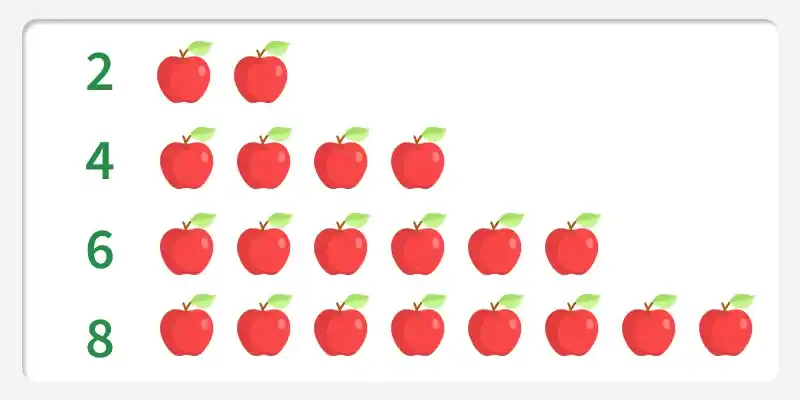
How to Identify Even Numbers
It’s easy to find out if a number is even or odd. Just look at its last digit.
If a number ends with 0, 2, 4, 6, or 8, it is an even number because it can be divided by 2 with no remainder.
Examples: 10880, 2314, and 23468 are all even numbers.
If a number ends with 1, 3, 5, 7, or 9, it is an odd number because it cannot be divided by 2 evenly. When you divide it by 2, you get a remainder of 1.
Examples: 16619 and 1923 are odd numbers.
Smallest Even Number
Zero is the smallest even number. Zero is an integer and meets all the criteria for being even. It is neither positive nor negative but is considered an even number due to its divisibility by 2.
Even Numbers List From 1 to 100

Even vs Odd Numbers

Below is the difference between even and odd numbers:
Even Numbers | Odd Numbers |
|---|---|
Divisible by 2, remainder is 0. | Not divisible by 2, remainder is 1. |
2, 4, 6, 8, 10 (positive); -2, -4, -6, -8, -10 (negative) | 1, 3, 5, 7, 9 (positive); -1, -3, -5, -7, -9 (negative) |
2 x n, where n is an integer | (2 x n) + 1, where n is an integer |
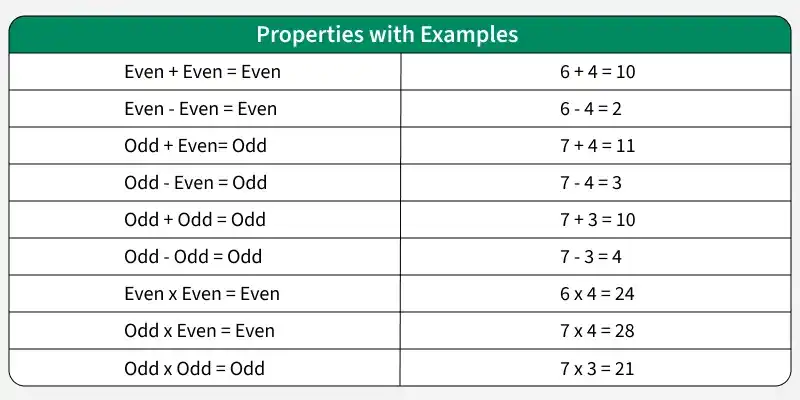
Rules of Even Numbers and Their Operations
Even Numbers on the Number Line

Even numbers can be easily represented on the number line. They are represented by skipping one number and marking the other number, starting from any even number.
Consecutive Even Numbers
Consecutive even numbers are the even numbers that have a difference of 2 between any two numbers that come one after another.
Suppose we write 6, 8, 10, and 12; then it is considered to be a consecutive even number, and if the even number is written as 4, 8, 14, then they are not considered to be a consecutive even number.
Even Natural Numbers
Natural numbers that are also even numbers are called even natural numbers.
Some examples of even numbers are 2, 8, 14, 18, etc.
Even Numbers that are Prime
For any number to be a prime number, its factors should be 1 and the number itself. All even numbers have 2 as their factor; they can't be prime.
But there is one exception to this rule as 2 is the prime as well as even number.
Thus, 2 is the only even number that is prime as well.
Related Articles:
Even Numbers Solved Examples
Example 1: Write any 10 consecutive even numbers between 1 and 50.
Solution:
As, every other number in a continuous series of natural numbers is even number.
So, 2, 4, 6, 8, 10, . . ., 48, 50 is the list of all even numbers between 1 and 50.
Thus, 2, 4, 6, 8, 10, 12, 14, 16, 18, 20 or 12, 14, 16, 18, 20, 22, 24, 26, 28, 30 or 22, 24, 26, 28, 30, 32, 34, 36, 38, 40 are some of the examples of 10 consecutive even numbers between 1 and 50.
Example 2: How many even numbers are between 1 and 300?
Solution:
Out of all integers, half of them are even and half of them are odd. So, there are 300 integers between 1 and 300 (including 1 and 300), so half of them are odd and half of them are even.
Thus, there are 150 even numbers between 1 and 300.
Example 3: What is the even natural number that can be written as the sum of two odd primes?
Solution:
The sum of two odd numbers is always even. Therefore, the smallest even number that can be written as the sum of two odd primes is 8.
The smallest two odd primes are 3 and 5. Their sum is 8, which is also even.
Therefore, the smallest even number that can be written as the sum of two odd primes is 8.
Example 4: Find the sum of even numbers from 10 to 20.
Solution:
Even Numbers from 10 to 20 are 12, 14, 16, 18
Sum = 12 + 14 + 16 + 18
Sum = 60
Thus, the sum of even numbers from 10 to 20 is 60
Practice Problems on Even Numbers
Here are some practice questions on even numbers 1 to 100 for you to solve:
1. Find the sum of even numbers from 20 to 40
2. Check if the numbers given are even numbers or not: 78, 23, 46, 90.
3. Find the product of 12 and 24.
4. How many even numbers are there from 50 to 100?