

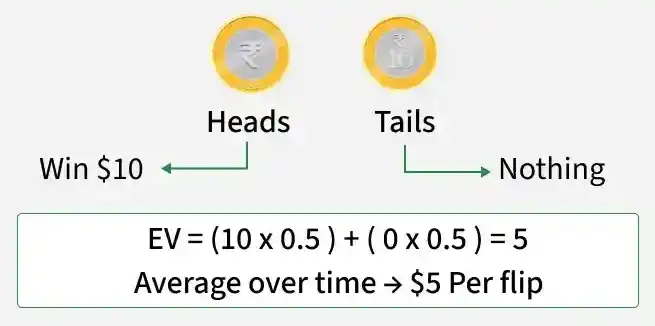
Expected value (EV) is the average value of a random variable, calculated by multiplying each possible outcome by its probability and adding the results. It represents the average outcome expected from a random experiment over many trials.
Properties of Expected Value
- Linearity Principle: E(X + Y) = E(X) + E(Y)
- Addition of a Constant: E(X + C) = E(X) + C
- Multiplication by a Constant: E(CX) = C × E(X)
Where E(X) and E(Y) denote the expected values of the random variables X and Y, and C is a constant.
Random Variables and Expectations
A random variable is a function that assigns a real numerical value to each outcome of a random experiment. It helps us represent the results of random events in numerical form so they can be analysed using probability and statistics.
Random variables can be divided into two broad categories depending on the type of data they represent: discrete random variables and continuous random variables.
Example:
- Discrete Random Variable: When a die is rolled, the possible outcomes are 1, 2, 3, 4, 5, and 6.
- Continuous Random Variable: The height of people in a population can take any value within a range.
Expectation
For a random variable X, expectation represents the average value that X is expected to take when a random experiment is repeated many times. It gives the long-term average outcome associated with the values of the random variable.
For random variable X which assumes values x1, x2, x3,...xn with probability P(x1), P(x2), P(x3), ... P(xn)
Expectation of X is defined as,
E(x) =
\sum P(x_{i})x_{i}
Example: Aman's dad gave him a die. To check if it was a fair die, he rolled the die 500 times and noted down the frequencies of the values obtained in the table on a piece of paper. Due to rain, some values on the table were washed away. So, instead of doing all the experiments again, he rolled the die 20 times and concluded that the expected value in 20 rolls was 3.37. The washed-away table is given below. Find the values of the missing frequencies.
| Die Value | Absolute Frequency |
|---|---|
| 1 | A |
| 2 | 110 |
| 3 | 95 |
| 4 | 70 |
| 5 | 75 |
| 6 | B |
| Total | 500 |
Solution:
Assuming that the expected value remains the same in both 20 and 500 trials.
Let's say the random variable "X" is defined as the value obtained on the die.
X can take values like 1, 2, 3, 4, 5 and 6
The expected value of a random variable is given by,
E(x) =
\sum P(x_{i})x_{i}
E(X) = \sum P(x_{i})x_{i} \\ E(X) = P(X = 1)(1) + P(X = 2)2 + P(X = 3)3 + P(X = 4)4 + P(X = 5)5 + P(X = 6)6 \\ E(X) = \frac{A}{500} + \frac{110}{500}.2 + \frac{95}{500}.3 + \frac{70}{500}.4 + \frac{75}{500}.5 + \frac{B}{500}.6 \\ Substituting the expected value,
3.67 = \frac{A}{500} + \frac{110}{500}.2 + \frac{95}{500}.3 + \frac{70}{500}.4 + \frac{75}{500}.5 + \frac{B}{500}.6 \\ 1685 = A + 220 + 285 + 280 + 375 + 6B \\ 525 = A + 6B Now this equation has two variables, one more equation is required to solve this.
A + 110 + 95 + 70 + 75 + B = 500
⇒ A+ B = 150
So, the two equations are,
A + B = 150
A + 6B = 525
Solving these equations, the values of variables come out to be.
A =75 and B = 75.
Solved Problems
Problem 1: Find the expected value of the outcome when a die is rolled.
Solution:
Consider X is a random variable that represents the value that comes when a die is rolled.
X = {1, 2, 3, 4, 5, 6}
Now, since the die is a fair die, the probability of getting each outcome is equal. That is
\frac{1}{6} E(X) =
\sum x_{i}P(X = x_i) ⇒ E(X) = P(X = 1)(1) + P(X = 2)(2) + P(X = 3)(3) + P(X = 4)(4) + P(X = 5)(5) + P(X = 6)(6)
⇒ E(X) =
\frac{1}{6}(1 + 2 + 3 + 4 + 5 + 6) ⇒ E(X) = 3
Problem 2: A company makes phones. Out of 100 phones, one is faulty. For each phone, the company makes a profit of Rs 2,000 and a loss of Rs 10,000 for the faulty phone. Find the expected profit.
Solution:
Let X be expected profit
E(X) = \sum x_{i}P(X = x_i) ⇒ E(X) = P(X = phone is working)(2000) + P(X = faulty phone)(-10,000)
⇒
E(X) = \frac{99}{100}.2000 + \frac{1}{100}(-10,000) ⇒ E(X) = 1980 - 100
⇒ E(X) = 1880
Problem 3: In a three-time coin toss experiment. Find the expected number of heads.
Solution:
Let X be the number of heads obtained
Sample Space = {HHH, HHT, HTH, HTT, THH, THT, TTH, TTT}
E() =
\sum x_{i}P(X = x_i) ⇒ E(X) =P(X = 0)(0) + P(X = 1)(1) + P(X =2)(2) + P(X = 3)(3)
Finding out the probabilities,
P(X = 0) =
\frac{1}{8} P(X = 1) =
\frac{3}{8} P(X = 2) =
\frac{3}{8} P(X = 3) =
\frac{1}{8} ⇒ E(X) = P(X = 0)(0) + P(X = 1)(1) + P(X =2)(2) + P(X = 3)(3)
⇒ E(X) =
\frac{1}{8}. 0 + \frac{3}{8}.1 + \frac{3}{8}.2 + \frac{1}{8}.3 ⇒ E(X) =
\frac{12}{8} ⇒ E(X) = 1.5
Problem 4: Two friends are fishing in a pond that contains 5 trout and 5 sunfish. Each time they catch a fish, they release it immediately. They made a bet. If the next three fish friend A catches are all sunfish, then friend B will pay him Rs 10; otherwise, friend A will have to pay Rs 2 to B. Find the expected profit from the bet.
Solution:
Let X be a random variable denoting the profit from the bet.
E(X) = P(A catches all three sunfish)(10) + P(A cannot catch all three sunfish)(-2)
Computing the probabilities,
P(A catches all three sunfish) =
\frac{5}{10}.\frac{5}{10}.\frac{5}{10} = \frac{1}{8} P(A doesn't catch all three sunfish) = 1 - P(A catches all three sunfish)
= 1 -
\frac{1}{8} =
\frac{7}{8} Substituting the values computed above into the expectation equation,
E(X) = P(A catches all three sunfish)(10) + P(A cannot catch all three sunfish)(-2)
⇒ E(X) = P(A catches all three sunfish)(10) + P(A cannot catch all three sunfish)(-2)
⇒ E(X) =
\frac{1}{8}.10 + \frac{7}{8}.(-2) ⇒ E(X) =
\frac{-4}{8} = -\frac{1}{2}
Problem 5: Find the expected value of the outcome when a die is rolled. Given that the die is not fair, the probability of getting a 6 is 0.4, and the rest of the numbers are equally likely.
Solution:
Consider X is a random variable that represents the value that comes when a die is rolled.
X = {1, 2, 3, 4, 5, 6}
Now, since the die is not fair die,
P(6) = 0.4
P(1) = P(2) = P(3) = P(4) = P(5) = 0.12
E(X) =
\sum x_{i}P(X = x_i) ⇒ E(X) = P(X = 1)(1) + P(X = 2)(2) + P(X = 3)(3) + P(X = 4)(4) + P(X = 5)(5) + P(X = 6)(6)
⇒ E(X) = (0.12)(1) + (0.12)(2) + (0.12)(3) + (0.12)(4) + (0.12)(5) + (0.4)(6)
⇒ E(X) = (0.12)(1 + 2 + 3+ 4+ 5) + 2.4
⇒ E(X) = 1.8 + 2.4
⇒E(X) = 4.2