

Exponential functions are mathematical functions in which the variable appears in the exponent.
- Describe quantities that increase or decrease rapidly.
- Their rate of growth or decay depends on their current value.
- Used to model population growth, compound interest, and radioactive decay.
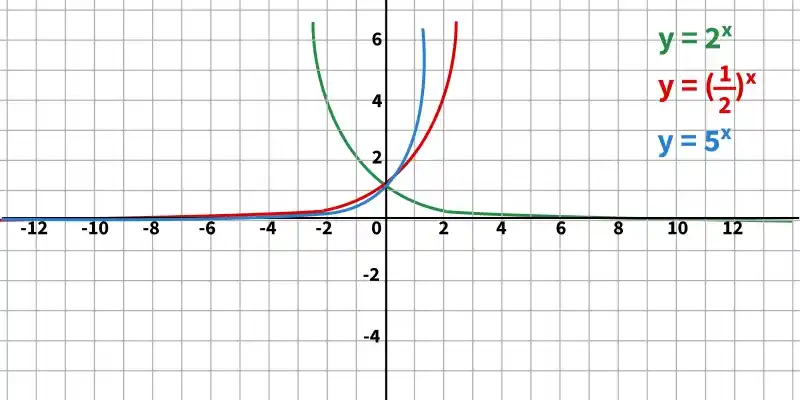
It is generally written as:
f(x) = ax
- a is a positive base, where a ≠ 1.
- x is the variable.
Key features:
- If a > 1, the function increases.
- If 0 < a < 1, the function decreases.
- The graph of an exponential function approaches but never touches the x-axis.
Exponential functions are widely used to model growth and decay, calculate investments, and study population changes.
Exponential Growth
In Exponential Growth, a quantity progresses rapidly. An exponentially growing function has an increasing graph. It can be used to illustrate economic growth, population expansion, compound interest, growth of bacteria in a culture, population increases, etc.
The formula for exponential growth is:
y = a(1 + r)x
- r is the growth rate.
Exponential Decay
In Exponential Decay, a quantity decreases very rapidly at first and then fades gradually. An exponentially decaying function has a decreasing graph. The concept of exponential decay can be applied to determine half-life, mean lifetime, population decay, radioactive decay, etc.
The formula for exponential decay is:
y = a(1 - r)x
Where r is the decay rate
Exponential Function Derivative
- For f(x) = eˣ, its derivative is, d/dx (eˣ) = eˣ.
- For f(x) = ax, its derivative is, d/dx (ax) = ax · ln a
Exponential Function Integration
- For f(x) = eˣ, its integration is ∫eˣ dx = eˣ + C
- For f(x) = ax, its integration is, ∫ax dx = ax / (ln a) + C