

An exponent is a short way to write repeated multiplication. In 53, 5 is the base and 3 is the exponent. It means 5 × 5 × 5 = 125. The whole expression 5³ is called a power.
Why Learn Exponents?
- Money: compound interest grows by repeated multiplication.
- Biology: bacteria that double every hour follow 2ⁿ.
- Computers: 1 KB = 210 = 1,024 bytes.
- Science: pH and the Richter scale are built on powers of 10.
- Numbers of any size: exponents let us write huge and tiny values compactly, like the distance to the Sun or the width of a hair.
Some examples are given below:
Example 1: Observe the pattern in the image. How does the value of 2n change as the exponent increases by 1?
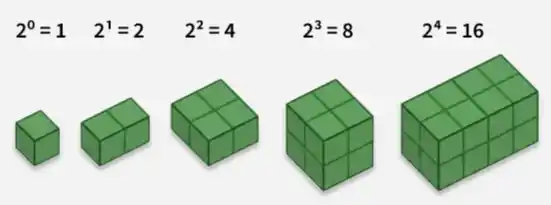
The value doubles each time the exponent increases by 1. For example, 22 = 4, 23 = 8, and 24 = 16.
Example 2: A file of 50 MB is compressed so that its size halves at each step. What is its size after 4 steps?

Method 1: step by step
Step
0
1
2
3
4
Size(MB)
50
25
12.5
6.25
31.25
Method 2: using exponents
Halving 4 times means dividing by 2 four times:Size after n steps = 50 ÷ 2ⁿ
Size after 4 steps = 50 ÷ 24 = 50 ÷ 16 = 31.25 MB
For Beginners
This section covers the basics of exponents, the core laws, special cases, and how they connect to roots.
- Laws of Exponents
- Negative Exponents
- Fractional Exponents
- Scientific Notation
- Writing Numbers in Standard Form
- Exponential Equation
- Exponents vs Powers
- Real-Life Applications
For Practice
Shortcut methods, solved examples, and commonly asked exponent questions for competitive exams.
- Add and Subtract Exponents
- Multiply and Divide Exponents
- Simplify Exponents
- Practice Questions on Exponents & Powers
- Exponential Equations Worksheet