

Factoring polynomials is a method in algebra where we break a polynomial into smaller and simpler parts. These smaller parts, when multiplied, give back the original polynomial.
The process by which we find the constituent factors of a higher-degree polynomial is called factoring polynomials.
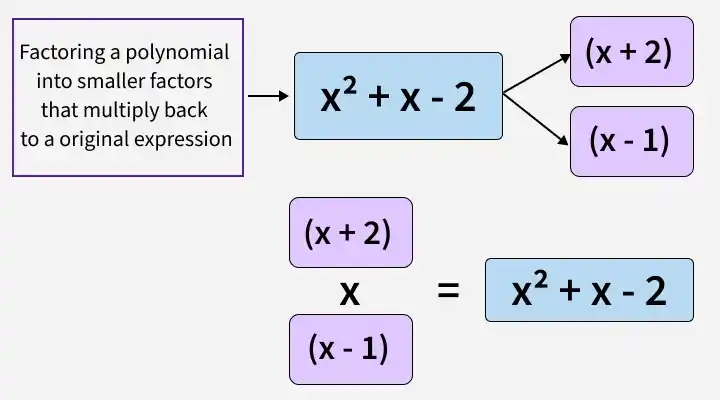
For example, by multiplying x+2 and x -1 we get x2+x-2, where x + 2 and x -1 are the factors of the expression x2+x-2.
By the fundamental theorem of algebra, we know that any polynomial of degree 'n' has n roots, either real or complex. Thus, it also has n factors as well as every unique root gives a unique factor to the provided expression.
Techniques for Factoring Polynomials
Common Factors
The first method is the common factors method, in which if there is a common factor for each term in the polynomial, we factor that common term out and write the remaining polynomial.
The first approach is known as the "common factors method," in which the common factors of each term are factored out in the polynomial.
Example: What are the factors of 3x2 + 6x +12?
Let f(x) = 3x2 + 6x +12
As 3 is present in each term as expression can be rewritten as
f(x) =3x2+3×2x-3×4
⇒ f(x) = 3(x2+2x+4)
Thus, factors of the 3x2 + 6x +12 are 3 and x2 + 2x +4.
Grouping Method
This method factors polynomials by grouping terms with two or more terms together and finding the greatest common factor for each grouping. Once the common factors for each grouping were found, each group had the same factor.
Example: Factorize the expression ax2 + 7abx + ax + 7ab as a and b are some real numbers.
Solution:
Let f(x) = ax2+7abx+ax+7ab
Grouping two elements at a time,
⇒ f(x) = (ax2+ax)+(7abx+7ab)
⇒ f(x) = ax(x+1)+7ab(x+1)
⇒ f(x) = (ax+7ab)(x+1)
Thus, ax+7ab and x + 1 are the required factors.
Splitting the Middle Term
Using this technique; the quadratic polynomials with a leading coefficient of 1, are factorized. This method is highly useful since higher-degree polynomials are frequently converted to quadratic polynomials using the factor theorem.
- Step 1: f(x) = x2+(a+b)x +ab
- Step 2: f(x)= x2+ax+bx+ab
- Step 3: f(x)= x(x+a)+b(x+a)
- Step 4: f(x)= (x+a) (x+b)
So all quadratic polynomial of form x2+(a+b)x + ab, can be factorize using Splitting the Middle Term method,
Example: Factorize x2+5x+6.
Let f(x) = x2+5x+6
f(x)= x2 + (2+3)x+2×3
⇒ f(x)= x2+2x+3x+2×3
⇒ f(x)= x(x+2)+3(x+2)
⇒ f(x)= (x+2)(x+3)
Thus, x+2 and x+3 are the factors of the expression x2+5x+6.
Long Division Method
Long Division is a method for dividing polynomials similar to numbers, where a higher-degree polynomial can be divided by the lower-degree polynomial to find the quotient and remainder. Using long division and the factor and remainder theorem together, we can factorize any polynomial with an integer coefficient easily.
For example: Long division of x3-5x2+9x-5 by x -1 is shown in the following illustration.

Factor Theorem
Factor Theorem states that for any polynomial f(x) = 0, x - a is the factor of f(x) if and only if x = a is the zero of the polynomial.
Example: Use the Factor Theorem to determine whether x - 3 is a factor of f(x) = x3 - 6x2 + 11x - 6.
By Factor Theorem we know, x - 3 is a factor of f(x) when f(3) = 0.
f(3) = 33 - 6(3)2 + 11(3) - 6
⇒ f(3)= 27 - 54 + 33 - 6 = 0
Since f(3) = 0, thus x - 3 is a factor of f(x).
Remainder Theorem
Remainder Theorem states that if (x-a) is the factor of a polynomial f(x)=0 then f(a) is the remainder of the polynomial when divided by x-a.
Example: Find the remainder when f(x) = 2x3 + 3x2 - 5x + 2 is divided by (x - 2).
To find the remainder, we need to evaluate f(x) at x = 2, since the divisor is (x - 2).
Therefore, the remainder is:
f(2) = 2(2)3+ 3(2)2 - 5(2) + 2
f(2) = 16 + 12 - 10 + 2 = 20
Therefore, the remainder when f(x) is divided by (x - 2) is 20.
With the help of both the above-mentioned theorems and the long division method, most of the polynomials can be factorized.
Example: f(x) = x3-6x2+3x+10
Step 1: Consider all the divisors of the constant part of the polynomial and out of those divisors one should satisfy the given polynomial.
- Constant part in the polynomial is 10 whose divisors are ±1, ±2, ±5.
- Now, f(1) = 1 - 6 +3 +10 = 8 ≠ 0, So x - 1 is not a factor of f(x).
- f(-1) = -1 - 6 -3 +10 = 0, thus x+1 is factor of f(x).
Step 2: Divide the polynomial f(x) with the newly found factor i.e., divide f(x) using long division by x+1.

So, f(x) = (x+1)(x2-7x+10)
Step 3: Factorize the remaining part using Splitting the Middle Term,
f(x) = (x+1)(x2-7x+10)
⇒ f(x) = (x+1)(x2-2x-5x+10)
⇒ f(x) = (x+1)[x(x-2)-5(x-2)]
⇒ f(x) = (x+1)(x-2)(x-5)
Thus, x+1, x-2 and x-5 are the factors of the polynomial f(x) = x3-6x2+3x+10
Shreedharacharya Formula
For any quadratic equation ax2+bx+c =0, its two roots can be calculated using Shreedharacharya Formula .

using factor theorem,
Related Articles
Factoring Polynomials Examples
Example 1: Factorize 7x2 - 21x.
Let f(x) = 7x2 - 21x
As 7 and x is common in each term of the given polynomial
f(x) = 7x(x -3)
Hence, 7x and x - 3 are the factors of the given polynomial.
Example 2: What are the factors of y2-8y+7?
Let g(y) = y2-8y+7
⇒ g(y) = y2-8y+7
⇒ g(y) = y2-7y-y+7
⇒ g(y) = y(y-7)-(y-7)
⇒ g(y) = (y-7)(y-1)
Thus, y-7 and y-1 are the factors of y2-8y+7.
Example 3: Factorize x2+x-1.
Comparing x2+x-1 with the general quadratic expression ax2+bx+c, we get
a = 1, b = 1 and c = -1
Using Shreedharacharya Formula,
\begin{aligned} &x =\frac{-1\pm\sqrt{1^2-4\times 1 \times (-1)}}{2\times 1}\\ &x =\frac{-1\pm\sqrt{1+4}}{2}\\ &x =\frac{-1\pm\sqrt{5}}{2}\\ &x =\frac{-1+\sqrt{5}}{2} \text{ or } x =\frac{-1-\sqrt{5}}{2} \\ \end{aligned} Thus, using factor theorem
x +\frac{1-\sqrt{5}}{2} andx -\frac{1+\sqrt{5}}{2} are the factors of the given polynomial.
Practice Questions
1. Factor the polynomial x2 - 9
2. Factor the quadratic polynomial x2 + 7x + 12
3. Factor the polynomial x3 - 3x2 + 4x - 12
4. Factor the polynomial 4x2 - 25
5. Factor x3 - 6x2 + 11x - 6