

Factorization in mathematics is the process of expressing a number or an algebraic expression as a product of simpler factors. Factorizing a polynomial means expressing it as a product of simpler polynomials or monomials. This helps simplify expressions, solve equations, and understand polynomial behavior.
Example: The factors of 12 are 1, 2, 3, 4, 6, and 12, and we can express 12 as 12 = 1 × 12, 2 × 6, or 4 × 3.
Prime Factorization of Polynomials
Just like numbers, algebraic expressions can also be factored into simpler polynomials. If an algebraic expression cannot be simplified further, then its factors are considered to be prime factors of the expression.
Example: Consider the polynomial 8xy.
The prime factorization of 8xy is:
8xy = 2 × 2 × 2 × x × y
Here, 2, x, and y are the prime factors of 8xy, considering that x and y are relatively prime to each other (they don't share any common factors other than 1).
Methods of Factorization of Polynomials
Factorization is the process of writing a number as the product of smaller numbers. It is the decomposition of a number (or) mathematical objects into smaller or simpler numbers/objects. Factorization of different types of algebraic expressions is very useful for various purposes used in mathematics. Various methods of factorization of polynomials are
- By Greatest Common Factor (GCF),
- By Regrouping,
- Factorization Using Identities,
- Factorization Using Splitting Terms (only for quadratic polynomials),
- Factorization Using Rational Roots and Factor Theorem.
Factorization of Polynomials by Greatest Common Factor
The highest common factor between the two numbers is called the GCF (Greatest Common Factor). It is useful for factoring polynomials
The steps for finding GCF are:
- Step 1: First, split every term of algebraic expression into irreducible factors
- Step 2: Then find the common terms among them.
- Step 3: Now the product of common terms and the remaining terms give the required factor form.
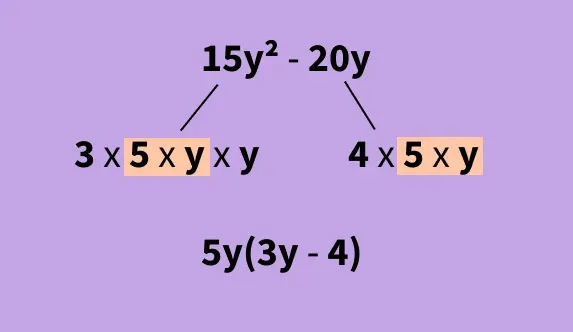
Example: Factorise 3x + 18
Solution:
Step 1: First splitting every term into irreducible factors.
3x = 3 × x
18 = 2 × 3 × 3Step 2: Next step to find the common term
3 is the only common termStep 3: Now the product of common terms and remaining terms is 3(x + 6)
So, 3(x + 6) is the required form.
Factorization of Polynomials by Regrouping
Sometimes the terms of the given expression should be arranged in suitable groups in such a way so that all the groups have a common factor, and then the common factor is taken out. In this way, factoring of a polynomial is done.
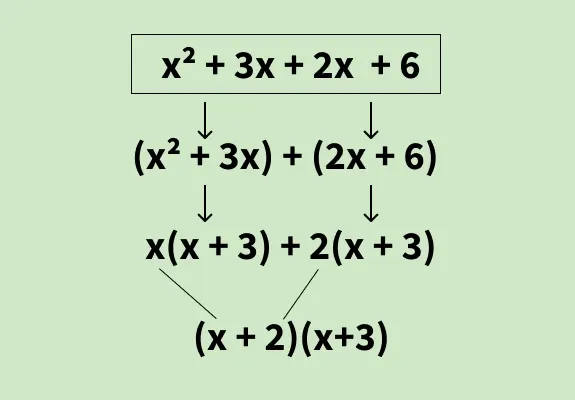
Example: Factorise x2 + yz + xy + xz.
Solution:
Here we don't have a common term in all terms, so we are taking (x2 + xy) as one group and (yz + xz) as another group.
Factors of (x2 + xy) = (x × x) + (x × y) = x(x + y)
Factors of (yz + xz) = (y × z) + (x × z) = z(x + y)After combining them,
x2 + yz + xy + xz = x(x + y) + z(x + y)Taking (x + y) as common we get,
x2 + yz + xy + xz = (x + y) (x + z)Thus, (x + y), and (x + z) are the factors of the given expression x2 + yz + xy + xz
Factorization of Polynomials Using Identities
There are many standard algebraic identities that are used to factorize various polynomials. Some of them are given below:
- a2 + 2ab + b2 = (a + b)2
- a2 - 2ab + b2 = (a - b)2
- a2 - b2 = (a + b) (a - b)
- a2 + b2 + c2 + 2(ab + bc + ca) = (a + b + c)2
- a3 + b3 + 3ab(a + b) = (a + b)3
- a3 - b3 - 3ab(a - b) = (a - b)3
- a3+ b3= (a+b)(a2+ b2– ab)
- a3 - b3= (a-b)(a2+ b2+ ab)
- a3 + b3 + c3 – 3abc = (a + b + c)(a2 + b2 + c2 – ab – bc – ca)
Example 1: Factorise x2 + 8x + 16.
Solution:
This is in the form of (a + b)2 = a2 + 2ab + b2
x2 + 8x + 16 = x2 + 2 × x × 4 + 42
= (x + 4)2
=(x + 4) (x + 4)
Example 2: Factorise x2 - 6x + 9.
Solution:
Let g(x) = x2 - 6x + 9
This is in the form of (a - b)2 = a2 - 2ab + b2
⇒ g(x) = x2 - 2 × x × 3 + 32
⇒ g(x) = (x - 3)2
⇒ g(x) =(x - 3) (x - 3)
Example 3: Factorise x3 - 27.
Solution:
Let g(x) = x3 - 27
Using, a3 - b3= (a-b)(a2+ b2+ ab)
g(x) = x3 - 33
⇒ g(x) = (x- 3 )(x2 + 32 + 3x)
⇒ g(x) = (x- 3 )(x2+ 3x + 9 )As , x2+ 3x + 9 can't be factorize further,
Thus factors of x3 - 27 are (x- 3 ), and (x2+ 3x + 9 ) .
Related Articles:
Examples on Factorization
Example 1: Factorize a2 - 20a + 100
Solution:
f(a) = a2 - 20a + 100
This is the form of (a - b)2 = a2 - 2ab + b2
⇒ f(a) = a2 - 2 × a × 10 + 102
⇒ f(a) = (a - 10)2
⇒ f(a) = (a - 10) (a - 10)
Example 2: Factorize 25x2 - 49
Solution:
This is the form of a2 - b2 = (a + b) (a - b)
25x2 - 49 = (5x)2 - 72
= (5x + 7) (5x - 7)
Example 3: Factorize 2xy + 3 + 2y + 3x
Solution:
Let f(x) = 2xy + 3 + 2y + 3x
⇒ f(x) = 2xy + 2y + 3x + 3 [rearranging terms to get common terms]
⇒ f(x) = 2y (x + 1) + 3(x + 1)
⇒ f(x) = (2y + 3)(x + 1)
Example 4: Factorize x3 - 8
Solution:
We know the identity, a3 - b3 = (a - b)(a2 + ab + b2). Here a = x and b = 2.
Thus, x3 - 8= (x - 2)(x2 + 2x + 22)
⇒ x3 - 8= (x - 2)(x2 + 2x + 4 )
Example 5: Factorize 2x3 + 4x2- 6x.
Solution:
Let f(x) = 2x3 + 4x2- 6x
⇒ f(x) = 2x(x2 + 2x - 3)
⇒ f(x) = 2x(x2 + 3x - x - 3)
⇒ f(x) = 2x[x(x + 3) - (x + 3)]
⇒ f(x) = 2x(x + 3)(x - 1)
Example 6: Factorise a4 – 81
Solution:
Using the identity a² − b² = (a − b)(a + b), we get:
a⁴ − 81 = (a²)² − (9)² = (a² − 9)(a² + 9)
= (a − 3)(a + 3)(a² + 9).
Unsolved Question
Question 1: Factorize: x2 + 14x + 49
Question 2: Factorize: 64y2 − 100
Question 3: Factorize: 3ab + 6a + 2b + 4
Question 4: Factorize: x3 + 27
Question 5: Factorize: 5x3 − 20x
Question 6: Factorize: a4 − 16