
Figurate numbers are a number that can be represented by a regular geometric shape composed of equally spaced elements. These elements can include squares, triangles, points, or other 2D or 3D geometric forms.
The diagonals of Pascal's Triangle represent figurate numbers, with each diagonal corresponding to a specific type of figurate sequence, such as triangular, tetrahedral numbers, and pentatope numbers.
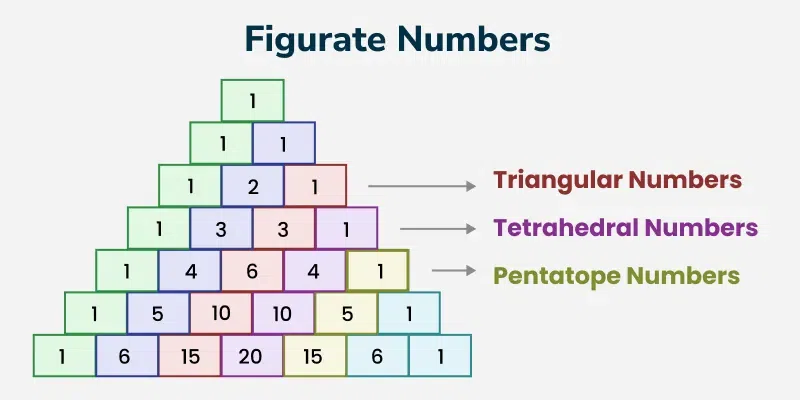
Here’s a table of common types of figurate numbers, their formulas, and the type of number sequence they belong to:
Type of Figurate Number | Formula (nth term) | Number Sequence |
|---|---|---|
Triangular Numbers | Tn = n(n+1)/2 | 1, 3, 6, 10, 15, 21, . . . |
Square Numbers | Sn = n2 | 1, 4, 9, 16, 25, 36, . . . |
Pentagonal Numbers | Pn = n(3n - 1)/2 | 1, 5, 12, 22, 35, 51, . . . |
Hexagonal Numbers | Hn = n(2n - 1) | 1, 6, 15, 28, 45, 66, . . . |
Heptagonal Numbers | Hpn = n(5n - 3)/2 | 1, 7, 18, 34, 55, 81, . . . |
Octagonal Numbers | On = n(3n−2) | 1, 8, 21, 40, 65, 96, . . . |
Cubic Numbers | Cn = n3 | 1, 8, 27, 64, 125, 216, . . . |
Tetrahedral Numbers | Ttn = n(n+1)(n+2)/6 | 1, 4, 10, 20, 35, 56, . . . |
Triangular Numbers
A triangular number is a figurate number that can be arranged in the shape of an equilateral triangle. The nth triangular number is the sum of the first n natural numbers, and it can be calculated using the formula:
Tn = n(n+1)/2
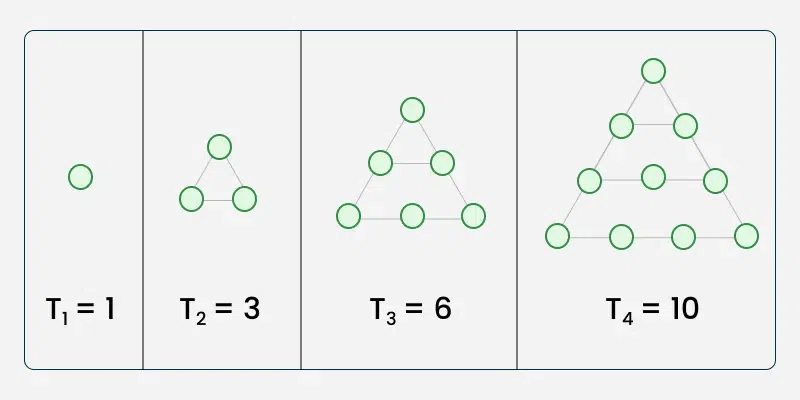
The sequence of triangular numbers starts with 1, 3, 6, 10, 15, and so on. These numbers represent the total number of dots that can form an equilateral triangle.
Square Numbers
A square number is a figurate number that can be arranged in the shape of a perfect square. The nth square number is the product of a number multiplied by itself, and it can be calculated using the formula:
Sn = n2
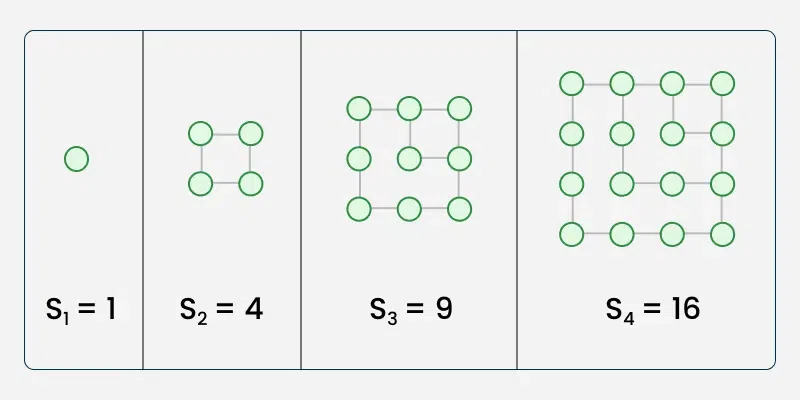
The sequence of square numbers starts with 1, 4, 9, 16, 25, and so on. These numbers represent the area of a square with side length n.
Pentagonal Numbers
Pentagonal numbers are figurate numbers that represent a pentagon (a five-sided polygon). The nth pentagonal number is given by the formula:
Pn = n(3n - 1)/2
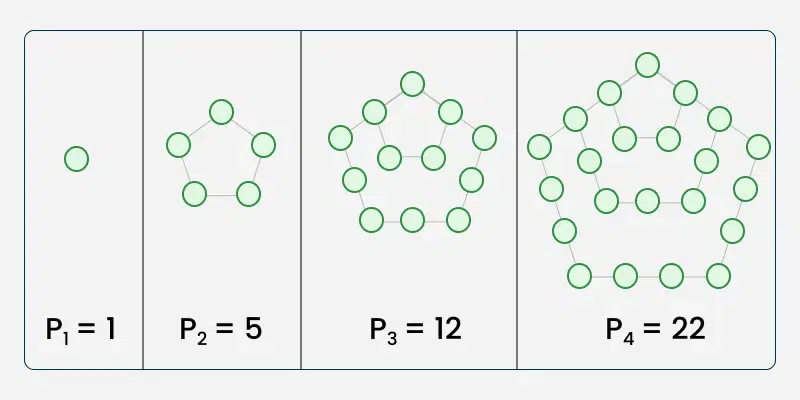
This sequence begins with 1, 5, 12, 22, 35, and so on. These numbers represent the number of distinct dots that can form a pentagon.
Hexagonal Numbers
Hexagonal numbers are figurate numbers that can be arranged in the shape of a hexagon (a six-sided polygon). The nth hexagonal number represents the total number of dots that can form a hexagon when arranged in a specific pattern.
The formula to calculate the nth hexagonal number is:
Hn = n(2n−1)
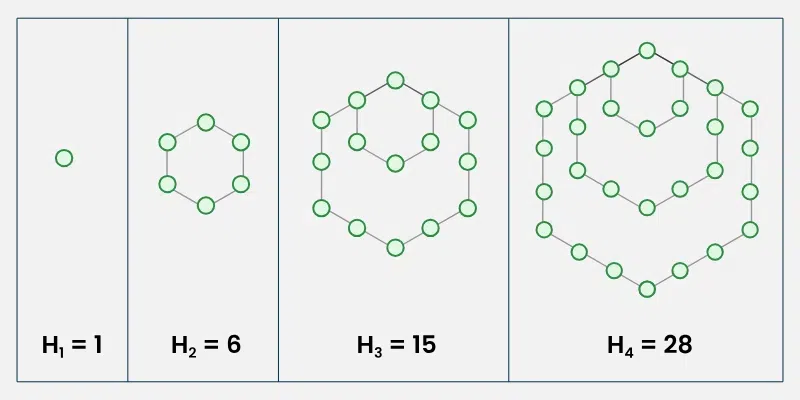
The sequence of hexagonal numbers starts with 1, 6, 15, 28, 45, and so on. These numbers represent the total number of dots that can form a hexagon.
Heptagonal Numbers
Heptagonal numbers are figurate numbers that represent a heptagon (a seven-sided polygon).
The nth heptagonal number is given by the formula:
Hpn = n(5n - 3)/2
The sequence of heptagonal numbers starts with 1, 7, 18, 34, 55, and so on. These numbers represent the total number of dots that can form a heptagon.
Octagonal Numbers
Octagonal numbers are figurate numbers that represent an octagon (an eight-sided polygon).
The nth octagonal number is given by the formula:
On = n(3n - 2)
The sequence of octagonal numbers starts with 1, 8, 21, 40, 65, and so on. These numbers represent the total number of dots that can form an octagon.
Cubic Numbers
Cubic numbers, also known as perfect cubes, are numbers that are the cube of an integer.
The nth cubic number is given by the formula:
Cn = n3
The sequence of cubic numbers starts with 1, 8, 27, 64, 125, and so on. These numbers represent the volume of a cube with side length n.
Tetrahedral Numbers
Tetrahedral numbers are figurate numbers that represent a three-dimensional pyramid with a triangular base, also known as a tetrahedron.
The nth tetrahedral number is given by the formula:
Tn = (n × (n + 1) × (n + 2)) / 6
The sequence of tetrahedral numbers starts with 1, 4, 10, 20, 35, and so on. These numbers represent the total number of spheres that can form a tetrahedron.
Conclusion
Figurate numbers uniquely illustrate the connection between numbers and geometric shapes, ranging from two-dimensional figures like triangles and squares to three-dimensional forms like cubes and tetrahedra.
Read More,