

Fractional exponents, also known as rational exponents (radicals), are used to represent powers and roots together in a single expression. In an exponential expression of the form aᵇ, where a is the base and b is the exponent, if b is a fraction (m/n), it is called a fractional exponent.
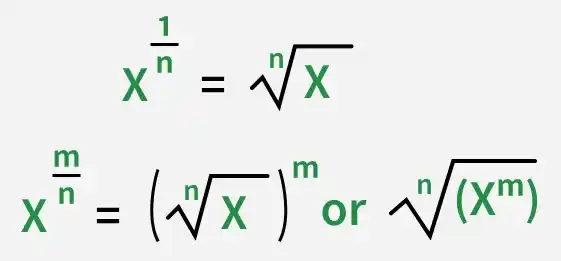
In a fractional exponent, the numerator (m) represents the power, and the denominator (n) represents the root.
Here are some common examples of fractional exponents:
| Exponent | Name of the exponent | Indication |
|---|---|---|
| 1/2 | Square root | |
| 1/3 | Cube root | |
| 1/4 | Fourth root |
Rules of Fractional Exponents
Rule 1: When multiplying powers with the same base, add the exponents:
Rule 2: When dividing powers with the same base, subtract the exponents:
Rule 3: When multiplying different bases with the same exponent, multiply the bases:
Rule 4: When dividing different bases with the same exponent, divide the bases:
Rule 5: A negative exponent means taking the reciprocal:
Example: Simplify (64/125)²⁄³
Solution:
64 = 4³ and 125 = 5³
So, (64/125)²⁄³ = (4³/5³)²⁄³
= ((4/5)³)²⁄³ (using law of exponents: (aᵐ)ⁿ = aᵐⁿ)
= (4/5)² (since 3 × 2/3 = 2)
= 16/25
Fractional Exponents vs Integer Exponents
The following table shows the difference between fractional and integer exponents:
Fractional Exponents | Integer Exponents |
|---|---|
| Used when the power is not an integer. | Used when the powers are whole numbers. |
| They are written in the form x a/b. | They are written in the form x a |
| Allows us to express roots and other non- integer powers. | Positive integer exponents indicate repeated multiplication, and negative integer exponents indicate repeated division. |
| Ex: 41/2=2 | Ex: 42 = 16 and 4-2 = 1/16 |