

Horizontal asymptotes are horizontal lines (parallel to the x-axis) that a graph approaches as
- It describes the end behavior of a function, what happens to the function as the input becomes very large (positive or negative).
- This concept helps in analyzing the long-term behavior of the functions and is essential in various fields such as physics, engineering, and economics.
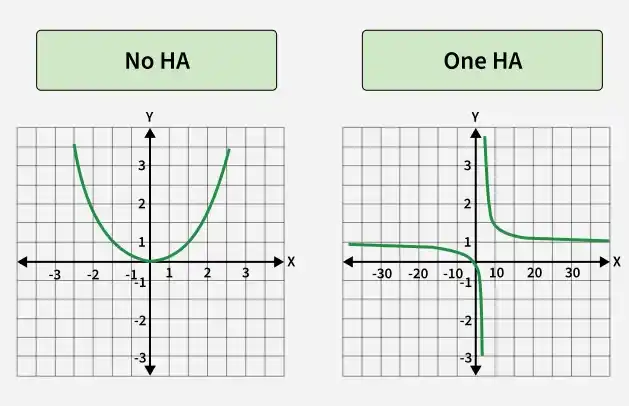
A line y = L is a horizontal asymptote of a function f(x) if
\lim\limits_{x \to \infty} f(x) = L \quad or
\lim\limits_{x \to -\infty} f(x) = L
Methods to Find Horizontal Asymptotes
1. Horizontal Asymptotes From Graph
- Observe the graph as
x \to \infty\ and \ x \to -\infty - Identify the value that the curve approaches
2. Horizontal Asymptotes from the Equation
- Evaluate limits at infinity:
\lim\limits_{x \to \infty} f(x),\ \lim\limits_{x \to -\infty} f(x)
Example:
\lim\limits_{x \to \infty} \frac{1}{x} = 0 Horizontal asymptote: y=0
Horizontal Asymptote of Rational Functions
For rational functions of the form
- If the degree of the P(x) is less than the degree of the Q(x), the horizontal asymptote is y = 0.
- If the degree of the P(x) is equal to the degree of the Q(x), the horizontal asymptote is
y = \frac{a}{b} where a and b are the leading coefficients of P(x) and Q(x), respectively.- If the degree of the P(x) is greater than the degree of the Q(x), there is no horizontal asymptote.
Example: Find the horizontal asymptote of
Step 1: Identify degrees
- Degree of numerator = 2
- Degree of denominator = 2
Step 2: Apply rule (degrees equal)
\text{Horizontal asymptote(y)} = \frac{\text{leading coefficient of numerator}}{\text{leading coefficient of denominator}}
y=\frac{4}{2} = 2

Horizontal Asymptote of Exponential Functions
For functions of the form
- If (b > 0) the horizontal asymptote is y = 0 as x to the
-\infty . - If (b < 0) the horizontal asymptote is y = 0 as x to the
\infty .
Example: Find the horizontal asymptote of
Step 1: Analyze behavior as
x \to -\infty
e^x \to 0 Step 2: Substitute limit
f(x) = 4e^x + 2 \to 4(0) + 2 = 2

Horizontal Asymptote of Logarithmic Functions
For functions like
Solved Examples
Example 1: Find the horizontal asymptote of
Degree of Numerator: 3
Degree of Denominator: 3
Since the degrees are equal the horizontal asymptote is determined by the ratio of the leading coefficients:
y = \frac{2}{1} = 2 Thus, the horizontal asymptote is y = 2.
Example 2: Determine the horizontal asymptote of the
As x to
\infty ,e^{-2x} to 0 .Therefore, g(x) to
3 \cdot 0 = 0 .Thus, the horizontal asymptote is y = 0.
Practical Questions: Horizontal Asymptote
Questions 1. Find the horizontal asymptote of
Questions 2. Determine the horizontal asymptote of
Questions 3. What is the horizontal asymptote of
Questions 4. Find the horizontal asymptote of
Questions 5. Determine if the function