

A square root is a value that gives the original number that multiplication of itself. e.g., 6 multiplied by itself gives 36 (i.e., 6 × 6 = 36), therefore, 6 is the square root of 36, or in other words, 36 is the square number of 6.
Solved Practice Questions
Question 1. Compute the square root of 144 by the Prime Factorization Method.
Solution:
\begin{array}{c|c} 2 & 144 \\ \hline 2 & 72 \\ \hline 2 & 36 \\ \hline 2 & 18 \\ \hline 3 & 9 \\ \hline 3 & 3 \\ \hline & 1 \\ \end{array} ⇒ 144 = {2 × 2} × {2 × 2} × {3 × 3}
⇒ 144 = 2 2 × 2 2 × 3 2
⇒ 144 = (2 × 2 × 3) 2
⇒ 144 = (12) 2
⇒ √144 = 12
Question 2. Solve: √(x + 2) = 4
Solution:
We know,
√(x + 2) = 4
On squaring both the sides, we obtain;
x + 2 = √4
⇒ x + 2 = ±4
⇒ x = ±4 – 2
Therefore, we have,
x = 2 or x = -6
Question 3. Can the square root of a negative number be a whole number? Explain.
Solution:
We know, the negative numbers cannot have a square root. The reason behind this is that if two negative numbers are multiplied together, the result obtained will always be a positive number. Therefore, the square root of a negative number will be in the form of complex number.
Question 4. Compute the square root of 25 by the method of repeated subtraction?
Solution:
Going by the above stated steps, we have,
25 - 1 = 24
24 - 3 = 21
21 - 5 = 16
16 - 7 = 9
9 - 9 = 0
Since the process is repeated 5 times, therefore, we have,√25 = 5.
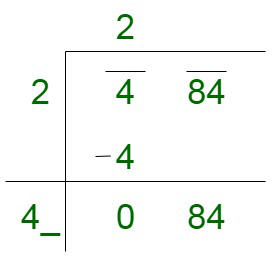
Question 5. Compute the square root of 484 by the long division method?
Solution:
By the long division method, we have,
Now,
The remainder is 0, therefore, 484 is a perfect square number, such that,
√484 = 22



Question 6: Determine the square root of 16 using the repeated subtraction method.
Solution:
In the repeated subtraction method, we subtract consecutive odd numbers starting from 1 until the result becomes zero:
- 16 - 1 = 15
- 15 - 3 = 12
- 12 - 5 = 7
- 7 - 7 = 0
Here it takes four steps to get the 0.
Hence, the square root of 16 is 4.
Question 7: Find the square root of 196 using the division method.
Solution:
The steps to determine the square root of 196 are:
Step 1: Start the division from the leftmost side. Here 1 is the number whose square is 1.
Step 2: Putting it in the divisor and the quotient and then doubling it will give.
Step 3: Now we need to find a number for the blanks in divisor and quotient. Let that number be x.
Step 4: We need to check when 2x multiplies by x give a number less than or equal to 96. Take x = 1, 2, 3 and so on and check.
In this case,
- 21 × 1 = 21
- 22 × 2 = 44
- 23 × 3 = 69
- 24 × 4 = 96
So, choose x = 4 as the new digit to be put in divisor and in the quotient.
The remainder here is 0 and hence 14 is the square root of 196.

Question 8: Find the square root of 9 + 40i.
Solution :
Let's use the following formula to determine the square root of the given complex number as:
\sqrt{a+ib} = \pm(\sqrt{\frac{\sqrt{a^2+b^2}+a}{2}}+i\frac{b}{|b|}(\sqrt{\frac{\sqrt{a^2+b^2}-a}{2}})) For the given case, substitute a = 9 and b = 40 in the above formula,
\begin{aligned}\sqrt{9+40i}&=\pm\left(\sqrt{\dfrac{\sqrt{9^2+{40}^2}+9}{2}}+i\dfrac{40}{|40|}\sqrt{\dfrac{\sqrt{9^2+(40)^2}-9}{2}}\right)\\&=\pm\left(\sqrt{\dfrac{\sqrt{81+{1600}}+9}{2}}+i\left(\dfrac{40}{40}\right)\sqrt{\dfrac{\sqrt{81+1600}-9}{2}}\right)\\&=\pm\left(\sqrt{\dfrac{\sqrt{1681}+9}{2}}+i\sqrt{\dfrac{\sqrt{1681}-9}{2}}\right)\\&=\pm\left(\sqrt{\dfrac{50}{2}}+i\sqrt{\dfrac{32}{2}}\right)\\&=\pm(5+4i)\end{aligned} which is the required solution.
Question 9: Find the square root of 3 + 4i.
Solution :
Let's use the following formula to determine the square root of the given complex number as:
\sqrt{a+ib} = \pm(\sqrt{\frac{\sqrt{a^2+b^2}+a}{2}}+i\frac{b}{|b|}(\sqrt{\frac{\sqrt{a^2+b^2}-a}{2}})) For the given case, substitute a = 3 and b = 4 in the above formula,
\begin{aligned}\sqrt{3+4i}&=\pm\left(\sqrt{\dfrac{\sqrt{3^2+{4}^2}+3}{2}}+i\dfrac{4}{|4|}\sqrt{\dfrac{\sqrt{3^2+4^2}-3}{2}}\right)\\&=\pm\left(\sqrt{\dfrac{\sqrt{9+16}+3}{2}}+i\left(\dfrac{4}{4}\right)\sqrt{\dfrac{\sqrt{9+16}-3}{2}}\right)\\&=\pm\left(\sqrt{\dfrac{\sqrt{25}+3}{2}}+i\sqrt{\dfrac{\sqrt{25}-3}{2}}\right)\\&=\pm\left(\sqrt{\dfrac{5+3}{2}}+i\sqrt{\dfrac{5-3}{2}}\right)\\&=\pm(\sqrt{4}+i\sqrt{1})\\&=\pm(2+i)\end{aligned} which is the required solution.
Question 10: Find the square root of 225 using the division method.
Solution:
The steps to determine the square root of 225 are:
Step 1: Start the division from the leftmost side. Here 1 is the number whose square is 1.
Step 2: Putting it in the divisor and the quotient and then doubling it will give.
Step 3: Now we need to find a number for the blanks in divisor and quotient. Let that number be x.
Step 4: We need to check when 2x multiplies by x gives a number which is either less than or equal to 125. Take x = 1, 2, 3 and so on and check.
In this case,
- 21 × 1 = 21
- 22 × 2 = 44
- 23 × 3 = 69
- 24 × 4 = 96
- 25 × 5 = 125
So we choose x = 5 as the new digit to be put in divisor and in the quotient.
The remainder here is 0 and hence 15 is the square root of 225.

Unsolved Questions
Question 1. Find the square root of 256 using the Prime Factorization Method.
Question 2. Solve the equation:
Question 3. Can the square root of a negative number be a natural number? Give a reason.
Question 4. Compute the square root of 36 using the repeated subtraction method.
Question 5. Find the square root of 324 using the long division method.
If you want, I can also add full worked solutions, or simplify these for Grade-level practice (with shorter steps).