

Integers are a set of whole numbers that include positive numbers, negative numbers, and zero, but do not include fractions or decimals.
Examples : ..., −5, −4, −3, −2, −1, 0, 1, 2, 3, 4, 5, ...

If a set is constructed using all-natural numbers, zero, and negative natural numbers, then that set is referred to as an integer. Integers range from negative infinity to positive infinity.
A set of integers is represented by the letter Z.
Type of Integers
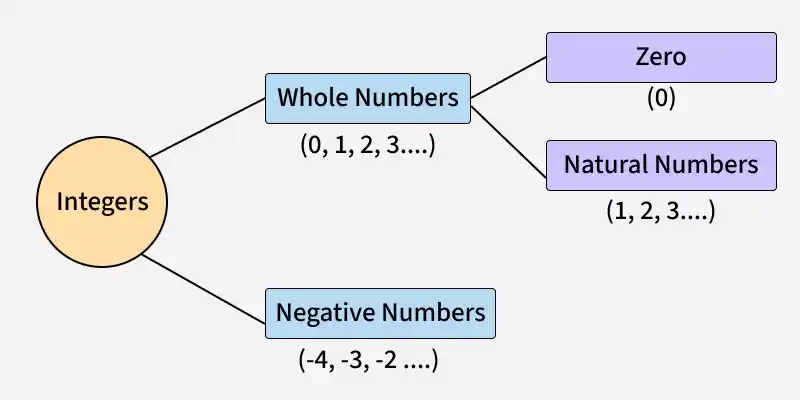
Integers are classified into three categories:
- Natural Numbers: Numbers greater than zero are called positive numbers. Example: 1, 2, 3, 4...
- Negative of Natural Numbers: Numbers less than zero are called negative numbers. Example: -1, -2, -3, - 4...
- Zero (0): It is a unique number that does not belong to the category of positive or negative integers. It is considered a neutral number and is represented as "0" without any plus or minus sign.
Integers on a Number Line
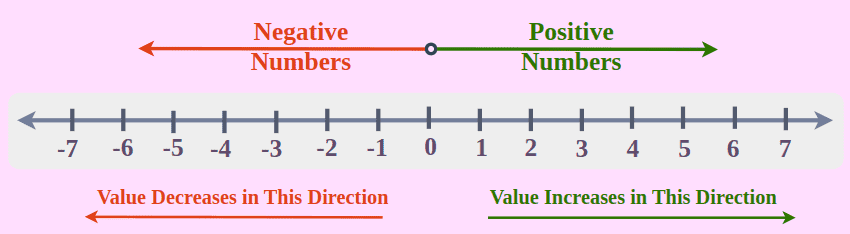
Integers can be visually represented on a number line, where zero (0) is at the center, positive integers lie on the right side, negative integers lie on the left side, and the line extends infinitely in both directions.
Arithmetic Operations on Integers
Four basic math operations performed on integers are:
Addition of Integers
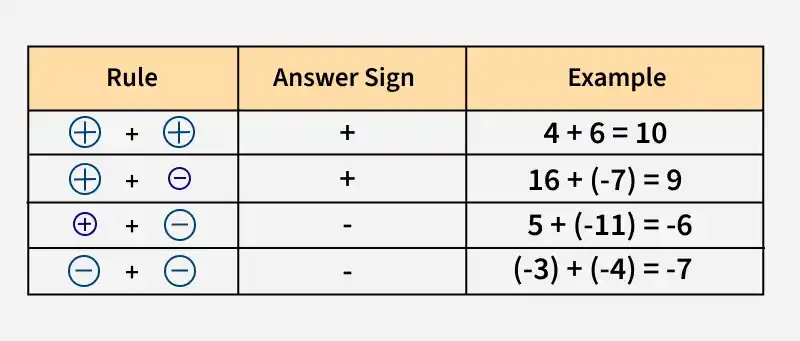
The addition of integers is similar to finding the sum of two integers. Read the rules discussed below to find the sum of integers.
Subtraction of Integers
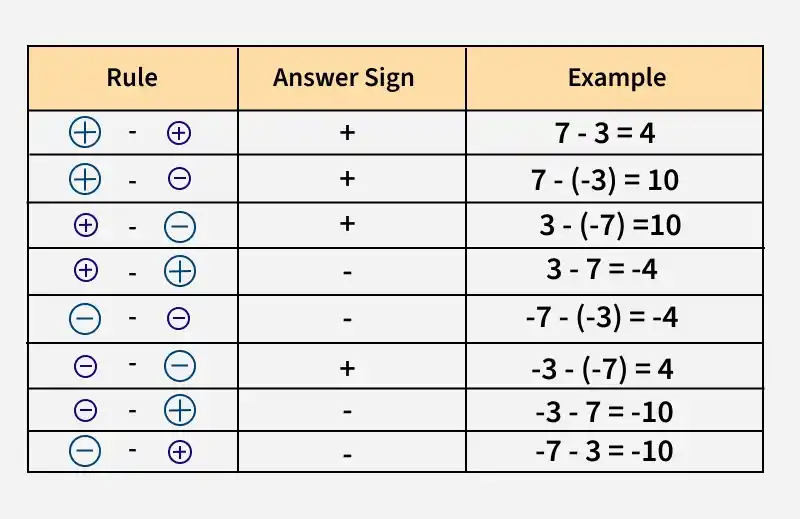
Subtraction of integers is similar to finding the difference between two integers. Read the rules discussed below to find the difference between integers.
Multiplication of Integers
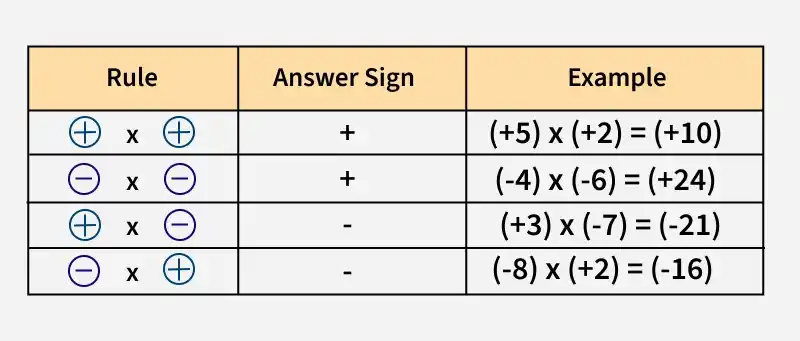
Multiplication of integers is achieved by following the rule:
- When both integers have the same sign, the product is positive.
- When both integers have different signs, the product is negative.
Division of Integers
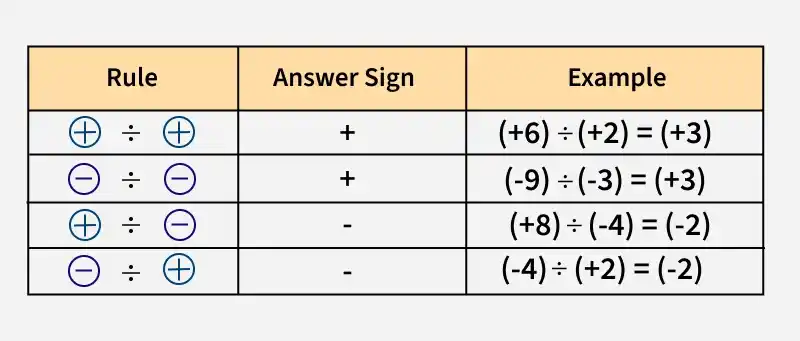
Division of integers is achieved by following the rule:
- When both integers have the same sign, the division is positive.
- When both integers have different signs, the division is negative.
Properties of Integers
The major properties of integers are
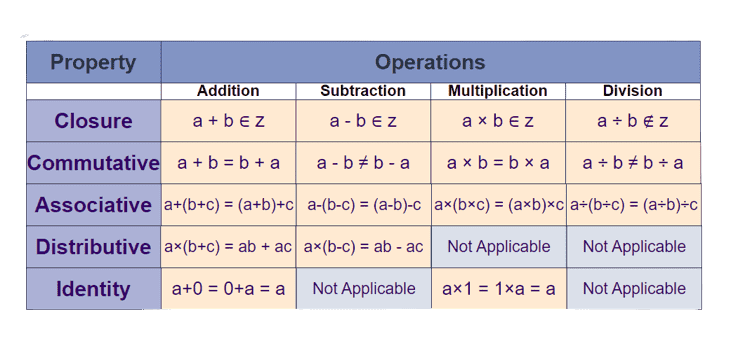
- Closure Property: The sum or product of two integers is always an integer.
- Commutative Property: The order of integers does not change the result in addition and multiplication (not valid for subtraction and division).
- Associative Property: The grouping of integers does not affect the result in addition and multiplication.
- Distributive Property: Multiplication distributes over addition.
- Identity Property: 0 is the additive identity (p + 0 = p), and 1 is the multiplicative identity (p × 1 = p).
- Additive Inverse: Every integer has an opposite value that sums to zero (p + (−p) = 0).
- Multiplicative Inverse: The reciprocal of an integer (1/p) gives 1 when multiplied by p (except 0).
Related Articles
Solved Examples
Example 1: Can we say that 7 is both a whole number and a natural number?
Solution:
Yes, 7 is both whole number and natural number.
Example 2: Is 5 a whole number and a natural number?
Solution:
Yes, 5 is both a natural number and whole number.
Example 3: Is 0.7 a whole number?
Solution:
No, it is a decimal.
Example 4: Is -17 a whole number or a natural number?
Solution:
No, -17 is neither natural number nor whole number.
Example 5: Categorize the given numbers among integers, whole numbers, and natural numbers.
- -3, 77, 34.99, 1, 100
Solution:
Numbers Integers Whole Numbers Natural Numbers -3 Yes No No 77 Yes Yes Yes 34.99 No No No 1 Yes Yes Yes 100 Yes Yes Yes