
Euler's number, written as "e," is a mathematical constant approximately equal to 2.71828. It is named after the Swiss mathematician Leonhard Euler, who significantly contributed to the understanding of this number.
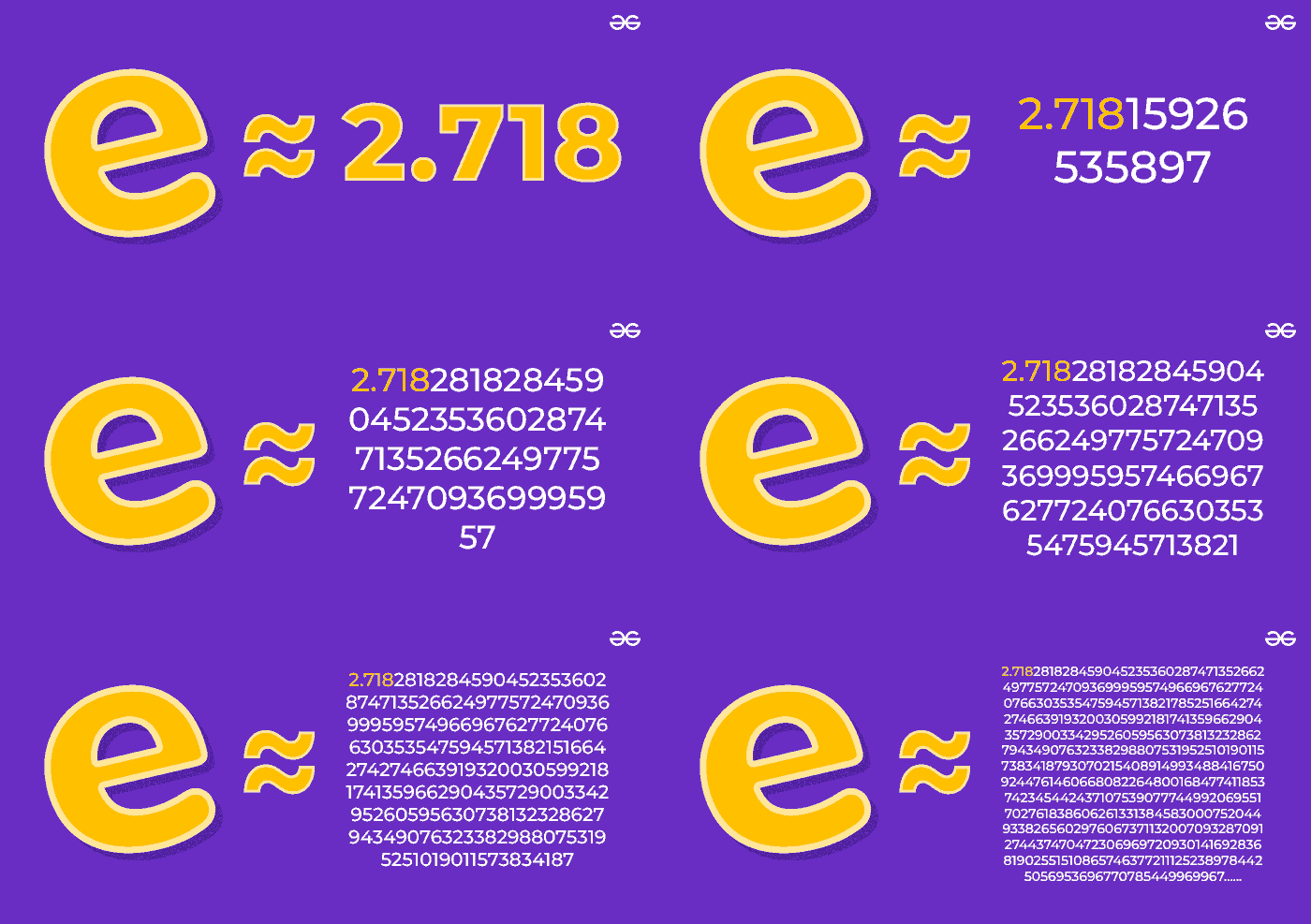
Euler number is an irrational number, meaning its decimal form goes on forever without repeating. Like the well-known number π (pi), e has many fascinating mathematical qualities.
Mathematically, e is expressed as:
e = \lim_{n \to \infty} \left(1 + \frac{1}{n}\right)^n Where,
- n is a positive integer,
- 1/n represents the reciprocal of n.
Some amazing facts about Euler's Number (e) are:
- e is an irrational number, meaning it cannot be expressed as a fraction of two integers. Its decimal expansion goes on forever without repeating.
- e is the base of the natural logarithm.
- ex is the only function in calculus that is equal to its derivative.
- It was first used by Jacob Bernoulli in the context of compound interest.
- e has been calculated to be an astonishing 31,415,926,535,897 digits (approximately π × 1013).
- The function y = ex has the unique property that at any point on the curve, the value of the function, its gradient (slope), and the area under the curve are all equal to ex.
- The number e can be represented in various fascinating ways, including as an infinite series, an infinite product, a continued fraction, or as the limit of a sequence.
- Euler's number e appears in many important formulas, like the Gaussian integral in probability, the Riemann zeta function in number theory, and indirectly in complex numbers related to the Pythagorean theorem.
- Not only is e irrational, but it’s also transcendental, meaning it cannot be the root of any non-zero polynomial with rational coefficients.
- Euler's number, e plays a key role in calculating compound interest continuously over time. The formula is:
- A = P × ert
- A is the accumulated amount,
- P is the initial principal,
- e is Euler's number,
- r is the interest rate, and
- t is the time in years.
- A = P × ert
- The continued fraction representation of e is both unique and interesting, represented as follows:
- e = [2; 1, 2, 1, 1, 4, 1, 1, 6, 1, 1, 8, …].
- An interesting fact about Euler's number e is that it appears in a famous equation called Euler's identity:
- eiπ + 1 = 0.
- We can write the full value of e as 2.7182818284590452353602874713527 . . .
- Where . . . implies the endless nature of the value.
- Euler's number, e plays a key role in calculating compound interest continuously over time. The formula is:
- A = P × ert.
Also Read: