

Linear algebra is the branch of mathematics that studies vectors, matrices, and linear equations and how they interact.
It’s about solving systems like the following:
\begin{cases}2x + y = 5 \\x - y = 1\end{cases} and understanding them in a structured, geometric, and algebraic way.
Types of Linear Algebra Study
Linear algebra is divided into different branches based on the difficulty level of topics, which are,
Foundations of Linear Algebra
Elementary linear algebra introduces the foundational concepts that form the building blocks of the subject. It covers basic operations on matrices, solving systems of equations, and understanding vectors.

- Scalars – Quantities with magnitude only (e.g., speed, mass, volume, etc.).
- Vectors – Quantities with both direction and magnitude, elements of a vector space (e.g., velocity, weight, friction, etc).
- Vector Space – A collection of vectors that can be added and scaled by scalars.
- Matrix – A rectangular array of numbers arranged in rows and columns.
- Matrix Operations – Arithmetic operations like addition, multiplication, and transposition.
Abstract Linear Algebra
Advanced/Abstract linear algebra mostly covers all the advanced topics related to linear algebra, such as Linear function, Linear transformation, Eigenvectors, and Eigenvalues.

Linear Transformations
A linear transformation is a special kind of function between vector spaces that preserves the operations of
In other words, if T is a linear transformation, then for any vectors u and v and scalar c:
T(u + v) = T(u) + T(v)
T(cu) = cT(u)
Eigenvalues and Eigenvectors
Eigenvalues and eigenvectors are fundamental concepts in linear algebra.
- An eigenvector is a vector whose direction doesn’t change when a matrix is applied.
- The eigenvalue is the factor by which that vector is scaled.
Mathematically:
A\mathbf{v} = \lambda \mathbf{v}
\mathbf{v} = eigenvector\lambda = eigenvalue
Singular Value Decomposition
Singular Value Decomposition (SVD) is a powerful mathematical technique used in signal processing, statistics, and machine learning.
- It decomposes a matrix into three other matrices, where one represents the rotation, another the scaling, and the third the final rotation.
- It's essential for identifying the intrinsic geometric structure of data.
Practical Linear Algebra
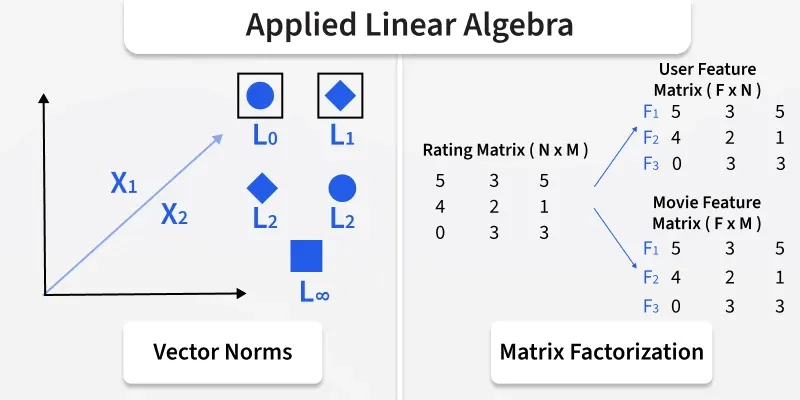
In Applied Linear Algebra, the topics covered are generally the practical implications of Elementary and advanced linear Algebra topics such as the Complement of a matrix, matrix factorization, norm of vectors, etc.
Linear Programming
Linear programming is a method to achieve the best outcome in a mathematical model whose requirements are represented by linear relationships.
- It is widely used in business and economics to maximize profit or minimize cost while considering constraints.
- This is a technique for optimizing (maximizing or minimizing) a linear objective function, subject to linear equality and inequality constraints.
- It's like planning the best outcome under given restrictions.
Linear Equation Systems
Systems of linear equations involve multiple linear equations that share the same set of variables.
The solution to these systems is the set of values that satisfy all equations simultaneously, which can be found using various methods, including substitution, elimination, and matrix operations.
Gaussian Elimination
Gaussian elimination is a systematic method for solving systems of linear equations.
- It involves applying a series of operations to transform the system's matrix into its row echelon form or reduced row echelon form, making it easier to solve for the variables.
- It is a step-by-step procedure to simplify a system of linear equations into a form that's easier to solve.
Important Linear Algebra Topics
- Matrix Inverses and Determinants
- Linear Mapping
- Orthogonal Matrices
- Vector Projection
- Solving systems of equations with matrices
- Applications
➢Practice: Solved Examples